






 Portuguese
  Spanish
  3 min of reading
  0 comments


Technology Used in Santos Anticipates the Future of Industrial Maintenance and Reinforces the Company’s Leadership in the Bulk Liquid Sector.
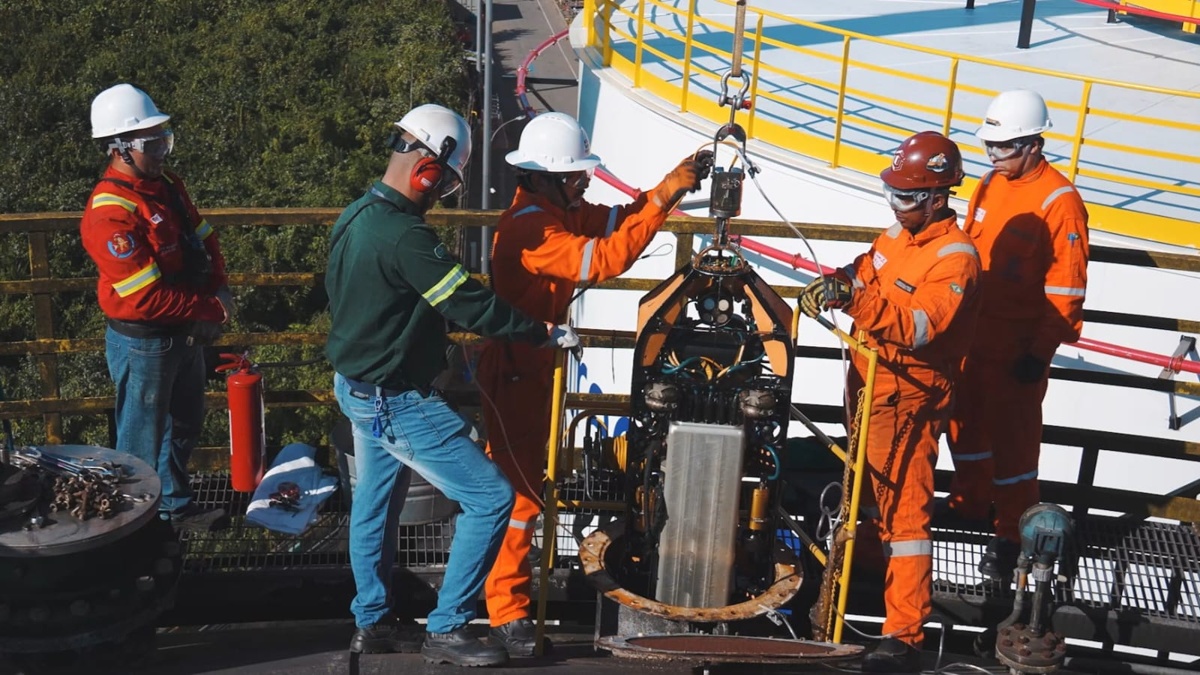
In June 2025, Ultracargo executed an unprecedented operation of robotized inspection on two tanks of flammable products at the Santos (SP) port terminal.
As a result, the robots operated with the tanks full and in full activity, without the need for emptying or operational stoppage, ensuring high efficiency.
Moreover, the inspection time, which previously took up to 15 days, was reduced to just two, with all operations maintained normally during the process.
-
Oil production grows in Rio, but reserve replacement raises a warning sign

-
Petrobras is expected to complete the drilling of the Morpho well in the Foz do Amazonas in August 2026, the first well in the Equatorial Margin, an oil frontier that the ANP estimates at more than 30 billion barrels and could redraw the map of Brazil.

-
Oil returns to the center of concerns with tension between the US and Iran

-
IEA reduces forecast for global oil demand in 2026 after impacts of the Middle East crisis


Thus, the solution prevented exposure of people to risks, eliminated waste, and also dispensed with the use of water, reaffirming the company’s sustainable focus.
Inspiration from Other Terminals Accelerated Innovation
Before the operation in Santos, Ultracargo conducted in January 2024 a remote inspection on a water tank at the Itaqui (MA) terminal.
Although the context was different, the experience inspired the team to adapt the technology for environments with flammables, which required greater technical effort.
Therefore, according to Leopoldo José Gimenes, Vice President of Engineering and Operations, the project needed almost a year of studies and integrated planning.
Additionally, the operation required attention to climatic factors, such as rain and electrical discharges, which could compromise safety and execution of the plan.
Finally, it was necessary to ensure that the internal vapors were within safe limits, before the robot entered the pressurized tanks.
Digital Inspection Avoids Stoppage, Generates Savings, and Anticipates Trends
During the execution of the inspection, Ultracargo used specific and highly precise technologies in different phases of the operation, which elevated the quality of the results.
- First, the robot performed thickness measurement by ultrasound, ensuring structural compliance.
- Next, onboard cameras captured internal visual images, transmitted in real-time.
- Moreover, the georeferencing system accurately mapped any anomalies.
- Finally, the entire operation was conducted remotely, without direct human intervention.
According to Everaldo Silva Sena, Maintenance Planning and Control Manager, “this technology brought gains in safety, reliability, and productivity”, as well as operational savings.
Thus, the solution eliminated the need to transfer products, avoided waste, and drastically reduced downtime, with the system always active.
More importantly, the data obtained confirmed that the tanks are fit to operate for another 10 years, following the international technical standard API 653.
Operation Follows International Standards and Will Be Expanded
Like companies in the United States, which already use similar robots, Ultracargo applied the international inspection model adapted to the national scenario.
For this reason, the operation in Santos is considered a strategic pilot project, with the potential for expansion to all company terminals in Brazil.
According to Gimenes, Ultracargo is already working to incorporate the technology into its logistics asset digitalization and modernization plan.
Thus, the company strengthens its leadership position, adopting global and sustainable practices, with a focus on technical excellence, safety, and operational efficiency.
Summary of Impacts and Next Steps
The operation generated significant and immediate impacts:
- Tanks inspected in two days, with operation maintained
- No need for stoppage or emptying
- Total reduction of risks to workers
- Zero waste generation and water savings
- Compliance validated with API 653 standard
- Model ready for replication in national terminals
Currently, the company is evaluating expanding the technology to all its terminals, as part of a continuous effort for innovation and maintenance automation.
By adopting this path, Ultracargo envisions long-term operational gains and strengthens its culture of environmental responsibility and industrial safety.
What Does the Future Hold for Port Maintenance in Brazil?
With this operation, the company consolidates a new maintenance model in Brazil, which unites robotics, sustainability, and cost reduction in a single innovative process.
However, for the country to advance on this path, it will be necessary to invest in technical training, appropriate regulation, and support for innovation in logistics chains.
In your opinion, is Brazil prepared to transform its industrial infrastructure with sustainable technologies like this?







Be the first to react!