





 Portuguese
  English
  Spanish
  6 min of reading
  0 comments


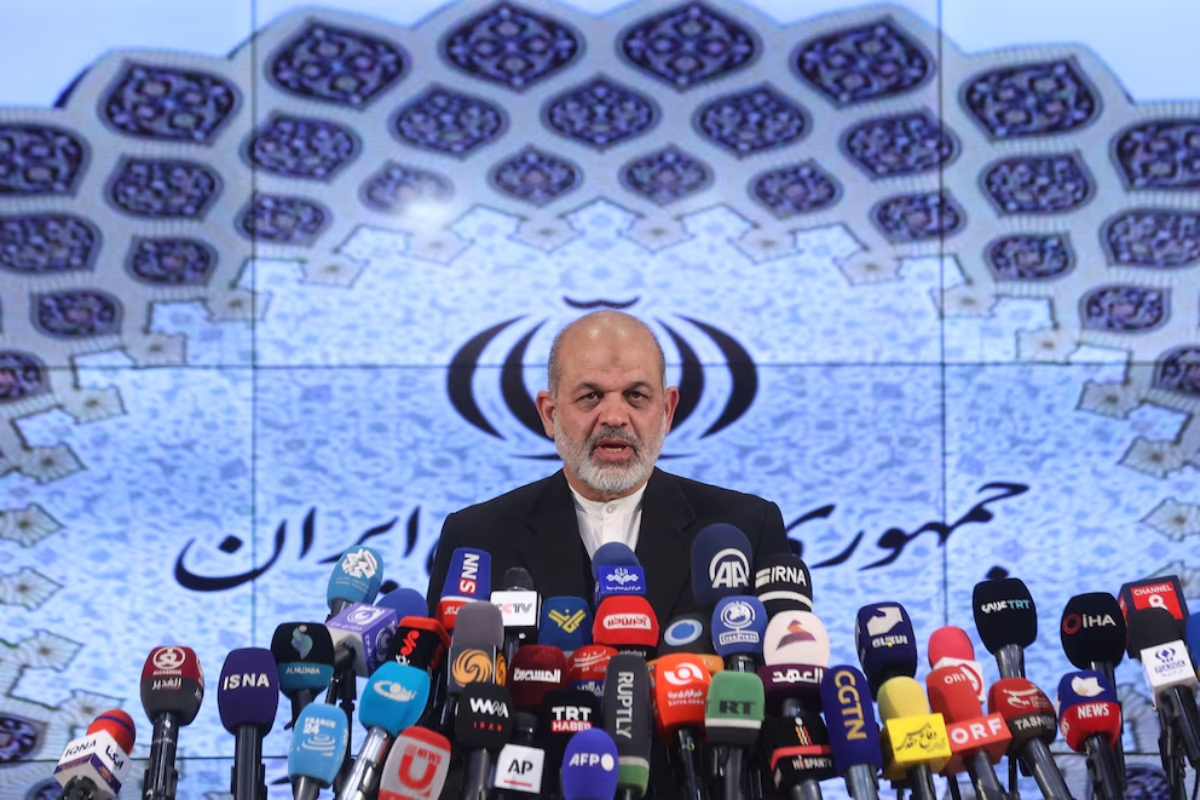
Iran Replaces The Head of The Revolutionary Guard and Appoints Vahidi, Fugitives in The AMIA Case; Appointment Follows Losses of Military Leaders And Reorganizes Power in Tehran
Iran announced on Sunday the appointment of Brigadier General Ahmad Vahidi as the new Commander-in-Chief of the Islamic Revolutionary Guard Corps, as reported by the Iranian agency Mehr. Vahidi is considered a fugitive by Argentine justice and is among those accused in the AMIA bombing.
He takes over from General Mohamad Pakpur, whose death has been attributed to attacks by the United States and Israel against Iran and was confirmed by the Iranian regime, according to EFE.
Tehran also communicated that, in addition to the Supreme Leader, Ayatollah Ali Khamenei, other officials died in the same attacks: the Chief of Staff of the Armed Forces, Major General Abdorrahim Mousavi; the Minister of Defense, Brigadier General Aziz Nasirzadeh; and the Secretary of the Defense Council, Ali Shamkhani.
-
More than 100 Chinese ships are surrounding Taiwan, warns the head of the country’s National Security Council.

-
Trump’s announcement about sending 5,000 American soldiers to Poland was received with relief by European allies, but it also raised doubts within NATO about the United States’ strategy, the permanence of the troops, and the division of defense costs on the continent.

-
Yesterday, on the 21st, President Lula stated that he fears an incursion by Donald Trump into the Amazon: while the Brazilian Army advances in a transformation policy that includes troop reorganization, use of technology, and 20% of the forces in a high state of readiness.
-
The war that doesn’t appear on the front: the silent bomb of demographic collapse threatens Russia as Putin loses young people in Ukraine, babies in statistics, and talents in exile.




Vahidi had previously held the position temporarily in 2025, following the death of Hossein Salami, who was killed in Israeli attacks against the Persian regime.
At 66 years old, Vahidi was born in Shiraz, a historic city in southwestern Iran, about 900 kilometers from Tehran. His connection to the Revolutionary Guard dates back to the early years after the 1979 Islamic Revolution, when he began to integrate into the military structure, considered a “parallel army” that responds directly to the Supreme Leader.
The Revolutionary Guard is often described as part of the operational apparatus of the regime and associated with carrying out actions abroad — among them, the 1994 attack, the most cited in this context, which targeted the Argentine Jewish entity.

Vahidi’s trajectory within Iranian power helps to gauge his political weight. He commanded the Quds Force — an elite unit responsible for operations outside the country — a position later occupied by Qassem Soleimani, who was killed in a 2019 U.S. airstrike in Baghdad. Vahidi is also part of a small circle of advisors with access to the Supreme Leader and is a member of the Supreme Council, the body that sets the regime’s strategic guidelines, including decisions related to the nuclear agreement.
Since November 2007, Vahidi’s name has appeared in Interpol databases through an active red notice. The accusation cites crimes such as qualified homicide, aggravated by motivation of racial or religious hatred and by common risk, related to 85 deaths, as well as injuries and damages, in the context of the 1994 AMIA bombing in Buenos Aires.
Prosecutor Alberto Nisman identified him as one of the main individuals involved in planning the attack. According to the judicial investigation, Vahidi — then commander of the Quds Force — allegedly participated in the meeting where the decision to carry out the attack was made, attributing execution to Hezbollah from Lebanon.
The United States is also seeking his capture and placed him on a sanctions list in 2010. In 2019, Argentina’s Financial Information Unit (FIU) and prosecutor Sebastián Basso requested that Vahidi and six others investigated in the AMIA case be included in Argentina’s terrorist registry. The FIU had previously stated that Vahidi and Mohsen Rezai conducted analyses on the proposal to attack Argentina under Iranian intelligence.
In 2021, Vahidi took over as Iran’s Minister of the Interior. He was in office when the Argentine government requested his detention during an official visit to Pakistan and Sri Lanka. At that time, the Argentine Foreign Ministry stated that he was part of an Iranian delegation abroad, and the country sought international cooperation for his arrest based on existing treaties.
Throughout his career, Vahidi has held high-ranking positions. In 2009, he was Minister of Defense during Mahmoud Ahmadinejad’s presidency, despite his international judicial situation. This internal support strengthened his prestige within the theocracy. He was also in this role when, in 2013, Argentina and Iran signed a Memorandum of Understanding to try to advance the investigation of the AMIA case during Cristina Kirchner’s government.
After Nisman’s death in 2015, new judicial authorities and the FIU maintained pressure on those accused abroad. Vahidi remains among those wanted by Interpol.

What Was Vahidi’s Role in The AMIA Attack
Ahmad Vahidi commanded the Quds Force when the terrorist attack against the Argentine Mutual Israelite Association (AMIA) occurred in 1994, an episode that left 85 dead and 151 injured. He is accused of being one of the intellectual authors of the attack and of having participated in a decisive meeting in which the execution of the attack was defined — one of the gravest crimes in Argentine history.
In November 2006, then-federal judge Rodolfo Canicoba Corral ordered the international capture of suspects considered intellectual authors of the case, including Vahidi. Others on the red list of Interpol include figures such as Mohsen Rezai (former head of the Revolutionary Guard), Ali Fallahijan (former Minister of Intelligence), Mohsen Rabbani (former cultural attaché in Argentina), Ahmad Asghari (former secretary of the Iranian embassy in Argentina), and, since 2009, Samuel Salman El Reda.
According to the UFI AMIA investigation, Vahidi — like Fallahijan — allegedly participated in a supposed meeting in 1993, in Mashhad, where the decision to attack was made. In the opinion signed by Nisman that year, the prosecutor stated that Vahidi not only attended but also advocated for Argentina to be chosen as the target, a proposal later evaluated by the Special Affairs Committee.
The opinion indicates that Vahidi presented the initiative in the so-called “intelligence area,” where he was part of the decision-making core. After the selection of the Argentine target, the political leadership of the operation would have fallen to the then Minister of Intelligence, Ali Fallahijan, while operational coordination would have been assigned to Vahidi, leading the Quds Force.
Vahidi, alongside Evo Morales, during a visit to Bolivia in 2011. He returned to Iran without being detained
In 2011, already as Minister of Defense, Vahidi traveled to Bolivia to participate in events with local authorities. Upon learning of his identity and background, the Bolivian government ordered his departure from the country. At the time, he attended official activities with Bolivian Minister María Cecilia Chacón, including the graduation of aviation pilots and the inauguration of the ALBA Defense School in Santa Cruz de la Sierra.
The visit generated a strong reaction in the Jewish community and in the Argentine political scene. At the time, the then president of AMIA, Guillermo Borger, classified Vahidi’s presence as “a provocation,” and DAIA requested that the Foreign Ministry present a formal diplomatic protest and demand the immediate detention of the Iranian representative. “This unacceptable presence in the brother country insults the memory of the victims, the community we represent, and Argentine society as a whole,” the entity stated.









Be the first to react!