






 Portuguese
  Spanish


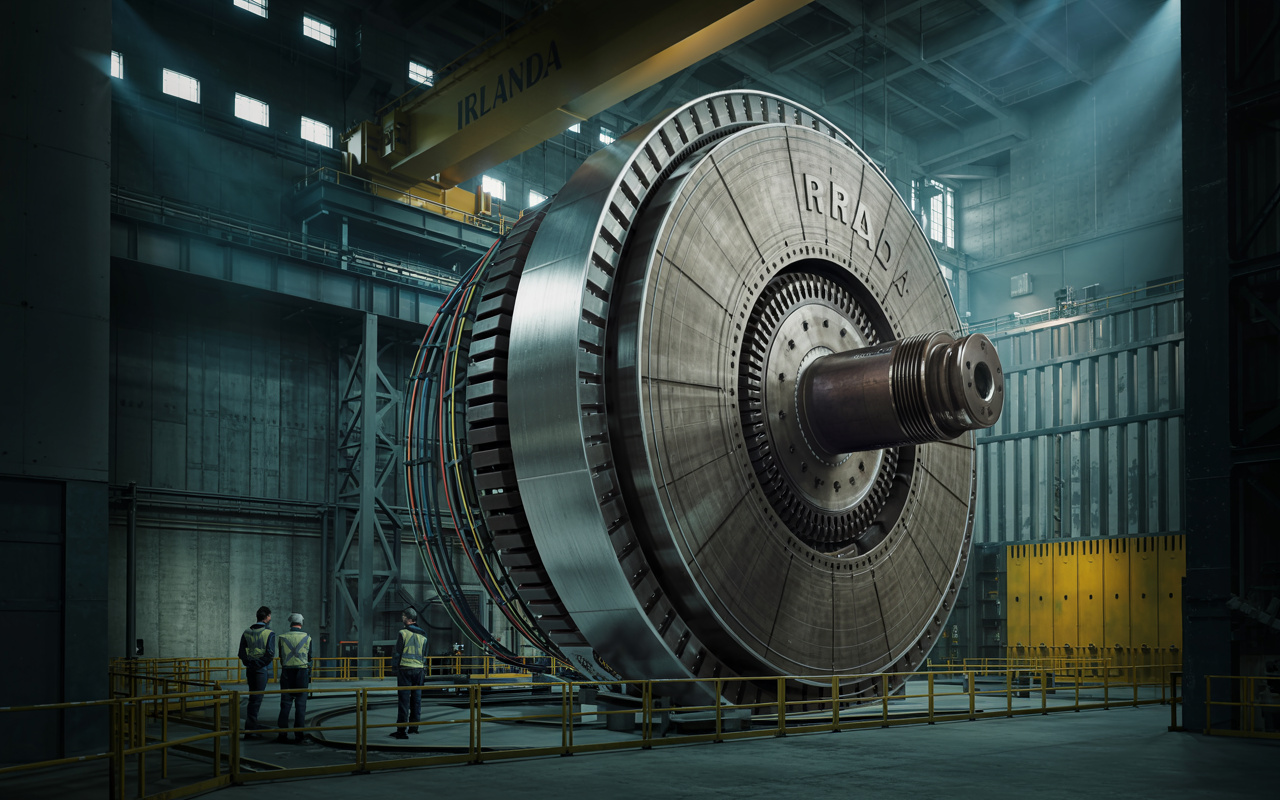


In An Era Dominated By Renewable Energy And Risk Of Blackouts, Ireland Launches An Unprecedented System: The Largest Flywheel In The World, Capable Of Stabilizing The Electric Grid With Pure Kinetic Energy — Without Polluting And Without Relying On Fossil Fuels
On the west coast of Ireland, where cutting winds and rough seas shape the landscape, something colossal spins at 3,000 revolutions per minute. It is the largest flywheel on the planet, a gigantic piece of engineering that does not generate energy — but could be the key to preventing blackouts and stabilizing the electric grid of an entire country. Located at the former coal plant of Moneypoint, this system symbolizes a new energy era. A time when the stability of the electric grid no longer depends on gas, coal, or diesel generators, but on intelligent, sustainable, and surprisingly mechanical solutions.
What Is A Flywheel — And Why Can It Prevent Blackouts?


Think of a Ferris wheel spinning at high speed. This wheel stores kinetic energy — energy of motion. And this energy, when released at the right moment, can compensate for sudden drops in frequency in the electric grid.
This is exactly what the Moneypoint flywheel does. It acts like a kind of lung of the grid, instantly releasing or absorbing energy to keep the electrical frequency stable — something essential in systems with high penetration of renewable sources, like solar and wind.
-
China Develops Custom 140-Ton Electric Mining Truck with 770 kWh Swappable Battery, Deploys 290 Units in Xinjiang’s Largest Zinc Mine

-
Meta to Launch Arena, a New Prediction App Targeting 3.56 Billion Users, Competing with Polymarket and Kalshi

-
Scientist Challenges Famous Human Evolution Theory, Argues Homo Sapiens Evolved Gradually Over Thousands of Years
-
15-Year-Old American Builds Ocean Generator with PVC Pipe and 3D-Printed Propeller for $12, Wins National Prize, Presents at White House, and Makes Forbes 30 Under 30 List




The Problem: Renewables Are Clean, But Unstable
Sources like wind and solar are wonderful for the environment, but they have a major flaw: they do not produce energy consistently. When a cloud covers the sun or the wind suddenly stops, energy production plummets — causing dangerous fluctuations in the electric grid, which can lead to blackouts.
Traditionally, this was resolved by the giant turbines of thermal or hydroelectric plants, with their rotating generators full of physical inertia. They spin all the time, stabilizing the grid like a pendulum. But as the world shuts down these polluting plants, the grid loses this “safety cushion”.
Anticipating this scenario, Ireland bet on a bold and unprecedented solution.
Moneypoint: From Coal Smoke To Clean Rotation
The former thermal plant of Moneypoint, once a symbol of dependence on fossil fuels, has been transformed into a hybrid center for clean energy and grid stabilization. At its heart is the largest flywheel ever built, manufactured by Siemens Energy.

The complete system has three components:
- Flywheel: weighs 130 tons and spins at 3,000 RPM.
- Synchronous Condenser: coupled to the flywheel, adds another 66 tons to the system.
- Giant Batteries: with 160 MWh of capacity, capable of powering 9,500 residences per day.
Together, these elements create a “cushion” of 4,000 megawatt-seconds of inertia, acting as a shield against fluctuations and blackouts.
A System That Responds In Milliseconds
The magic of the flywheel lies in its ability to react instantly. When the grid experiences a drop in frequency (for instance, when a solar plant stops producing), the flywheel releases its stored kinetic energy — even before batteries or other systems notice the drop.
This ultra-fast response keeps systems running, avoids blackouts and reduces damage to sensitive equipment, such as servers, hospitals, and industrial systems.
The Future Of The Electric Grid Is Hybrid — And Needs Inertia
The Irish installation is a model for the future. With the EU goal to achieve zero carbon emissions by 2050, the share of intermittent sources is only expected to increase. But with it, the risk of instability also rises.
In Spain, a blackout that occurred on April 28 was attributed to the low inertia of the grid, caused by the absence of rotating plants in operation. In this context, systems like Moneypoint emerge as invisible guardians of renewable energies.
Other countries are already paying attention:
- United Kingdom: with the Keith Greener Grid Park project, using flywheels for stabilization.
- Germany, Switzerland, and Italy: are studying or have already implemented similar systems.
- Canary Islands (Spain): have been operating with a flywheel since 2013 at the Mácher substation.
And Brazil?
In Brazil, where the electric matrix is still heavily dependent on hydroelectric plants, the issue of inertia is not yet critical. However, the increase of solar and wind sources in the Northeast is already starting to raise discussions about frequency stability.
For now, the country relies on batteries and digital control systems, but still lacks robust projects with flywheels, like those in Ireland. A warning sign for the future.
The flywheel at Moneypoint does not generate energy, does not make noise, and does not shine like solar panels. But it is likely one of the most important systems of the modern energy transition.
In a world seeking clean, cheap, and abundant energy, grid stability is as valuable as the generation itself. And Ireland, spinning at 3,000 RPM, has already understood this — before the next blackout shows the price of negligence.







Desde quando uma usina hidrelétrica é poluente?! E poluição por poluição, usinas eólicas geram GRANDE poluição sonora e danos à fauna (aves e morcegos), enquanto as usinas solares vão gerar um GRANDE passivo ambiental com placas solares inutilizadas, devido aos metais pesados usados na sua fabricação.