Portuguese
  Spanish


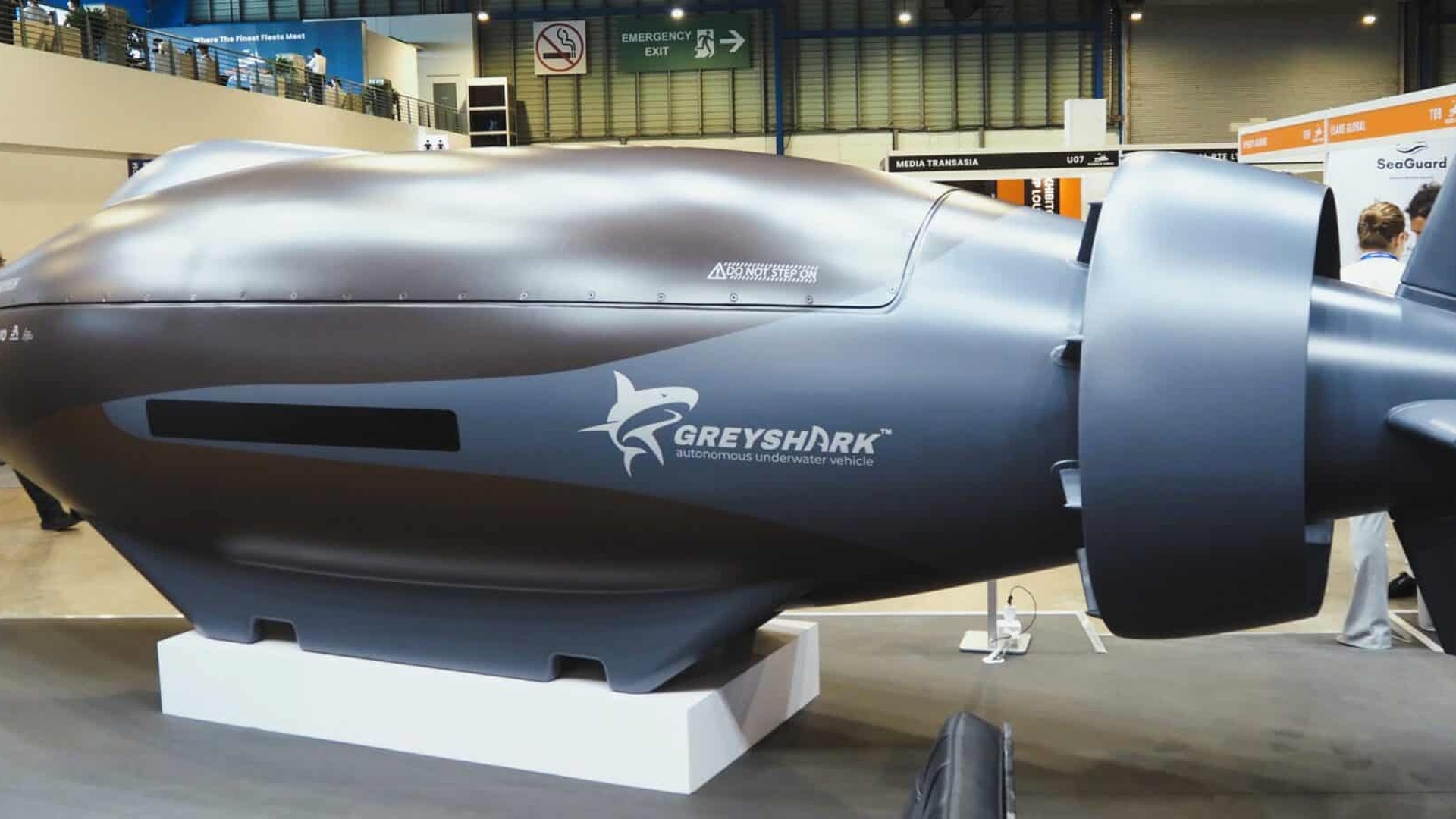


Greyshark Foxtrot uses hydrogen fuel cell, operates up to 16 weeks submerged and monitors cables, mines, and unmanned submarines.
According to Interesting Engineering, the Greyshark Foxtrot began its first water tests in the week of April 6, 2026, off the coast of Damp, near Kiel, in the German Baltic, and continued at the SeaSEC, the Marine Security Experimentation Center in Rostock, the following week. The system was developed by Euroatlas, from Bremen, in partnership with EvoLogics, from Berlin. The Greyshark family has two models: the Bravo, battery-powered, for short-term missions, and the Foxtrot, powered by a hydrogen fuel cell, with autonomy of up to 16 weeks submerged without surfacing, recharging, or contact with operators. At 10 knots maximum speed, the autonomy drops to 6 days; at 4 knots cruising speed, the range reaches 10,700 nautical miles.
The underwater drone has 17 integrated sensors, including synthetic aperture sonar, multibeam echosounder, optical, electromagnetic, and LiDAR sensors. The seabed image resolution reaches 1.6 inches per pixel, less than 2 centimeters, sufficient to identify an object the size of a water bottle on the ocean floor.
Greyshark Foxtrot was created to protect submarine cables and critical infrastructure on the seabed
The Greyshark Foxtrot emerges at a time of high tension over the security of underwater infrastructure. In November and December 2024, four data cables and one power cable were cut or damaged in the Baltic Sea and the North Sea.
-
China Develops Custom 140-Ton Electric Mining Truck with 770 kWh Swappable Battery, Deploys 290 Units in Xinjiang’s Largest Zinc Mine

-
Meta to Launch Arena, a New Prediction App Targeting 3.56 Billion Users, Competing with Polymarket and Kalshi

-
Scientist Challenges Famous Human Evolution Theory, Argues Homo Sapiens Evolved Gradually Over Thousands of Years
-
15-Year-Old American Builds Ocean Generator with PVC Pipe and 3D-Printed Propeller for $12, Wins National Prize, Presents at White House, and Makes Forbes 30 Under 30 List




The investigation pointed to ships associated with the so-called Russian “shadow fleet”, formed by tankers used to transport Russian oil despite Western sanctions. These ships may have used anchors to damage cables, pipelines, and critical structures on the seabed.
Submarine cables carry 95% of all international internet traffic, while gas and power pipelines in the Baltic supply entire countries. Protecting this network with manned ships, 24 hours a day, over hundreds of kilometers, is expensive, predictable, and difficult to sustain.
Autonomous underwater drone can patrol for 16 weeks without surfacing
The operational advantage of the Greyshark Foxtrot lies in its persistence. A warship patrolling the same stretch of cable for weeks consumes fuel, requires a crew, reveals presence, and can be tracked by adversaries.


The Foxtrot operates submerged for up to 16 weeks, without needing to surface, without transmitting position, and without relying on constant contact with operators. This allows for discreet surveillance on submarine cable routes, gas pipelines, oil pipelines, ports, straits, and sensitive military areas.
The CEO of Euroatlas, Eugen Ciemnyjewski, summarized the context by stating that, in the past, there was a lot of time and little money; now, there is a lot of money and little time. The phrase reflects NATO’s race for autonomous systems capable of protecting critical infrastructure before new attacks occur.
Hydrogen fuel cell gives Greyshark autonomy that batteries cannot deliver
The 16-week autonomy of the Greyshark Foxtrot would not be possible with conventional batteries. It comes from the hydrogen fuel cell, a technology known in the automotive industry and adapted for submarine use.
A fuel cell generates electricity through the chemical reaction between hydrogen and oxygen, producing water as a byproduct. There is no combustion, no conventional engine noise, and no significant thermal emission.
For a submarine vehicle, this combination is strategic. Low acoustic signature and low thermal signature make the Foxtrot harder to detect, especially in surveillance, reconnaissance, and submarine infrastructure patrol missions.
Greyshark Bravo and Foxtrot serve short missions and long-range submarine operations
Euroatlas developed two models for different mission profiles. The Greyshark Bravo uses a battery, measures 6.5 meters, weighs about 3.5 tons, and is suitable for short-duration operations in areas where frequent retrieval is feasible.

The Greyshark Foxtrot is larger, measuring between 7 and 8 meters, weighing approximately 4.5 tons, and uses a hydrogen fuel cell. This configuration allows for operations lasting weeks or months in regions where regularly retrieving the vehicle would be impractical.
According to Verineia Codrean, head of strategy at Euroatlas, the Foxtrot can operate in locations like the Arctic, where there is simply no option to frequently retrieve the AUV. In such remote environments, autonomy ceases to be a comfort and becomes an operational condition.
Six Greyshark Foxtrot could map the Strait of Hormuz in up to 24 hours
One of the most concrete examples cited by the company involves the Strait of Hormuz, a 33 km wide passage through which about 20% of the world’s exported oil passes. In mid-April 2026, Iran allegedly planted mines in the region during a phase of tension.
The problem, according to Codrean, is that not even the Iranian authorities would know exactly where the mines were. Clearing an area like this with divers, manned ships, or conventional equipment would be slow, expensive, and extremely dangerous.
Euroatlas claims that six Greyshark Foxtrot units, operated by a single person on land, could map the entirety of the Strait of Hormuz in up to 24 hours. No manned asset would perform the same sweep in the same timeframe without exposing humans to direct risk.
Synthetic aperture sonar and 17 sensors allow identification of objects on the ocean floor
The Greyshark Foxtrot was designed to see the seabed with high precision. Its 17 sensors include synthetic aperture sonar, multibeam echosounder, optical, electromagnetic, and LiDAR sensors.
The image resolution reaches 1.6 inches per pixel, less than 2 centimeters. This allows the detection and classification of small objects on the ocean floor, such as mines, abandoned equipment, cable damage, or suspicious items near critical infrastructure.

In mine countermeasure missions, this precision is decisive. The system not only covers large areas but produces images detailed enough to distinguish real threats from noise, rock, or common debris.
Level 5 Autonomy allows the submarine drone to change missions without human command
The Greyshark operates at Level 5 autonomy, the highest category in the industry, which means it can operate without human intervention under any planned operational condition. It is not just a drone that follows a programmed route.
The onboard artificial intelligence allows automatic target recognition, obstacle avoidance, and dynamic mission adaptation based on sensor data. A Foxtrot can start by patrolling cables and, upon detecting a suspicious object, reclassify the mission for mine search or anti-submarine activity.
This behavior changes the logic of underwater surveillance. The vehicle ceases to be just a submerged camera and starts functioning as an autonomous tactical decision platform, capable of investigating, marking position, and generating reports without waiting for direct command.
EvoLogics acoustic communication creates a submarine network between drones
The artificial intelligence of Greyshark was developed with the support of EvoLogics, a Berlin-based company specializing in underwater acoustic communication. The technology uses modulation inspired by dolphin communication to transmit data in noisy submerged environments.
The vehicles can exchange information via acoustic modems and form an underwater mesh network, similar to an underwater WiFi network. In this configuration, several Greysharks act as repeaters for each other, expanding coverage and redundancy.
When the mission requires absolute secrecy, the Foxtrot can operate in complete silence, without emitting signals. In this case, it stores the data and only transmits when in a safe area or when the mission allows communication without compromising its position.
Greyshark Foxtrot shows the future of autonomous naval warfare and persistent surveillance
The Greyshark Foxtrot addresses a need that traditional navies have not yet solved well: persistent maritime awareness. Maintaining continuous presence on the seabed with ships and crews is expensive, limited, and difficult to scale.
Niko Schmidt, deputy head of autonomous systems at Euroatlas, stated that this persistent maritime awareness is impossible to achieve with manned assets alone. The Foxtrot attempts to fill this gap with 16-week autonomy, swarm operation, and high-resolution sensors.
The result is a new category of underwater military presence. Cables, pipelines, mines, submarines, and strategic straits can now be monitored by silent, autonomous, and persistent vehicles, capable of operating for months where no manned ship could remain with the same cost and discretion.