






 Portuguese
  Spanish


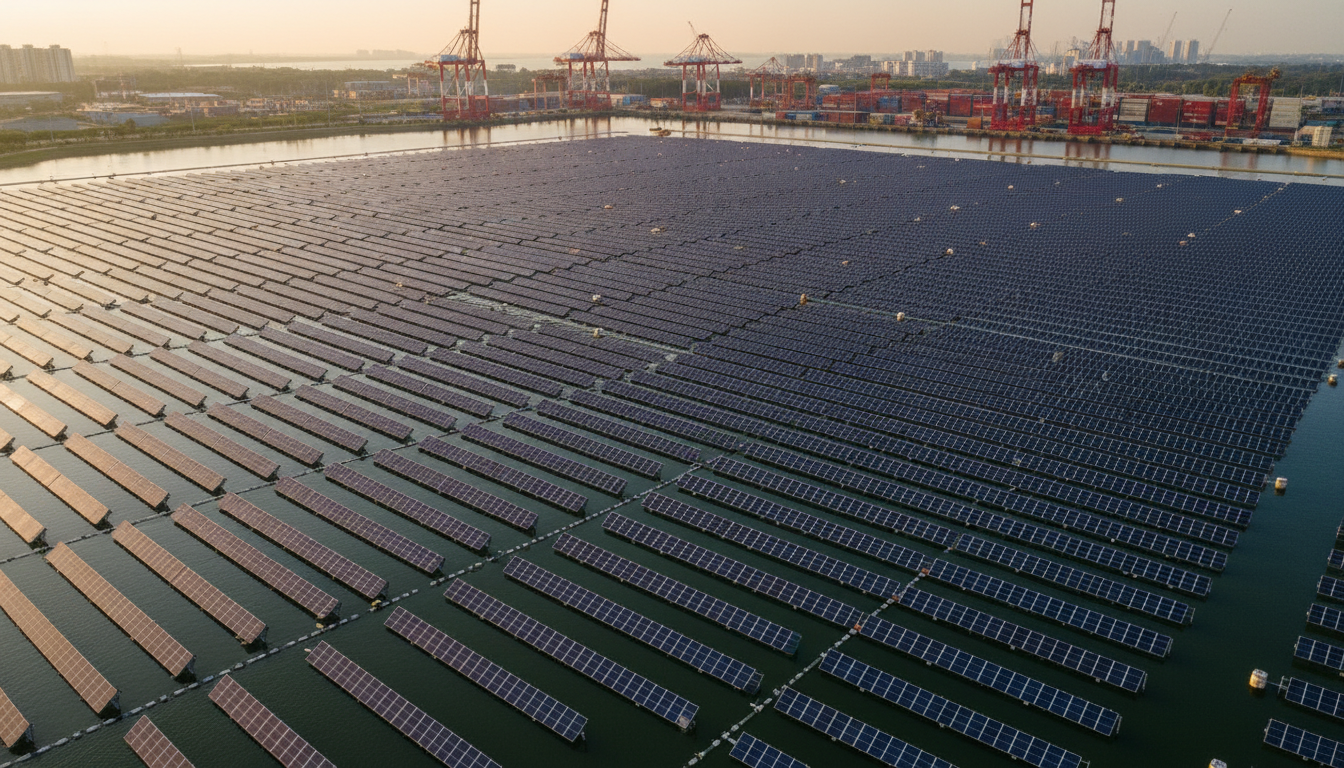

Singapore covered 45 hectares of the Tengeh reservoir, in the industrial district of Tuas, with 122,000 interconnected floating solar panels across ten photovoltaic islands to try to reduce the chronic dependence on imported natural gas that has suffocated the city-state for six decades. According to the operator Sembcorp Industries, the complex became fully operational with an installed capacity of 60 megawatts-peak, enough to supply about 16,000 homes and pump treated water to the vicinity of Asia’s largest automated port, according to data published by the PUB, Singapore’s national water agency.
The project is part of a broader official strategy of the city-state to generate at least 2 gigawatts-peak of solar energy by 2030, a bold goal considering that Singapore has only 730 square kilometers of total area and almost no free land available for traditional ground panels. Deploying the infrastructure over water became the only viable solution, and Tengeh became the first large-scale industrial laboratory for this approach.
In parallel, Sembcorp operates a second solar installation in Tuas, on 10 hectares of temporary vacant land, with 33,580 additional panels and a capacity of 17.6 megawatts-peak. Combined, the two systems exceed 77 megawatts-peak continuously in the same industrial district, directly powering part of the automated logistics operations of the Tuas Port, considered the largest port project in the world completed in the last five years.
-
Cassini Discovers Fresh Organic Molecules Emanating from Enceladus’ Hidden Ocean, Making Saturn’s Icy Moon a Prime Target in the Search for Extraterrestrial Life

-
Scientists Discover Simple Fluids Can Shatter Like Solids Under Extreme Force, Challenging Our Understanding of Matter

-
Xiaomi to Launch Robot Vacuum 6 Max Globally: Features 85°C Mop Cleaning, 35,000 Pa Suction, Extendable Arms, AI with 3 Cameras, and 6 cm Obstacle Clearance
-
Engineers Develop Jacket That Converts Air Humidity Into Drinkable Water, Producing Up to 900 ml Daily for Hikers, Campers, Rescuers, Rural Workers, and Military in Remote Areas



Why covering a reservoir with panels became Singapore’s only way out
The city-state has historically depended on imported natural gas from Malaysia and Indonesia to generate 95% of its electricity, a vulnerability exposed in various episodes of international price drops and regional diplomatic tensions. Reducing this dependence has always been at the center of the government agenda of Lee Hsien Loong and remains an absolute priority for the current cabinet of Prime Minister Lawrence Wong.
The problem is geographic. Singapore has 5.9 million inhabitants living in one of the highest population densities in the world, with residential and commercial buildings occupying practically all available useful space. Very little free land is left for large-scale solar projects, and the remaining options are building rooftops, commercial facades, and the surface of potable water reservoirs.
Covering reservoirs solves two problems simultaneously. On one hand, it releases clean energy in a relevant volume. On the other, it reduces the evaporation of treated water by about 25%, according to preliminary studies by the PUB, helping to alleviate the pressure on water imports from Malaysia, which remain regulated by an international treaty in force until 2061.
How the 122,000 floating panels over ten islands in Tengeh work
The technical design was developed in partnership between engineers from Sembcorp Industries and the German photovoltaic research agency, with high-density polyethylene floats anchored to the reservoir bottom by cables resistant to artificial tide cycles. Each of the ten islands gathers approximately 12,000 panels, connected by marinized inverters, moisture and extreme heat resistant.
The structure needed to be designed to withstand monsoon winds of up to 110 kilometers per hour, common in Southeast Asia between November and January, and torrential rains capable of dumping 100 millimeters in a few hours. The submarine cabling that connects the islands to the land substation operates in 22-kilovolt alternating current and was buried in trenches at the reservoir bottom to avoid interference with water intake.

According to official data from the Sembcorp portal dedicated to floating solar energy, the complex generates energy equivalent to the annual planting of 150,000 native trees and avoids the emission of 32,000 tons of carbon dioxide per year, a value calculated by crossing electricity generation with the average emission factor of Singapore’s energy matrix.
The automated Tuas Port that consumes half of this new energy
The Tuas Port is the most ambitious port megaproject in the world delivered in the last decade, built in phases starting in 2015 and with total completion expected in 2040. When fully operational, it will handle 65 million containers per year, more than double the combined capacity of all Brazilian ports, and will concentrate 100% of the city-state’s container movement.
The terminal is fully automated, with gantry cranes remotely operated by artificial intelligence algorithms, autonomous electric container transport vehicles, and rows of robotic stackers that dispense with human operators in the yard. A significant part of this electrical energy now comes from Tengeh’s solar panels and other smaller solar installations around the industrial district.
According to the EDB, Singapore’s national economic development agency, the total investment in Tuas Port will exceed 20 billion dollars over the 25 years of execution. Integration with local clean energy became a project requirement starting in 2022, when the government formalized mandatory carbon neutrality targets for critical infrastructure.

The goal of 2 gigawatts by 2030 and what still needs to be built
Singapore’s solar trajectory jumped from just over 200 megawatts-peak installed in 2020 to approximately 750 megawatts-peak in 2024, and the government maintains the official goal of reaching 2,000 megawatts-peak by 2030. To close this gap, the country needs to add at least 250 megawatts-peak per year over the next six years, a pace that requires industrial scale.
The National Energy Plan 2026, released by the regulatory authority EMA earlier this year, foresees accelerated expansion of the floating model to other reservoirs and advanced studies for panels on commercial building facades. There are also projects under evaluation to import solar energy from inland Australia and Indonesia via high-voltage submarine cables.
Researchers have discovered that the more water surface areas Singapore covers with panels, the more the average temperature of the water itself drops by a few tenths of a degree, reducing algae proliferation and improving the quality of treated water. This unexpected side effect has become an independent line of study in partnership with Swiss universities.
Why Brazil closely follows the Singaporean model
Brazil has dozens of hydroelectric reservoirs with the potential to receive similar projects, and companies like Eletrobras, Cemig, and Light have already studied pilot proposals inspired by Tengeh. In particular, the Sobradinho hydroelectric plant in Bahia and the Furnas reservoir in Minas Gerais appear in preliminary project evaluations for the next decade.
ANEEL even published a technical note in 2024 recognizing floating solar technology as eligible for renewable energy auctions starting in 2026, paving the legal way for Brazilian projects to follow the Asian model. Chinese and European companies have already made proposals to participate in the first auctions of this category in the country.
As other discoveries about megaprojects of infrastructure and energy transition frequently appear in our Curiosities and Science sections, connecting global advances to Brazilian opportunities in the ongoing energy transition.

What could go wrong in the expansion over the next few years
Experts consulted by sectoral publications warn that the accelerated expansion of the floating model brings environmental risks that are still poorly mapped. The reduction of sunlight reaching the water column can alter populations of microalgae and fish, with an impact not fully predicted on internal reservoir ecosystems.
On the other hand, the result already proven in Tengeh, maintained for more than four years without serious environmental incidents, gives confidence to the Singaporean government to move forward. The next phase foresees floating panels in open sea, in Singaporean territorial waters, with technology developed in partnership with Norwegian companies specialized in offshore structures.
It is worth noting that the case of Singapore remains a worldwide reference for small, densely populated countries dependent on imported fossil fuels. The combination of a clear goal, state financing, partnership with the private sector, and technology adapted to local geography has become a model replicated in studies by dozens of city-states and environmental agencies on all continents.


