Portuguese
  Spanish


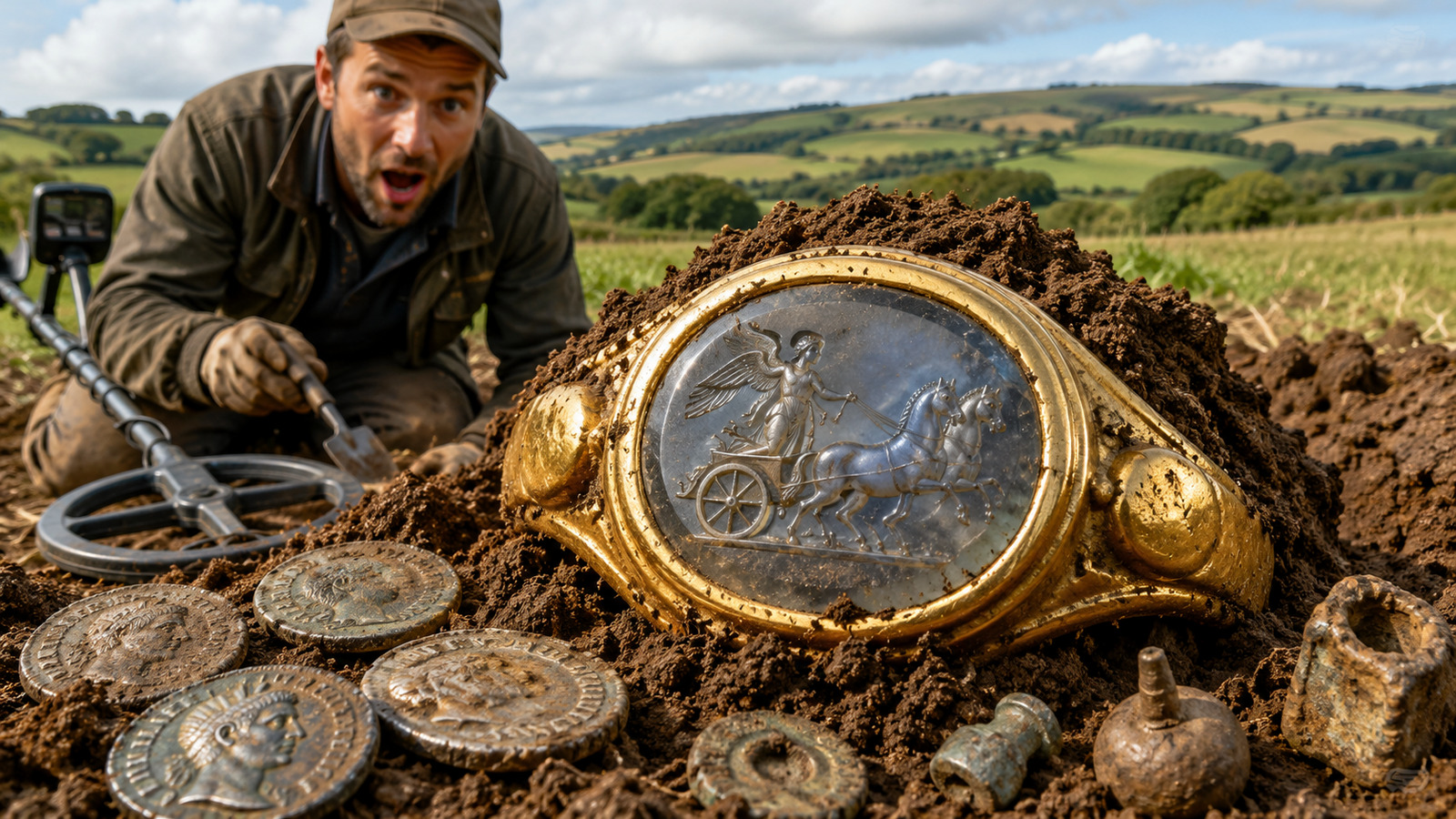

Found in Somerset along with 297 Roman coins, the Ilminster Ring weighs almost 48 grams, features the goddess Victoria engraved in a gem, and may have belonged to a wealthy person from Roman Britain
The Ilminster Ring, a solid gold Roman jewel weighing almost 48 grams, was found by a detectorist in a field near Ilminster, in Somerset, along with 297 coins and other objects. The piece remained buried for almost 1,700 years and is considered by experts as one of the finest examples of Roman jewelry ever discovered in Britain.


Ilminster Ring was found by detectorist in area with Roman coins
The discovery was made by Kevin Minto, who had been exploring the site with a metal detector since 2017. In the area, he had already recovered several Roman coins, and when the device signaled again, he thought he had found another one.
The object removed from the ground, however, was different. At first, Minto thought it might be a coin. Then, he considered the possibility of it being a brooch. Only after a closer look did he realize it was a gold ring.
-
ispace Pays SpaceX $50 Million to Hitch a Ride on Starship, Aiming for a Shared Commercial Route to the Moon by 2030

-
Solar-Powered Cell Tower to Connect 10,000 Residents on Remote Brazilian Island, Reducing Diesel Dependence
-
Snowman-shaped asteroid captured by Hayabusa2 probe during flyby just 10 km away

-
Scientists Discover Clue in Rodent Brains Explaining Why Early Childhood Memories Fade Over Time


In an interview with The Guardian, he described the feeling as hard to explain. According to Minto, it was like “being hit by an express train,” because the surprise came in stages until the identification of the ring.
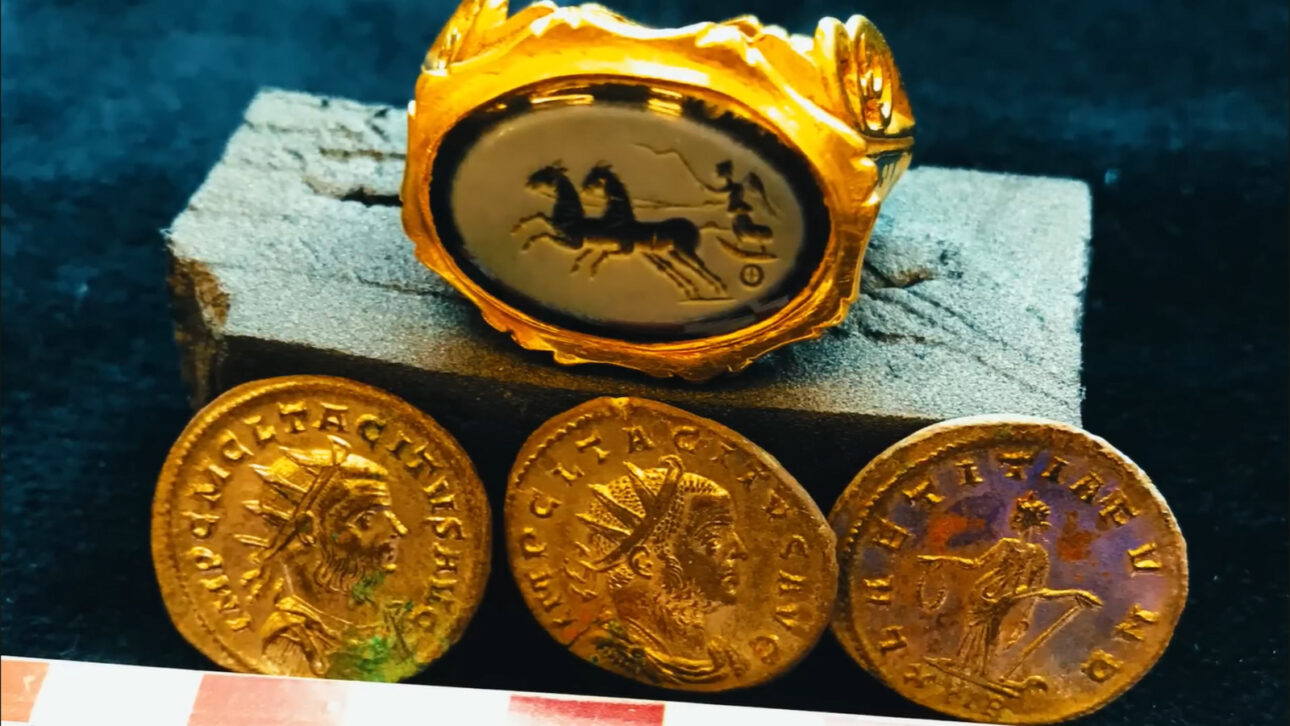
Solid gold jewel features image of Roman goddess Victoria
The ring weighs almost 48 grams and was made of solid gold. On the front, there is a grayish-blue gem with the image of Victoria, the Roman goddess associated with triumph.
According to information from the South West Heritage Trust, the scene shows Victoria driving a chariot pulled by two horses. She appears holding a whip and the reins, with wings and a helmet.
The image was produced using the engraving technique, where the design is carved into the stone. This detail helps explain why the piece caught the attention of specialists, both for the material and the execution.
Amal Khreisheh, senior curator at the South West Heritage Trust, described the ring as large and heavy. She highlighted the elaborate gold work and the finely executed engraving on the gem.
According to the curator, although there are other examples, the combination of these elements forms a spectacular ring, with parallels only in continental discoveries.
Treasure had 297 coins and was buried during a period of political upheaval
The Ilminster Ring was not isolated. It was part of a set that included 297 Roman coins, as well as lead and ceramic objects.
The date associated with the burial of the treasure places it shortly after a turbulent period in Roman Britain. Between 286 and 296 AD, the province operated separately from the Roman Empire.
This interval occurred under the rule of Carausius and then Allectus. Historians refer to this episode as the Carausian Revolt.
The South West Heritage Trust reported that the ring was likely hidden shortly after the end of this period. The hypothesis presented in the material is that whoever buried the set never returned to retrieve it.
For wealthy individuals, the scenario of instability could make the protection of valuable assets a priority. In different parts of Roman Britain, some individuals buried belongings hoping to retrieve them later.

Experts investigate who could have used the piece
The amount of gold used in the ring indicates that it belonged to someone with considerable resources. Researchers suggest possibilities such as a wealthy landowner, a merchant, or a local public official.
The size, weight, and quality of the craftsmanship reinforce the interpretation that the object was a luxury piece. The image of Victory also links the ring to symbols of military success and triumph in Roman culture.
Khreisheh stated that archaeologists usually deal with broken objects, such as pottery fragments or animal bones. Therefore, complete and elaborate pieces like this do not appear frequently.
New analyses should try to indicate whether the ring was manufactured in Britain or brought from another part of the Roman Empire. Researchers also intend to investigate whether a lead-lined sarcophagus, found by Minto in the same field, may be related to the ancient owner of the jewel.
This article was prepared based on information from the South West Heritage Trust and The Guardian, with data, numbers, and statements preserved as per the consulted material.