Portuguese
  Spanish


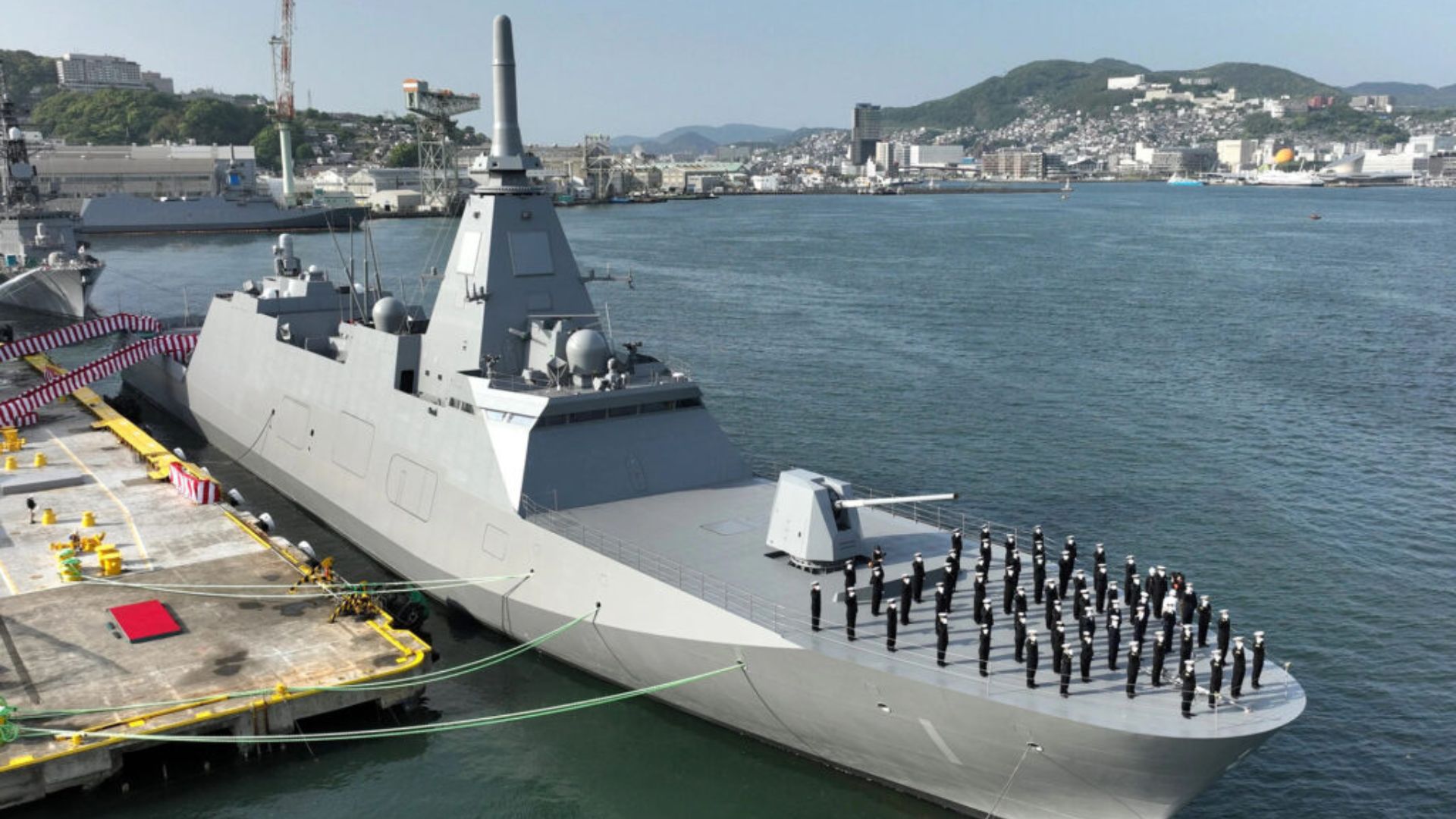

New generation of Japanese warships expands military power, accelerates naval modernization, and strengthens strategic presence amid growing tensions in the Asian region
Japan has taken another decisive step toward strengthening its military capability by formalizing a new billion-dollar contract for the construction of advanced frigates. The information was disclosed by “Defense Forces,” based on recent specialized reports, indicating that the Japanese Ministry of Defense has signed an agreement with Mitsubishi Heavy Industries for the production of three new units of the “Upgraded Mogami” class.
In total, the contract involves hulls 3 to 5 of the New FFM program, with an estimated value of 128.6 billion yen — equivalent to approximately $850 million to $900 million. This investment not only reinforces the modernization of the Japanese fleet but also signals a direct response to the increasingly competitive landscape in the Indo-Pacific.
Japanese naval expansion accelerates mass production and strengthens strategic presence


Moreover, this new order does not arise in isolation. In March 2025, Mitsubishi Heavy Industries had already received authorization to build the first two units of the new generation, consolidating a mass production that is gaining momentum.
-
U.S. Military Intervention Risk in Brazil Raises Alarm, Highlights National Sovereignty Amid Tensions Over Washington’s Terrorist Designation of PCC and Comando Vermelho

-
Brazilian Air Force’s Sole KC-30 Aircraft Completes Strategic Mission to Spain for 105mm Anti-Tank Ammunition for Leopard 1A5 Tanks

-
Brazilian Air Force Seeks to Acquire More Gripen Fighter Jets
-
U.S. Air Force Launches Air-to-Air Missile Project with Range of Up to 1,850 km for Indo-Pacific Operations




As a result, Japan significantly expands its naval escort capacity, an essential factor for protecting maritime routes and ensuring regional stability. At the same time, the country demonstrates a clear strategy: to rapidly increase the number of modern vessels, with lower crew requirements and a high level of automation.
Another relevant point is that the New FFM program gained even more international prominence after Australia announced, on April 18, the selection of a variant of the “Upgraded Mogami” for its future frigates. This move reinforces the competitiveness of the Japanese project on the global stage, elevating its status as a reference in naval technology.
Upgraded Mogami frigates bring technological advances and greater combat power

On the other hand, the great differentiator of the new class lies in the significant technical improvements compared to the original Mogami class version. The updated frigates measure approximately 142 meters in length, compared to 132.5 meters of the previous version, along with a beam of about 17 meters.
The standard displacement reaches approximately 4,800 to 4,880 tons, potentially reaching around 6,200 tons at full load — a considerable jump from the 5,500 tons of the previous class. Despite the increase in size and capacity, the maximum speed remains above 30 knots, maintaining high operational performance.
In terms of armament, the advancement is even more evident. While the original Mogami class has 16 Mk 41 vertical launch cells, the “Upgraded Mogami” version doubles this capacity, reaching 32 cells. This significantly enhances the firepower, allowing the use of missiles such as the improved Type 12, the new NSAM surface-to-air system, the Type 23 A-SAM, and the Type 17 SSM.
Furthermore, the sensors and combat systems have been enhanced. The evolved multifunction radar, combined with more advanced anti-submarine warfare systems, ensures greater efficiency in complex scenarios. The integration with unmanned systems, such as USVs and UUVs, also represents an important technological leap, aligning Japan with the latest trends in naval warfare.
Japanese military strategy focuses on automation, efficiency, and rapid response

Consequently, the New FFM program positions itself as one of the main priorities of Japanese naval modernization. The proposal goes beyond the simple replacement of ships: it aims to create a more agile, efficient force prepared to respond quickly to emerging threats.
Another strategic aspect is the reduction of the crew, estimated at around 90 people, a relatively low number for vessels of this size. This is made possible by the high level of onboard automation, which reduces operational costs and increases efficiency in prolonged missions.
At the same time, the CODAG propulsion type — which combines diesel engines with a gas turbine — ensures a balance between performance and economy. This configuration allows the frigates to operate flexibly in different scenarios, from routine patrols to high-intensity operations.
Japanese industry strengthens and consolidates leadership in military shipbuilding
Finally, from an industrial perspective, the contract reinforces the role of Mitsubishi Heavy Industries as the main protagonist in military shipbuilding in Japan. The company consolidates its strategic position by leading one of the most ambitious projects currently in the defense sector.
Moreover, the initiative demonstrates Tokyo’s intention to accelerate the production of surface ships with enhanced capabilities in anti-submarine warfare, air defense, and surface attack. This move not only strengthens national security but also positions Japan as one of the leading global players in the defense industry.
In light of this scenario, it is evident that the advancement of the “Upgraded Mogami” frigates is not just a technological upgrade, but rather a milestone in the transformation of Japanese naval power — with direct impacts on the strategic balance of the Indo-Pacific.
With information from: Naval Power