Portuguese
  Spanish


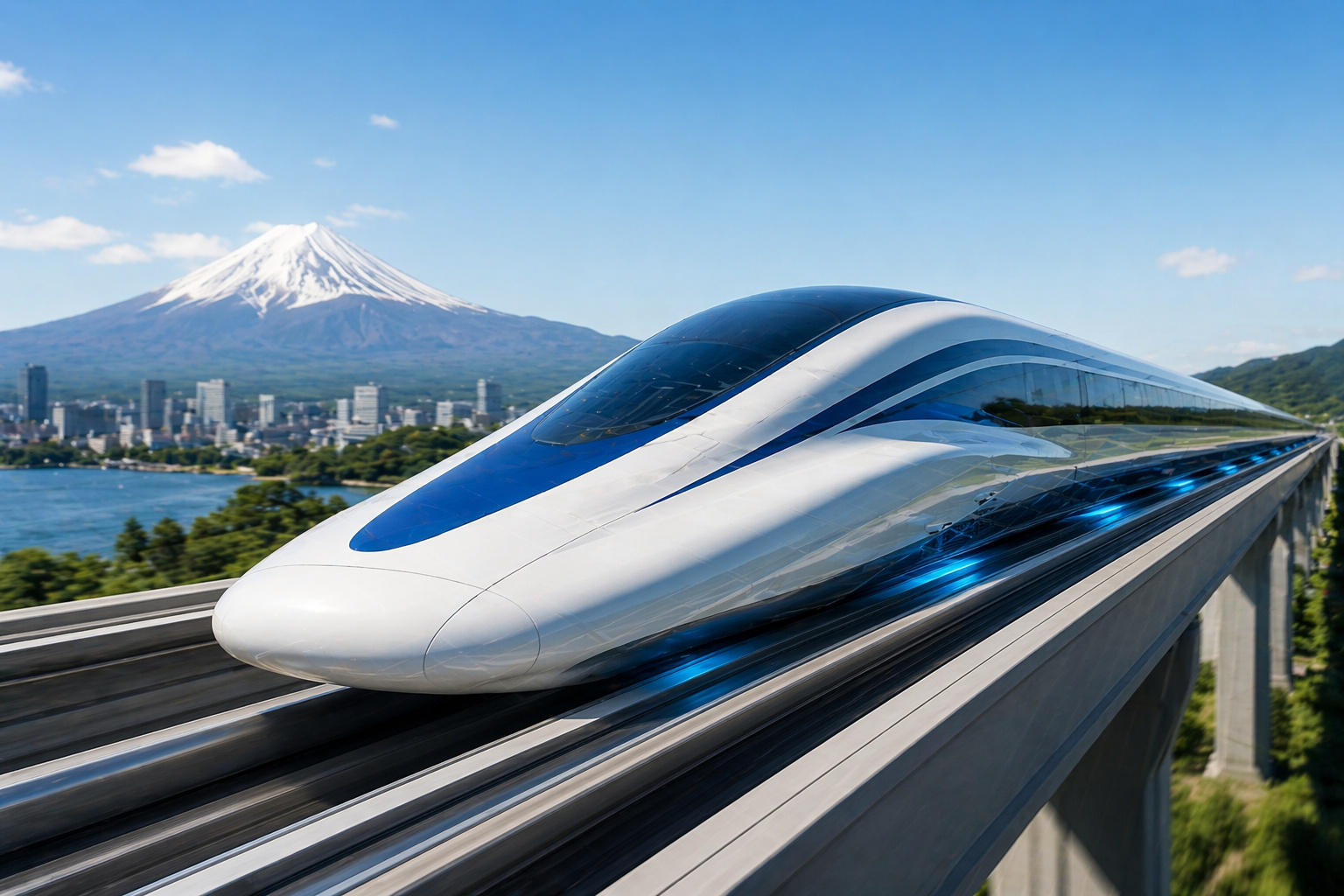


The Japan is advancing in the development of high-speed trains that are even faster and is already conducting tests that exceed 500 km/h with magnetic levitation technology. With this, the country opens a new chapter in the evolution of the Shinkansen and reinforces its position as a global reference in high-performance rail transport.
Additionally, the project aims to drastically reduce travel time between major urban centers, such as Tokyo and Nagoya, increasing efficiency and connectivity in the country.
Magnetic technology promises to revolutionize transport
Unlike traditional trains, the new system uses magnetic levitation (maglev) and eliminates contact with the tracks.
-
Cold War Secret Plane Lost Engine Mid-Flight, Forcing Six to Parachute in Darkness; Wreckage Remains in Death Valley Mountains 73 Years Later

-
Opened in 1980, Shopping Recife was Pernambuco’s first mall and helped transform Boa Viagem into a bustling and sought-after district in southern Recife.
-
Tired of Monthly Water Supply, South African Villagers in Limpopo Connect Mountain Spring to Taps, Bringing Water to 5,000 People with $700 Initiative

-
Rare Case of Neurocysticercosis in Spain: 60-Year-Old Man’s Suspected Brain Cancer Turns Out to Be Tapeworm Cysts, Avoiding Invasive Cancer Treatments





As a result, friction virtually disappears and allows for speeds far superior to conventional models.
Furthermore:
- reduces mechanical wear
- improves noise levels
- increases operational efficiency
Thus, maglev consolidates itself as one of the most promising technologies for the future of mobility.
Reduction of travel time between cities is the main objective
Currently, the route between Tokyo and Nagoya already shows high efficiency. Still, with the new technology, Japan aims to further reduce this time and bring cities closer together as if they were integrated metropolitan areas.
In practice, this transforms the economic dynamics of the country, as it facilitates the movement of people, services, and businesses.
Moreover, the reduction in travel time directly contributes to gains in productivity and quality of life.
Japan reinforces global leadership in rail innovation
The Shinkansen already stands out globally for its efficiency, safety, and punctuality. However, Japan continues to invest to maintain this leadership.
In this scenario, tests with trains above 500 km/h place the country at the forefront of innovation, especially as other nations also accelerate similar projects.
Challenges are still part of the project
Despite the advancements, large-scale implementation still faces significant obstacles. Among them:
- high infrastructure costs
- need for exclusive lines for maglev
- environmental requirements
- urban adaptation
Still, Japan has the experience and technical capability to overcome these challenges over time.
Impact goes beyond transportation
More than just speeding up travel, the advancement of the Shinkansen drives the economy and technological innovation.
This happens because projects of this scale:
- stimulate the industry
- generate specialized jobs
- strengthen international competitiveness
Furthermore, the country can export this technology and expand its global presence in the railway sector.
What to expect in the coming years
In the coming years, Japan is expected to intensify testing with maglev technology and advance in the construction of new lines.
At the same time, the country is paving the way for large-scale commercial operation, connecting even more cities.
In this way, long-distance transportation is likely to become increasingly fast and efficient.


What’s at stake
The advancement of the Shinkansen with magnetic levitation represents not just an increase in speed. In fact, it redefines how people move.
By reducing distances and optimizing time, the project aligns with a global trend for faster, more efficient, and sustainable mobility.
Thus, Japan is not only testing new trains — it is setting a new standard for the future of transportation.