Portuguese
  Spanish


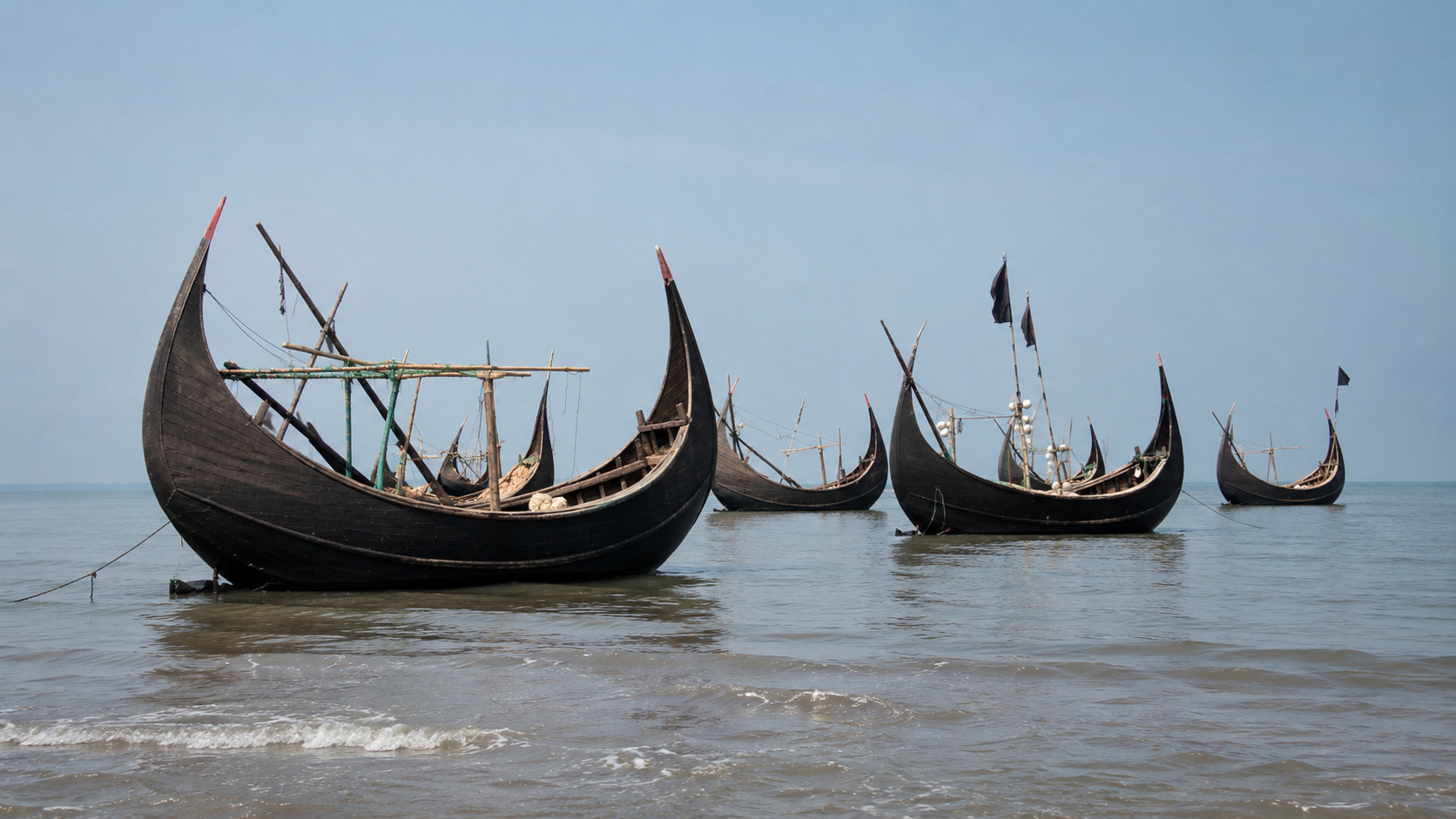

Moon boats from Bangladesh use crescent-shaped hulls to cross strong waves, sandbanks, and surf zones.
On the southeastern coast of Bangladesh, near Cox’s Bazar, fishermen use a handcrafted boat so unusual that it seems designed more to tackle waves than to sail in a straight line. Known as the moon boat, it has a crescent-shaped hull and was created to navigate the strong surf of the Bay of Bengal, a region marked by sandbanks, rough seas, and challenging conditions near the coast.
The design stands out because it was not born as a tourist attraction but as a practical response to a real problem faced by local fishermen. According to the organization Watever, the shape of the boat is linked to the need to cross a sandy barrier located a few hundred meters from the beach, where the waves form a kind of “wall” daily between the coast and the fishing areas.
Moon boat originated in Cox’s Bazar as a simple solution to cross strong waves
The moon boat is typical of the Cox’s Bazar region, in southeastern Bangladesh, near the border with Myanmar. Watever describes the vessel as one of the most characteristic elements of the naval heritage of the Bay of Bengal, with variations depending on the type of wave it needs to face every day.
-
How to Prevent Brown Recluse Spider Bites: Common Hiding Spots and Free Tips to Reduce Risks

-
Natto: The Unusual Japanese Superfood Gaining Popularity on Social Media and Driving Record Exports
-
Brazilian Mayor Goes Undercover as Homeless for 24 Hours to Assess Public Services

-
15-Year-Old Entrepreneur Malu Lira Publishes 20 Children’s Books on Financial Education, Earns $500,000, and Expands Her Project to the Amazon Rainforest






The logic of the design is straightforward: instead of using a common, straighter, and elongated hull, the moon boat has a pronounced curvature along the keel line. This shape helps the vessel overcome the natural barrier of sand and waves near the beach, where coastal navigation becomes more unstable.
The crescent shape helps the boat handle the surf zone
The surf zone is one of the most dangerous parts of coastal navigation for small boats. It is where the waves break forcefully, push the vessel sideways, and can cause the hull to lose stability in a matter of seconds.
According to Náutica, the moon boats were designed precisely to “bypass” these waters, using the hull’s curvature to cross strong waves and sandbanks formed by the volume of sediments brought by large rivers like the Ganges and the Brahmaputra.

The result is a boat that does not impress with a powerful engine or electronic technology, but with naval geometry. The very shape of the hull acts as an adaptation to the environment, allowing fishermen to cross a coastal strip where conventional vessels may have more difficulty.
Zigzag navigation reduces the risk of facing the waves head-on all the time
Zigzag navigation makes sense in surf areas because it allows adjusting the angle of attack against the waves. Instead of facing the full force of the sea frontally and continuously, the boat can change orientation to find safer passages between crests, foam, and sandbanks.
In the case of moon boats, this behavior matches the arched hull. The curvature helps the vessel rise and fall over the water differently from straight boats, while fishermen use local experience to choose the best path to the open sea.
This is practical knowledge, passed down through observation and daily use. It is not a laboratory solution, but coastal engineering born from the repetition of thousands of crossings in difficult seas.
Artisanal boat uses local materials and techniques passed down through generations
The moon boats are built by traditional carpenters from the Cox’s Bazar region. Nautica points out that the production involves local materials, such as wood, bamboo, and natural fibers, with techniques passed down from generation to generation by coastal communities.

Watever documented this tradition in 2013, when it took five carpenters from Cox’s Bazar to the TaraTari shipyard to build, photograph, document, and archive the process of making a moon boat. The goal was to preserve the knowledge before it disappeared along with the traditional fleet.
The traditional fleet has been declining for about two decades
Despite still being seen on the beaches of Cox’s Bazar, the moon boats are in decline. Watever states that the traditional fleet of Bangladesh has been gradually disappearing for about two decades, pushing ancestral shipbuilding techniques into oblivion.
Nautical also highlights that the replacement by more modern boats and the risk of losing oral knowledge threaten the continuity of this type of vessel. The problem is not just losing a beautiful boat, but losing a popular technology adapted to a specific coast.
The moon boat shows how an old solution can solve problems that modern technology doesn’t always resolve
The moon boat is surprising because it seems simple, yet it responds to a complex physical challenge: crossing an unstable coast, with strong waves, sandbanks, and rough seas, without relying on large engines or sophisticated systems.
Its value lies precisely in adaptation. The crescent-shaped hull transforms a fishing vessel into a specialized tool for a difficult environment, where every detail of the design was shaped by the need to reach the sea and return safely.
In a world accustomed to associating innovation with sensors, software, and expensive materials, the moon boats of Bangladesh remind us that some of the smartest solutions still arise from direct observation of nature, the experience of fishermen, and the artisanal engineering accumulated over generations.