






 Portuguese
  Spanish


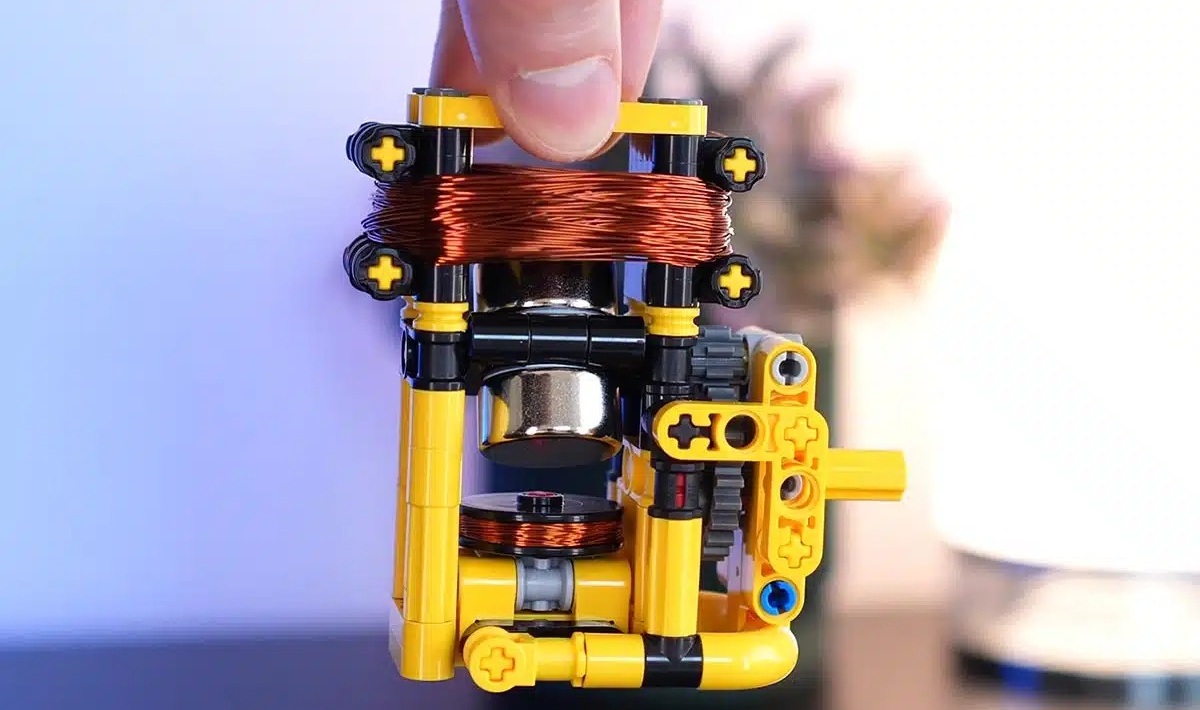


Project Developed by the Creator of Jamie’s Brick Jams Shows How an Electric Motor Can Be Built Using Only LEGO Parts, Magnets, Copper Coils, and a 9-Volt Battery, Achieving Up to 4,000 Revolutions Per Minute Without Programming or Complex Electronic Systems
A creator from Jamie’s Brick Jams developed a functional electric motor using LEGO blocks, magnets, copper wire, a transistor, and a 9-volt battery, achieving up to 4,000 revolutions per minute in a project based solely on fundamental physical principles.
Electric Motor Built with LEGO Uses Only Basic Applied Physics Components
The project features an electric motor primarily assembled with parts available in the official LEGO catalog, without the use of microcontrollers or advanced robotics kits.
The operation relies solely on magnets, copper coils, a TIP31C transistor, and a 9-volt battery.
-
China Develops Custom 140-Ton Electric Mining Truck with 770 kWh Swappable Battery, Deploys 290 Units in Xinjiang’s Largest Zinc Mine

-
Meta to Launch Arena, a New Prediction App Targeting 3.56 Billion Users, Competing with Polymarket and Kalshi

-
Scientist Challenges Famous Human Evolution Theory, Argues Homo Sapiens Evolved Gradually Over Thousands of Years
-
15-Year-Old American Builds Ocean Generator with PVC Pipe and 3D-Printed Propeller for $12, Wins National Prize, Presents at White House, and Makes Forbes 30 Under 30 List




The system transforms electrical energy into mechanical motion through the interaction of magnetic fields. The proposal highlights a complete visualization of the internal workings, allowing direct observation of each step of the physical process responsible for rotation.
The rotor is formed by neodymium magnets installed on an axle structured with pieces similar to those used in conventional LEGO assemblies.
When electric current flows through the main coil, a magnetic field is created that can attract or repel the magnets.
This process generates continuous movement, causing the rotor to spin. The entire mechanism remains exposed, making the operation of the electric motor easily understandable during operation.
Structure of the Electric Motor Allows Understanding Synchronization Without Software or Algorithms
The main coil has approximately 150 turns of copper and is responsible for generating the magnetic field. A second coil, with about 100 turns, acts as the rotor position sensor.
This coil detects the passage of the magnets and sends an electrical signal to the TIP31C transistor. The component automatically activates the next electrical pulse needed to maintain the system’s movement.
Operation occurs through natural self-synchronization, dispensing with programming or digital control. The electric motor operates solely based on the physical response between electrical current and magnetism.
According to the demonstration presented, the project represents a direct return to the fundamentals of electricity and electromagnetism, without reliance on intelligent modules or computational systems.
Different Configurations Alter Speed and Torque of the System
In the simplest configuration, using two magnets on the rotor, the electric motor reaches approximately 1,300 revolutions per minute. This version prioritizes higher rotational speed.
By adding a gear reduction of 3:1, the speed decreases while torque increases. In this condition, the motor becomes capable of moving a small car built with LEGO parts.
The creator also tested a rotor equipped with eight magnets. In this format, the speed was reduced to about 480 revolutions per minute, while the movement became more stable with more consistent torque.
The project allows modification of performance and mechanical behavior by simply changing the number of magnets or the gear system, while maintaining the same 9-volt power source.
Among the main elements used are a main coil of 150 turns, a sensor coil of approximately 100 turns, a TIP31C transistor, a 9-volt battery, and a configurable rotor with two or eight magnets.
Educational Project Expands Use of LEGO Beyond Entertainment
The demonstration highlights the use of building blocks as an educational tool applied to experimental physics. The electric motor allows disassembly, adjustments, and direct observation of the involved phenomena.
The modular principle employed follows the logic of construction by independent parts, facilitating understanding, maintenance, and practical experimentation. Each component can be removed or modified without compromising the understanding of the system.
The initiative shows that structures traditionally associated with entertainment can serve as a basis for accessible scientific experiments. The visible operation of the motor transforms abstract concepts into observable processes.
For students, educators, and science enthusiasts, the project allows real-time tracking of the conversion of magnetic fields into mechanical motion, as well as observation of natural synchronization without the use of software.
The demonstration reinforces that experiments based on physical fundamentals can be conducted with simple components, provided there is precision in the assembly and understanding of the principles involved.






