Portuguese
  Spanish


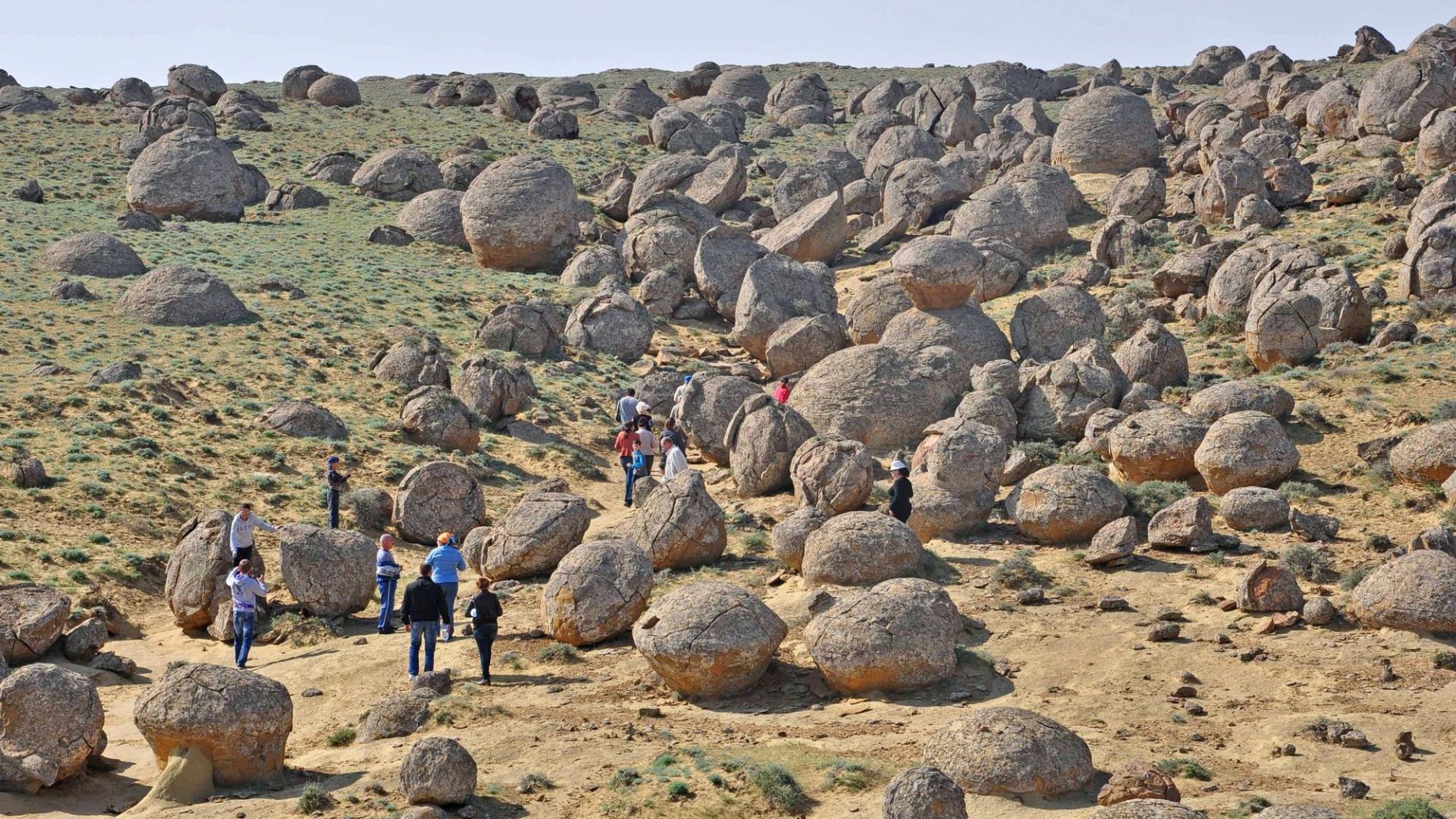

The Torysh Valley in Kazakhstan gathers thousands of giant rocky spheres formed in an ancient sea tens of millions of years ago.
In the arid west of Kazakhstan, in a landscape dominated by dry steppes, salt flats, and wind-sculpted rock formations, lies one of the most intriguing geological settings in Central Asia. Scattered across kilometers of terrain are thousands of almost perfect stone spheres, some larger than a car. Known as Torysh, or simply Valley of Balls, the site is located in the Mangystau region, near the village of Shetpe and the Sherkala mountain.
According to geological information gathered by researchers, Wikipedia, and scientific tourism institutions in the country, the structures are natural concretions slowly formed within ancient marine sediments, in a process that took tens of millions of years.
Thousands of giant spheres cover the desert in one of the strangest landscapes on the planet
The first visual impact of Torysh is the number of spheres scattered across the landscape. According to the specialized platform Advantour Kazakhstan, there are thousands of stone balls distributed over several kilometers, ranging from small marble-like structures to huge blocks with between 1 and 3 meters in diameter, although some specimens can exceed 4 meters.
-
Egypt Discovers 18 Ancient Tombs with Gold Tongues, Unveiling Unusual Funeral Rituals and Amulets Believed to Give Voice to the Dead

-
Nigeria Dumps 120 Million Tons of Sand into Atlantic to Build Massive City with 8.4 km Sea Wall for Protection Against Ocean Waves and Erosion
-
German Engineer Developed Diesel Engine Running on Vegetable Oil Decades Before Electric Cars Became Popular; Can This Forgotten Idea Work in 2026?

-
James Webb Telescope Uncovers Unexpected Clues on Mysterious Moon, Potentially Redefining Planetary Origins




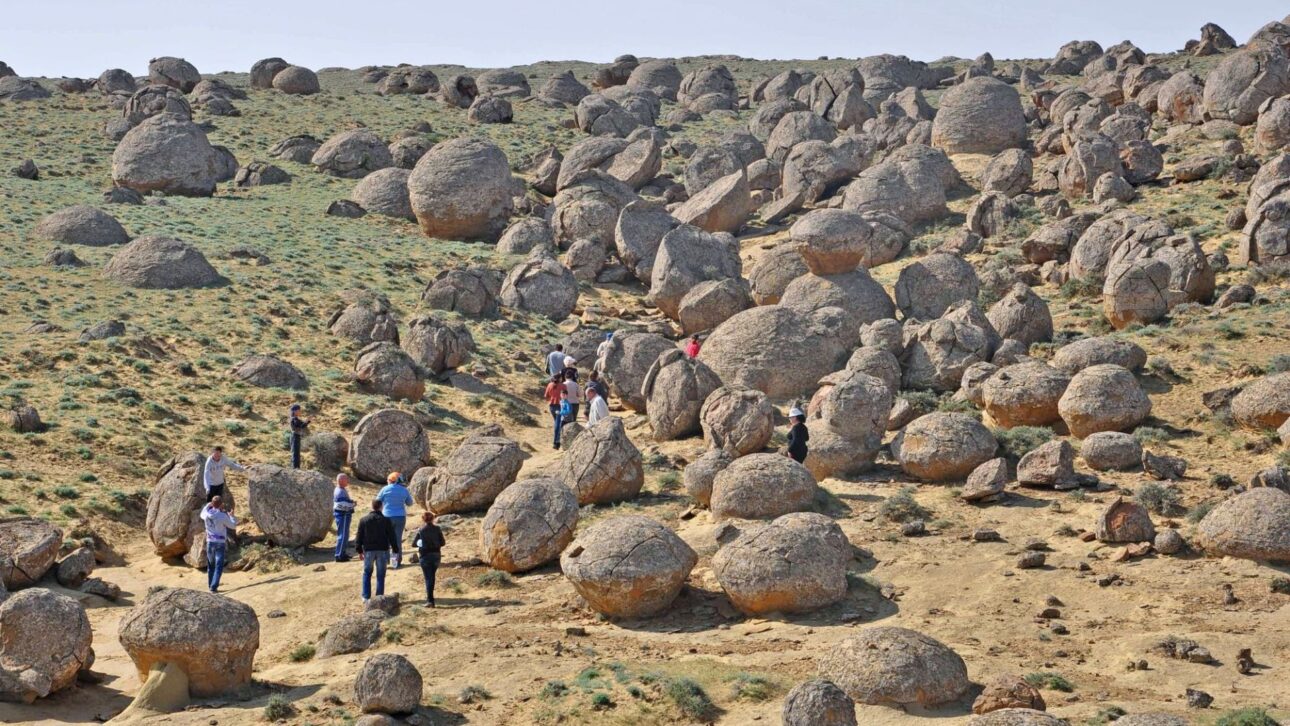
Many remain completely intact, while others appear cracked, flattened, or partially buried in the sediments, creating a landscape reminiscent of a gigantic field of abandoned projectiles.
According to the tourist portal Mangystau Overland, some concretions are only 10 to 15 centimeters, while others reach approximately 4 meters in diameter, demonstrating the enormous diversity of sizes present at the site.
Scientists believe the spheres formed in an ancient vanished ocean
Although the appearance of the stones has fueled local legends for centuries, the most accepted explanation today is linked to sedimentary geology.
According to the geological description of Torysh compiled by the encyclopedia Wikipedia, the region was part of areas associated with the ancient Tethys Ocean, which occupied extensive portions of Eurasia for millions of years.

Researchers from mangystau believe that small organic fragments, shells, mineral grains, or biological remains acted as initial nuclei for the deposition of minerals dissolved in the water.
Over time, minerals such as calcite, silicates, and iron oxides were deposited layer upon layer around these nuclei, forming progressively larger concretions.
Subsequently, compaction and cementation processes hardened the structures. With the tectonic uplift of the region and the erosion of more fragile sediments around, the resistant concretions remained exposed on the surface, creating the landscape observed today.
Some stones have cracks that resemble giant eggs about to hatch
Not all spheres have a smooth appearance. According to reports compiled from Advantour Kazakhstan and by geological tourism operators, many have superficial cracks and natural divisions that resemble huge fossilized eggs or capsules about to split open.
This characteristic has contributed to the emergence of numerous popular interpretations. Some compare the stones to giant dinosaur eggs, cannonballs abandoned by ancient civilizations, or extraterrestrial objects scattered across the desert.

However, science continues to point to a natural formation mechanism based on sedimentary concretions, a phenomenon also observed in places like the Moeraki Boulders in New Zealand and Bowling Ball Beach in California.
Some estimates indicate that the spheres may be between 40 and 60 million years old
The exact age of the formations is still a subject of debate. According to Advantour Kazakhstan, studies estimate that the Torysh concretions developed between 40 and 60 million years ago, after the sedimentation of materials deposited in the ancient Tethys Ocean.
Other interpretations cited in geological materials suggest that some structures could be associated with older sediments, dated from the Jurassic and Cretaceous, between approximately 120 and 180 million years.
There is no absolute consensus on the chronology of all the spheres, as the valley is still considered relatively understudied compared to other famous geological formations in the world.
The Valley of Balls remains one of the greatest geological mysteries of Central Asia
Despite advances in scientific interpretations, Torysh remains shrouded in mystery. The enormous concentration of spheres in a single location, combined with the scale of the landscape and the almost artificial appearance of the rocks, makes the region one of the most impressive settings on the planet for geologists, photographers, and travelers.
In the silence of the Kazakh desert, thousands of stones remain scattered across the ground as witnesses to an ocean that disappeared millions of years ago.
And the feeling remains the same for those who arrive at the site for the first time: it seems like a gigantic being interrupted a continental-scale bowling game and never returned to collect the balls.