





 Portuguese
  English
  Spanish
  5 min of reading
  0 comments


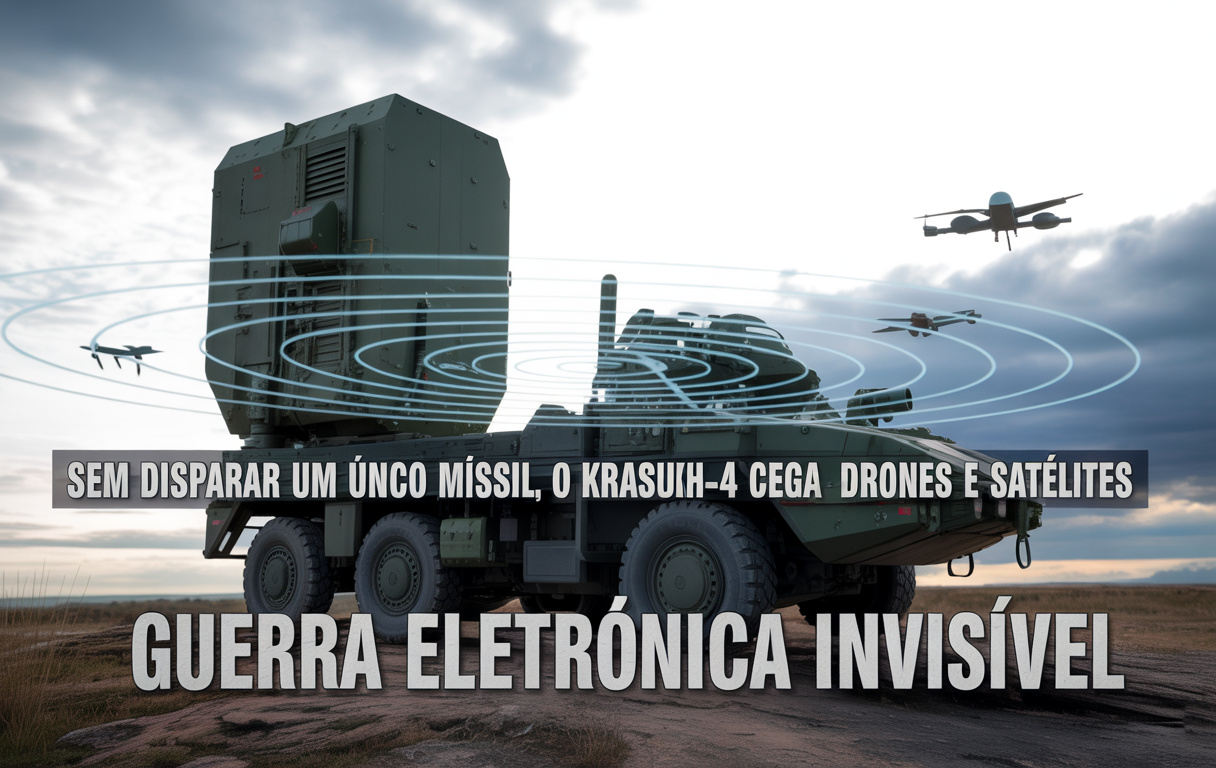
The Krasukha-4 Does Not Explode or Fire, but Shuts Down Radars, Drones, and Satellites from Long Distances and Reveals Why Electronic Warfare Has Become a Central Weapon.
When thinking about military power, the immediate image is usually that of tanks, missiles, supersonic fighters, or explosions captured by drones. But, away from the cameras, there exists a type of weapon that decides entire battles without leaving craters in the ground: electronic warfare. Within this silent and highly technical field, one system has become a symbol of this new form of invisible combat: the Krasukha-4.
Developed in Russia, the Krasukha-4 represents a profound shift in the logic of modern warfare. It does not physically attack the enemy. Instead, it attacks the eyes, ears, and electronic brain of entire forces, rendering radars, drones, sensors, and even satellite communications useless.
War Without Shots, but with Strategic Effect
The concept behind the Krasukha-4 is simple to explain but extremely complex to execute: if an army relies on sensors, communications, and digital systems to operate, simply denying that access can paralyze the entire chain of command. In modern wars, this means preventing target detection, aircraft navigation, missile guidance, and real-time data transmission.
-
Students drop out of ESA after reports of sergeants driving for Uber, and a silent crisis in the Armed Forces begins to worry candidates in 2026

-
More than 500 Marines, robots, drones, and armored vehicles are deployed in Rio de Janeiro for the UN to certify Brazil at the highest level of readiness for peacekeeping missions. It is the first force in the country to achieve this status in all of history.

-
With 24-meter wings, two turbodiesel engines, 49 hours of autonomy, and the ability to launch sonobuoys to hunt submarines, the Turkish drone Aksungur can monitor an area the size of Brazil for two consecutive days without landing.

-
Pentagon wants to transform drones into mass ammunition, produce 340,000 units in two years, and lead the US Army to a fleet of 1 million disposable aircraft for modern warfare.



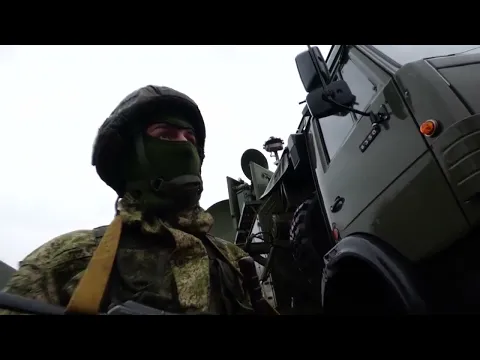

The Krasukha-4 was designed precisely for this purpose. It acts as a mobile electronic jamming system, capable of emitting high-power signals that saturate, confuse, or blind enemy electronic equipment.
What the Krasukha-4 Really Does
Unlike air defense systems, the Krasukha-4 does not fire anything. Its “attack” occurs through targeted electromagnetic emissions, adjusted to interfere with frequencies used by radars, data links, and sensors. Among its documented functions are:
- interference with airborne radars (such as those of early warning aircraft);
- degradation of the performance of reconnaissance and attack drones;
- disruption of satellite communications and data links;
- creation of temporary “blind spots” on the battlefield.
Practically speaking, this means that opposing forces can remain physically intact but operationally blind.
Game-Changing Range
One of the most impressive aspects of the Krasukha-4 is the range attributed to the system. Open sources and military analyses indicate jamming capability at hundreds of kilometers, depending on the target, the type of radar, and the electromagnetic conditions of the environment.
This places the system at a strategic level: it does not only operate on the front lines but can affect air operations and surveillance over large areas, even far from direct contact with enemy troops.
Mobility as a Weapon
Another decisive differentiator of the Krasukha-4 is its mobility. The system is mounted on heavy vehicles, allowing for rapid movement and constant repositioning. This complicates its detection and neutralization, as it is not a fixed installation easily identifiable by satellites or aerial reconnaissance.
In a conflict scenario, this mobility allows for the creation of temporary electronic denial bubbles, appearing, jamming, and disappearing before the enemy can react.
Proven Use in Real Conflicts
The Krasukha-4 is not a theoretical concept or a military fair prototype. It is frequently cited in western analyses as a operational system, employed in real conflict theaters. Reports from defense specialists associate its use with the degradation of airborne surveillance capabilities and the irregular performance of drones and sensors in areas where Russia maintains a military presence.

Even without detailed confirmation of each operation — something common in this type of warfare — the consensus among analysts is that the system is not experimental, but an active part of the Russian electronic warfare arsenal.
Why Satellites Also Come into Play
One of the most striking points about the Krasukha-4 is its frequent association with interference in satellite-linked systems. In modern wars, satellites are essential for navigation, communication, surveillance, and command. Interfering with these signals does not mean “shooting down” a satellite, but temporarily undermining its operational usefulness.
By confusing or degrading satellite communication links, an electronic warfare system can cause delays, synchronization failures, and widespread loss of situational awareness.
A Weapon That Leaves No Visual Evidence
Perhaps the most disturbing aspect of the Krasukha-4 is precisely its invisibility. There are no explosions, debris, or dramatic images. For those being affected, what occurs is a sequence of failures: screens become garbled, signals disappear, drones lose control, radars stop “seeing.”
This creates a type of warfare that is difficult to document and, at the same time, extremely effective. When systems fail, it is not always clear whether the problem is technical, environmental, or a result of deliberate interference.
Psychological and Doctrinal Impact
In addition to the technical effect, electronic warfare has a profound psychological impact. Forces that rely heavily on technology start to operate with mistrust, reducing the use of sensors or changing procedures for fear of electronic exposure. This, in itself, already reduces operational efficiency.
The Krasukha-4 symbolizes this shift in mindset: it is not just about destroying the enemy, but about making their tools useless.
The Global Race for Electronic Warfare
The success and notoriety of the Krasukha-4 reflect a global trend. Major powers are increasingly investing in systems capable of interfering, deceiving, and electronically neutralizing adversaries. Modern warfare is not decided only in the air, at sea, or on land but also in the electromagnetic spectrum.
In this scenario, those who control the spectrum control the battle — and often, without the world realizing that it has happened.
A War That Happens in Silence
The Krasukha-4 is an uncomfortable reminder of how 21st-century conflicts are changing. Weapons that do not fire, do not explode, and do not appear in viral videos can be more decisive than any missile. By blinding radars, confusing drones, and disrupting communications, systems like this show that modern warfare can be won even before the first shot.
And while the spotlight continues to shine on visible and destructive weapons, the real struggle for control of the battlefield takes place on invisible frequencies — where systems like the Krasukha-4 operate away from sight but at the center of strategic decision-making.









-

-

-

-

12 people reacted to this.