





 Portuguese
  English
  Spanish
  3 min of reading
  0 comments


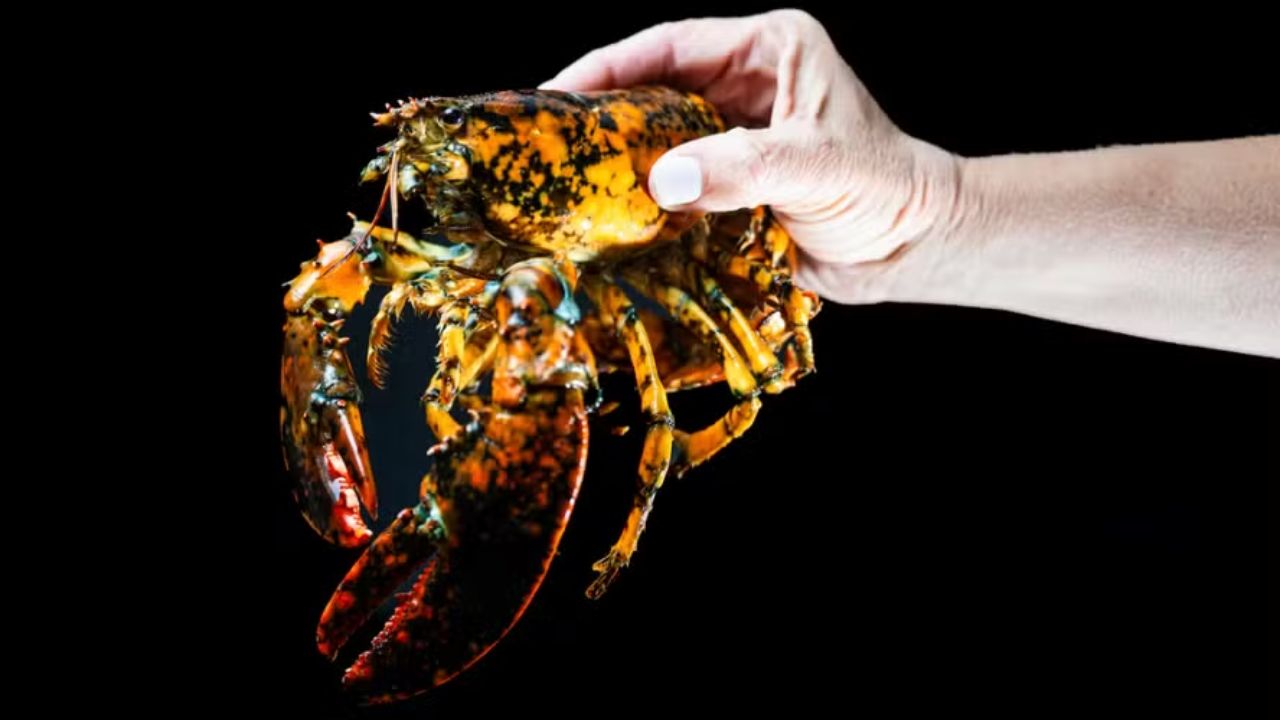
A Rare Calico Lobster With an Orange Shell and Black Spots Was Caught in Massachusetts. Learn How This Discovery Impresses Scientists and Becomes a Marine Education Tool.
A lobster with a vibrant orange shell speckled with black spots was caught in Massachusetts, USA, by a local fisherman.
The female, named Jackie, is considered of the “calico” type, a coloration that occurs in only one in 30 million lobsters, according to a statement from the Northeastern University Marine Science Center.
Currently, the animal is under the center’s protection, which keeps Jackie in safe conditions for study and observation.
-
The smallest bird of prey in the world is at risk of extinction and could disappear by 2050.
-
Researchers extracted DNA from a bone fragment of a Neanderthal found in the Denisova Cave in Russia.

-
Navios dump 40 tons of shells and concrete blocks into the sea off the UK, reversing 200 years of destruction, bringing oyster reefs back, cleaning the water, and testing if the ocean floor can regenerate on a large scale.

-
Scientists released one-ton giant bison in the mountains of Romania, and the result surprised even zoologists: the vegetation in the region increased by 30%, and the soil began to capture ten times more carbon than before.


The find was unexpected but provides a rare opportunity to better understand genetic alterations and pigmentation processes of the American Lobsters (Homarus americanus).
Characteristics That Make Jackie a Unique Lobster
Jackie displays a mix of pigments that results in her unusual appearance.
The intense orange hue comes from astaxanthin, a chemical compound from the carotenoid group, combined with other pigments and proteins that give rise to the black spots and bluish joints.
This same protein, called crustacyanin, is also present in another rare lobster at the center, Neptune, which has a cobalt-blue coloration.
American lobsters typically exhibit more subdued colors, such as brown, reddish, or greenish tones, which help them camouflage against predators.
On the other hand, Jackie’s vibrant colors make her survival until capture even more impressive.
Comparisons With Other Rare Lobsters
Neptune, the center’s bright blue lobster, also drew attention for its unusual shell derived from a genetic anomaly.
However, Jackie qualifies as an even rarer variation than her cobalt-blue counterpart, whose coloration occurs in one in two million lobsters.
Sierra Muñoz, the Marine Science Center’s extension program coordinator, commented on Jackie’s arrival:
“I said, ‘Of course we do.’ It’s such a thoughtful – and fun – donation to our scientific education program.”
Mike Tufts, a local fisherman, had sent a photo of the lobster to the center asking about the possibility of accommodating another unique specimen.
Educational Importance and Conservation
Jackie and Neptune are kept in separate tanks due to their territorial behaviors, but both serve as educational attractions.
Neptune, for example, participates in field trips to local primary schools. Muñoz emphasizes:
“The students are loving it. Kids love to learn about rare animals, how special they are, and how many different types of life exist in the ocean. It really sparks interesting questions and connections.”
These initiatives highlight the importance of teaching science in a hands-on and engaging manner, showing children rare and fascinating species of the marine world.
Lobster Longevity
American lobsters can live over 100 years without relying on adverse environmental conditions, such as disease and predators.
This allows for long-term studies on their biology and genetics.
Jackie’s presence offers researchers the opportunity to analyze rare combinations of pigments and better understand the genetic variations that produce extraordinary colors.
In addition to its scientific value, protecting these individuals reinforces awareness of marine biodiversity and the need to preserve natural habitats so that species like the American lobster can continue to exist.
The discovery of Jackie, the calico lobster from Massachusetts, shows how nature still holds impressive surprises.
Her vibrant coloration and extreme rarity make her a symbol of scientific education and marine conservation.
These unique animals remind everyone of the importance of studying and protecting the oceans, ensuring that future generations can learn about and be enchanted by the diversity of marine life.
With information from Revista Galileu.







Seja o primeiro a reagir!