Portuguese
  Spanish


The mini castle built in the forest shows how Vasya uses raw wood, a firm base, manual joints, and simple tools to transform natural materials into a vertical cabin with a medieval look, rustic finish, and integration with the environment, revealing creativity, patience, and artisanal engineering in each step of the manual project in nature.
The mini castle erected in the middle of the forest draws attention because it seems to come out of a medieval tale, but it arises from a simple logic: raw wood, common tools, manual labor, and intelligent use of available resources.
The construction made by Vasya shows how a tower-shaped cabin can gain visual presence without relying on luxury. The impact is precisely in the transformation of natural materials into a rustic, functional refuge integrated with the environment.
How the mini castle begins to take shape in the forest

The first stage of the mini castle is in the choice of terrain and the preparation of the base. Before any wall rises, it is necessary to observe the soil, define the position of the structure, and ensure that the foundation can support the vertical weight of the tower.
-
Giant 3,600-ton Crane Breaks Two World Records by Installing World’s Largest Single-Piece Forged and Welded Hydrogenation Reactor, Weighing 3,037 Tons, in Chinese Petrochemical Plant in Just Six Days

-
$80 Million Bridge in Brazil Cuts Travel Time from 30 Minutes to 1 Minute, but Audit Reveals Major Flaws
-
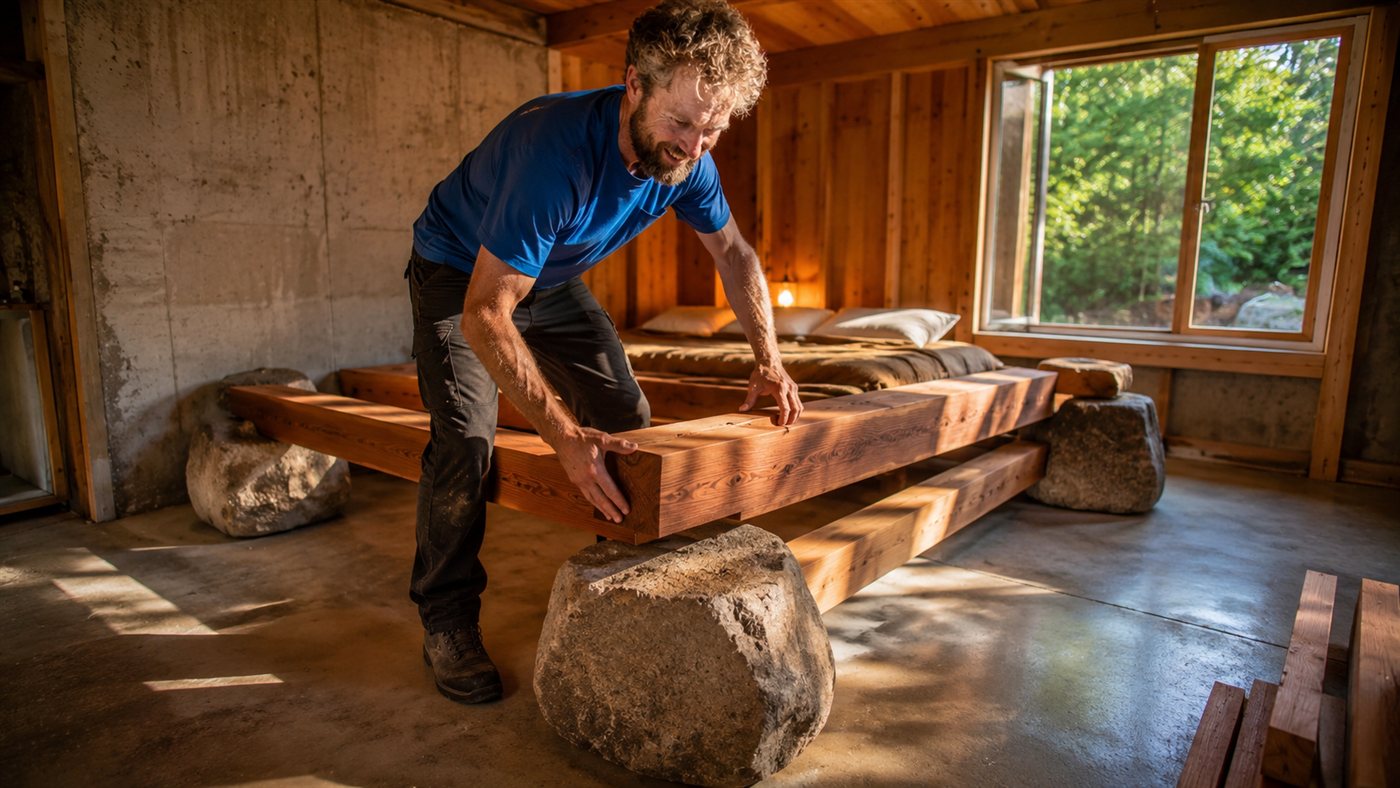
Man Builds Stone Bed with Granite Rocks and Hand-Sawn Cedar Beams, Home Extension Garners Over 437,000 Views on Bonus Bolts Channel

-
Brazilian Researcher Develops Color-Changing Roof Tile to Reduce Air Conditioning Use by Up to 15%



This initial care is decisive because the construction grows upwards. A tower-shaped cabin requires stability from the first supports, as any failure in the base can compromise alignment, safety, and resistance throughout the assembly.
The proposal is not to make a large house, but to create a compact structure with a strong visual presence. Therefore, each piece needs to be positioned with attention, respecting the weight of the wood and the natural behavior of the material.
In the middle of the forest, the work also needs to dialogue with the environment. The base must avoid excessive contact with moisture, while the structure needs to withstand time without losing the artisanal aspect that makes the project so striking.
Raw wood transforms simple resources into a rustic refuge
Wood is the element that gives identity to the mini castle. Instead of hiding the natural marks of the material, the construction values texture, irregularity, color, and rustic appearance, creating a direct connection with the surrounding forest.
The result seems more authentic because it doesn’t try to look industrial. The raw wood reinforces the feeling of a handmade shelter, as if the tower had emerged from the natural environment itself.
Even with a simple look, the use of wood requires criteria. The pieces need to be firm, resistant, and suitable for the external environment, especially in a construction exposed to moisture, wind, and temperature changes.
The rustic finish also doesn’t mean carelessness. On the contrary: for the refuge to be beautiful and durable, it is necessary to carefully adjust cuts, fittings, and protections, respecting the behavior of the material over time.
Simple tools highlight the craftsman’s skill

One of the most interesting points of the mini castle is the use of simple tools. The work does not rely on large machines or sophisticated equipment to impress; it stands out for the patience and skill of the builder.
Each cut, fit, and adjustment reveals manual mastery. The strength of the project lies in the artisanal precision, in reading the pieces of wood and the ability to transform limited resources into an organized structure.
This type of construction requires time. The tower does not appear ready all at once; it emerges gradually, layer by layer, with practical decisions made during assembly.
Vasya’s skill appears precisely in this process. He needs to balance strength, aesthetics, and functionality, ensuring that each part contributes to the final set without losing the rustic character of the cabin.
Tower format gives a medieval appearance to the shelter

Verticality is the detail that makes the cabin look like a mini castle. The tower format completely changes the perception of the construction, giving the shelter a more striking presence than a common cabin.
This choice creates an almost medieval look, as if the refuge were a small fortification hidden among trees. Even without luxurious elements, the vertical silhouette already conveys the idea of a castle on a reduced scale.
To function, the structure needs to combine proportion and safety. Well-fitted walls, a firm foundation, and protected roofing help keep the construction stable and preserved in the external environment.
The roof also plays an important role. Besides completing the tower’s aesthetic, it protects the wood against infiltration and increases the structure’s durability, especially in a construction made in the middle of nature.
Refuge shows creativity in the face of limited resources


The mini castle stands out because it shows that creativity can weigh as much as budget. With natural materials and manual labor, Vasya transforms a simple idea into a construction full of personality.
The beauty of the project lies in the solution found for each limitation. Instead of relying on expensive finishes or technology, the work uses what is available and values integration with the setting.
This type of construction also draws attention for reviving a more direct relationship with manual work. At each stage, the structure reveals effort, persistence, and attention to detail.
In the end, the refuge impresses not only by its shape but by the process. It shows that a small construction can have a big impact when it combines technique, patience, and an intelligent reading of the environment.
Integration with the forest makes the work even more remarkable
The forest does not serve merely as a backdrop for the mini castle. It is part of the visual identity of the project, reinforcing the sense of isolation, simplicity, and direct contact with nature.
The wood, vertical shape, and rustic finish help the cabin blend into the environment. The result is a construction that seems to belong to the place, rather than compete with the surrounding landscape.
This integration also explains part of the fascination with the work. The refuge seems distant from urban routine and brings the reader closer to an idea of a simple, manual, and quiet life.
At the same time, the construction shows that simplicity does not have to mean fragile improvisation. When well-planned, a rustic cabin can be solid, beautiful, and functional, even using limited resources.
Mini castle proves the value of artisanal construction
The mini castle made by Vasya shows how a manual work can transform raw wood into a structure that arouses curiosity, admiration, and the desire to follow each step.
More than a tower-shaped cabin, the project represents the human ability to create shelter, beauty, and identity using few resources. It is a small construction in size, but large in visual impact.
The work also reinforces an interesting question: to what extent do we still value constructions made with patience, manual skill, and natural materials in an increasingly industrialized world?
And you, would you live in a rustic mini castle in the middle of the forest or do you prefer the comfort of a traditional house in the city? Share your opinion.