Portuguese
  Spanish



SBM Offshore, Modec And MISC Are Leading Competition To Provide Floater For The Pre-Salt Field And Proposals Will Be Presented On February 14, Brazilian Shipyards Are Already Being Consulted
Three floating companies are emerging as the main competitors as a consortium led by Petrobras prepares to receive bids for a large FPSO for the development of the pre-salt in the Mero-2 field in Brazil. SBM Offshore, Modec, and MISC are practically in a silent war, not only for the lucrative contracts but for the development milestone that this will represent in the coming years.
The SBM Offshore Is Looking For A New Brazilian Project After A Long Period Behind The Scenes due to compliance issues with state-controlled Petrobras. With the ban lifted, Petrobras’s delays in completing the bidding process have given the “Dutch player” extra time to catch up on its engineering and logistics preparations, and a highly competitive bid is expected.
SBM is choosing to focus on the Mero-2 field, excluding other Petrobras bids due to the higher values required in this pre-salt unit, with its high specifications for an ultra-productive field.
-
Over 2,000 Tons of Discarded Fishing Nets Since 2020 Repurposed into Durable Caps, Fins, and Parts

-
Seals and Sea Lions Lose Habitat and Food as Climate Change Advances, Impacting Ice, Prey, and Coastal Communities

-
Brazilian Innovator Uses 3D-Printed Device to Cool Two Rooms with One Air Conditioner
-
China Uses 432 Robots to Move a 7,500-Ton Historic Building in Shanghai, Preserving Architecture While Creating Space for Underground Center


However, Japanese Modec is equally determined not to let rivals disrupt its success in Brazil.
Recent contracts for large pre-salt floaters include long-term charters for the Mero-1 and Sépia fields, both expected to come online in 2021.
“Modec has a leadership in terms of repeatability of the most relevant projects, so perhaps the only question is whether this company is getting overwhelmed with taking on large contracts in Brazil, along with its entry into Mexico and the latest (front-end engineering and design) contracts for the Barossa project in Australia,” said an experienced market source.
Among the bidders, the “outsider” that is putting together an increasingly credible offer for Mero-2 is MISC, according to sources. The Malaysian group has ramped up its engineering capacity in Asia and has built on prior preparatory work in bids such as the Búzios-5 floater.
Potential partners for the work, such as the supply and integration of topsides modules, include Siemens and Sembcorp Marine. MISC appears to have chosen Mero for its first serious investment in Brazil due to the repeatability aspect, and has been working hard on local content issues, Brazilian sources said.
One is fully compliant with three categories of local content:
- 40% for engineering
- 40% for machinery and equipment;
- 40% for construction, integration, and assembly –
- The remainder belongs to the “global” percentage
The global percentage reflects the formula adopted by the consortium led by Petrobras for the Mero-1 floater, seeking an exemption from the much higher contractual requirements.
However, the exemption on local content has not been granted in full, and non-compliance in Modec’s early contracts could lead to some form of penalty being applied by ANP.
A softening of the regulatory stance on these penalties means that Petrobras wants to compare the total costs of non-compliance, it appears. The arrival of CEO Roberto Castello Branco at Petrobras and his promise to improve capital efficiency suggests that the state-controlled company’s shift away from local content will continue.
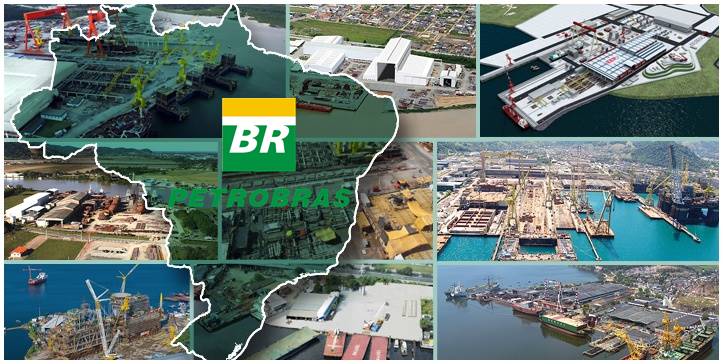
Brazilian Shipbuilding Industry Capacity And Shipyard Reactivation
However, the ability to meet local content requirements is a factor in any scenario and bidders have consulted shipyards such as EBR, Techint, BrasFels, and Jurong Aracruz.
Petrobras – along with Libra partners, Shell, Total, China National Offshore Oil Corporation (CNOOC), and China National Petroleum Corporation (CNPC) – has set February 14 as the date for proposal submissions.
The Mero-2 unit, which will have a capacity of up to 180,000 barrels of crude oil and 12 million cubic meters of gas per day, will be chartered for over 22 years.