






 Portuguese
  Spanish
  6 min of reading
  0 comments


Petrobras Returns to The Global Podium of The Most Profitable Oil Companies With Strong Operational Advance After Jumping 140% in Profit in The 1st Half of 2025 Amid Record Production and Exchange Rate Effects That Boosted The Result.
Petrobras returned to the podium of the most profitable oil companies on the planet in the 1st half of 2025.
The Brazilian state-owned company closed the period with a net profit of US$ 10.7 billion, an increase of 140% compared to the same period in 2024, ranking just behind Saudi Aramco and ExxonMobil.
Thus, it surpassed European rivals like Shell and TotalEnergies and recorded its best positioning since 2020.
-
JBS Invests Nearly $160 Million in Texas Megaproject to Expand Beef Production and Operations Through 2027

-
The urgent need to implement a severe cut in public spending and a massive increase in taxes, in addition to drastically compromising the quality of basic services and the purchasing power of the population, could result in social unrest in the country, with the population leading protests, strikes, and frequent disturbances.

-
FIRJAN’s mega plan of R$ 526.3 billion for Rio de Janeiro aims to revive Brazil’s largest industry, with two-thirds of the investments going to oil and gas.

-
China signals an increase in beef imports, Brazil has already consumed 70% of the 1.106 million ton quota and seeks to renegotiate the tariff that jumps from 12% to 55%, while demand from the US also skyrockets.



Production Record Compensates for Brent Drop
The gain occurred in a scenario of approximately 15% drop in Brent prices. Even so, the company offset the price environment with a surge in oil and gas production.
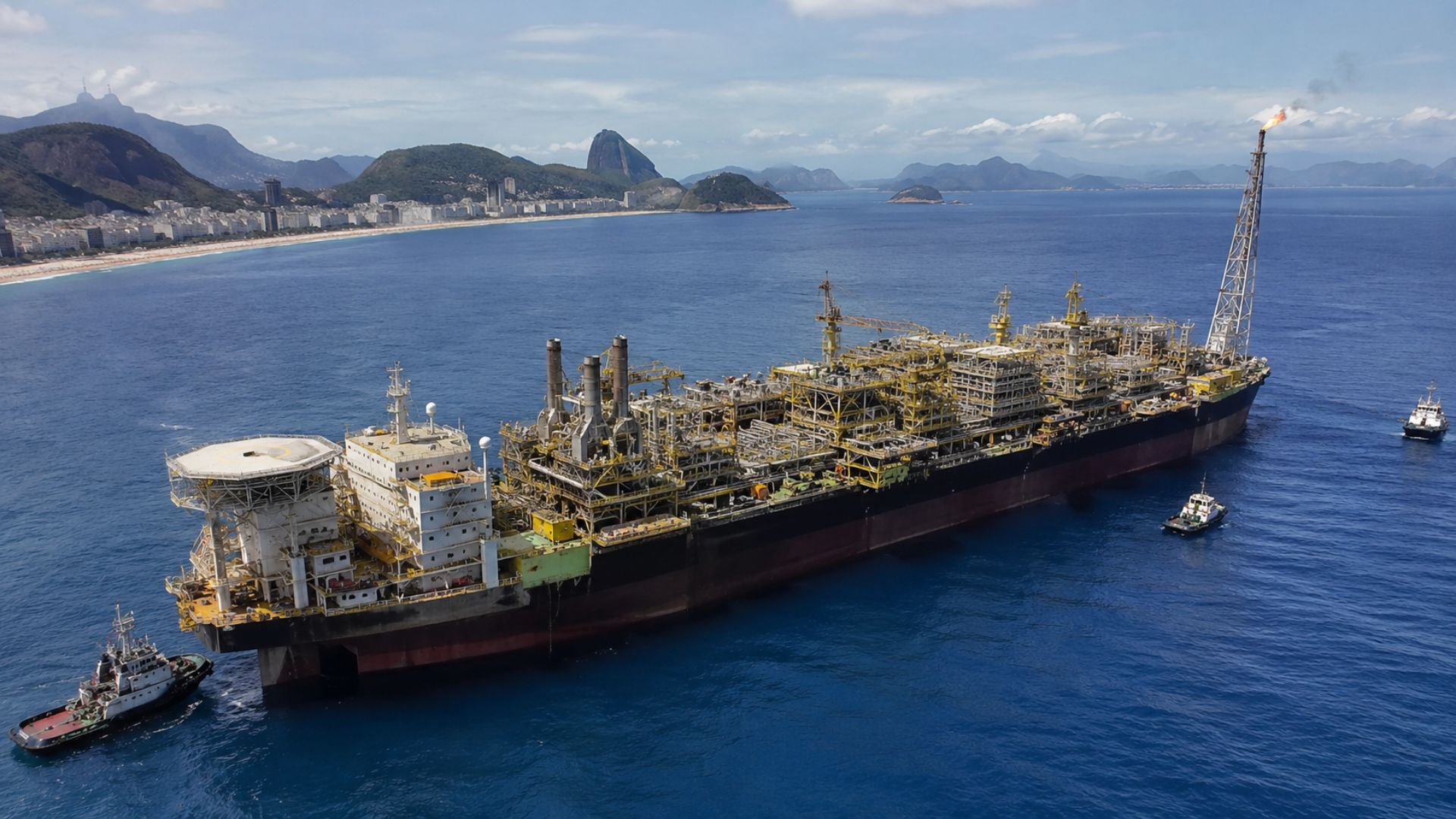
In July 2025, average production reached 2.47 million barrels per day, a figure 380 thousand barrels above that observed in the 4th quarter of 2024.
According to the company itself, the trend allows projecting year-end closure close to the upper limit of the annual target of 2.8 million boe/d (barrels of oil equivalent per day).
Although the accounting result surprised, part of the performance stems from effects classified as non-recurring — items that do not reflect the typical operation of the business.
The company reported gains of US$ 5.2 billion from exchange rate variations in the semester.
Without this extraordinary boost, the adjusted profit totals US$ 8.1 billion, which represents a nearly 25% decline year-over-year.
Financial Indicators Show Pressures
From an operational and financial perspective, the numbers for the semester point in different directions.
The adjusted EBITDA, excluding one-off events totaled US$ 20.9 billion, a drop of 14% compared to the 1st half of 2024.
The decline was attributed to a combination of cheaper oil and higher expenses, including provisions related to production individualization agreements.
In terms of profit, the picture also changes when the effect of non-recurring items is removed.
Although the reported net profit more than doubled, the adjusted profit declined and suggests an environment of tighter margins.
In other words, the structural profitability did not grow at the same rate as the disclosed final result.
Experts Urge Caution with The Results
According to José Mendes, corporate finance consultant at StoneX, the balance sheet requires careful analysis.
He stated, “Without these effects, the adjusted profit drops to US$ 8.1 billion, a decline of nearly 25% versus the adjusted profit of the 1st half of 2024, indicating pressure on structural profitability.”
The expert added that despite the advance in the main number, “the adjusted result reflects significant pressures – such as falling Brent prices, rising expenses, and provisions related to production individualization agreements. The operational performance was consistent, but the accounting number needs to be interpreted deeply.”
In market evaluation, readings of this type usually separate what is the effect of exchange rate volatility and commodity prices from what derives from the recurring performance of the company.
Petrobras Regains 3rd Position in Global Ranking
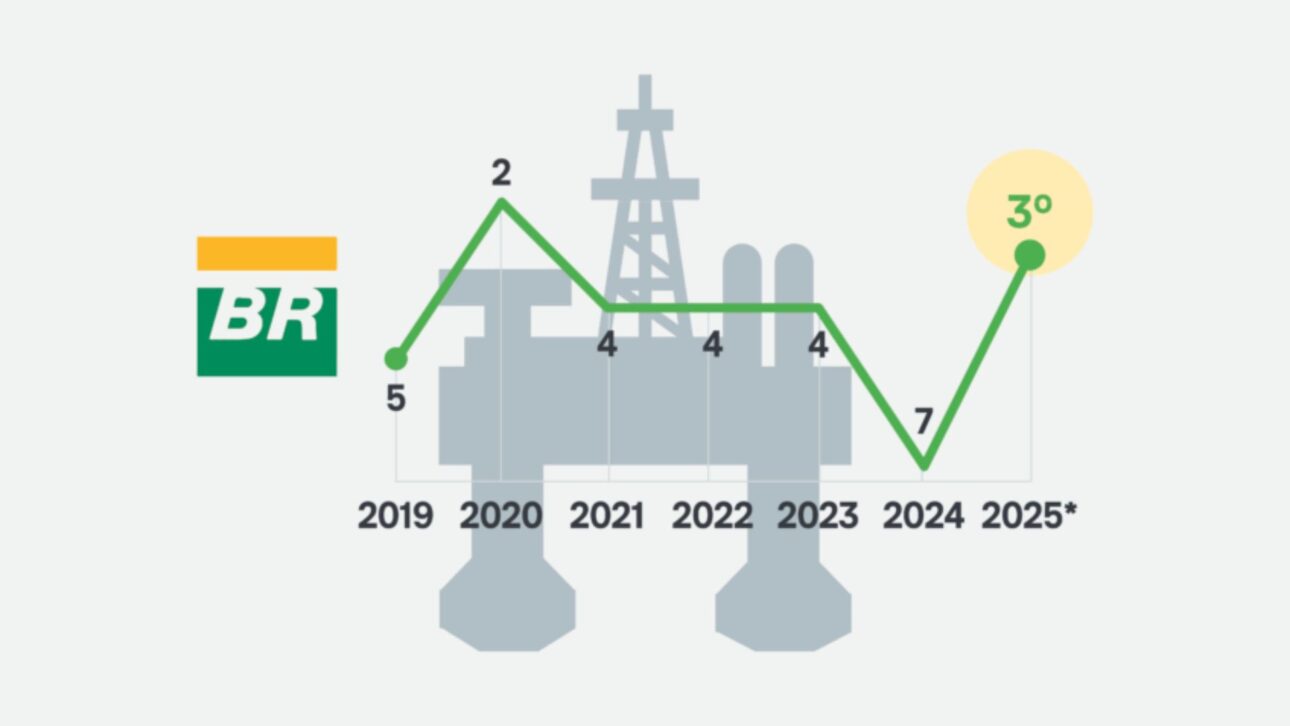
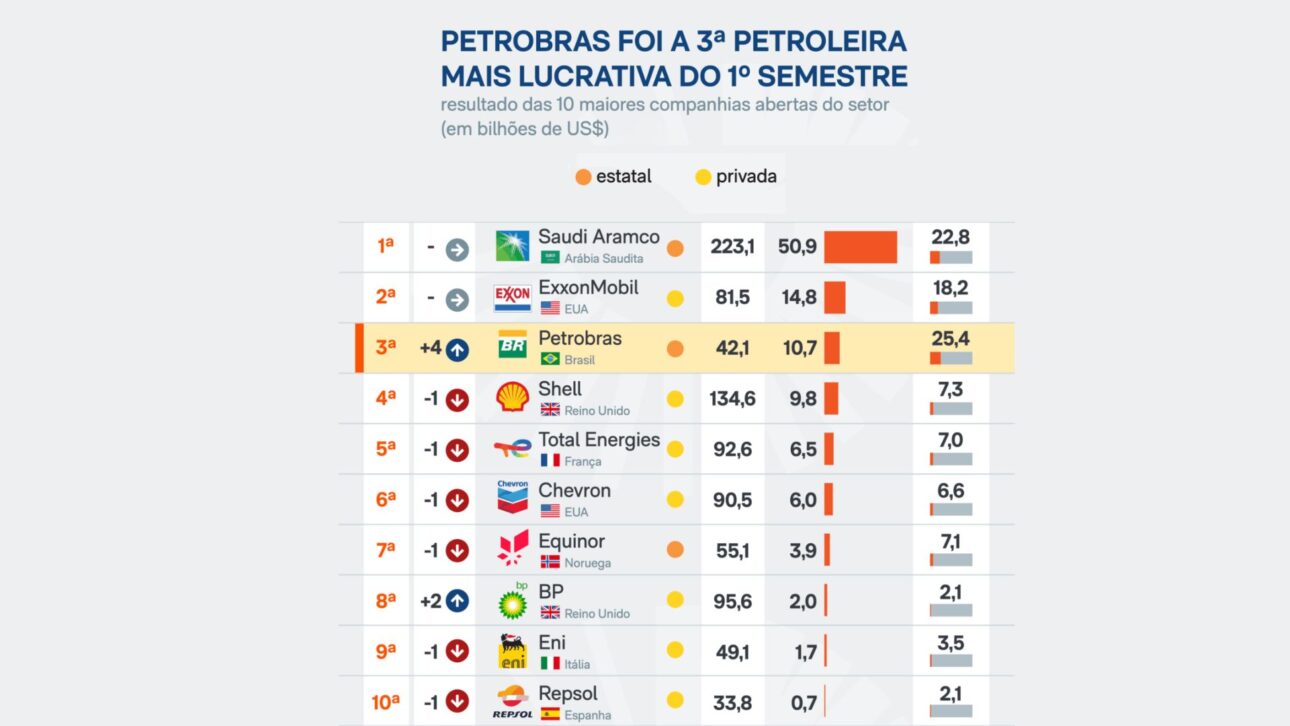
In the international comparison, the state-owned company regained 3rd position among the giants of the sector in the 1st half of 2025.
Saudi Aramco maintained the lead with US$ 22.8 billion in profit, followed by the American company ExxonMobil with US$ 18.2 billion.
Petrobras appeared right after, ahead of Shell (US$ 7.3 billion) and TotalEnergies (US$ 7 billion).
This movement contrasts with the performance of 2024 when the Brazilian company had dropped to 7th place, its worst mark in six years.
This repositioning results from a combination of high production, economies of scale in mature pre-salt projects, and specific factors such as the exchange rate appreciation during the period.
Meanwhile, European groups were affected by the normalization of refining margins and gas seasonality, which helped narrow the distance in the ranking.
Increased Production Supports 2025 Targets
The data from July reinforces the trend of recovery in the extracted volume.
The company has indicated that the performance of the platform park, combined with the entry of new wells and the management of scheduled stoppages, tends to keep production near the top of the annual target.
At this pace, the operational result should remain robust in the second half, as long as there are no large unplanned interruptions.
The share of natural gas followed the oil advance and contributed to the production mix during the period.
At the same time, the investment curve remains focused on higher productivity assets, a strategy that, according to industry executives, reduces unit costs and softens the impact of Brent fluctuations on margins.
Structural Profitability Still Faces Challenges
Despite the operational boost, the compression of adjusted EBITDA indicates that profitability is facing obstacles.
Among the pressure vectors are financial expenses, the update of provisions related to the individualization of areas with oil and gas, and the normalization of margins of derivatives after peaks observed in 2022 and 2023.
In an environment of lower international prices, cost discipline and logistical efficiency gain centrality to preserve cash.
The behavior of the exchange rate remains a key variable. In the semester, the appreciation of the real against the dollar had a positive effect on the financial result line.
However, it is a volatile component and, by definition, non-recurring.
To measure recurring value generation, analysts tend to rely on metrics such as adjusted EBITDA, free cash flow, and leverage, in addition to the execution of production targets.
What to Expect for The Second Half
With the main operations driven by the pre-salt, Petrobras enters the second half of the year with a set of known risks and catalysts.
Among the risks are abrupt changes in Brent, eventual unplanned stoppages, and the evolution of operational costs.
On the positive side, the continuation of the ramp-up of production systems, the operational stability of existing units, and portfolio management could sustain high volumes.
In competitive terms, maintaining the profitability podium will also depend on the performance of rivals.
Aramco benefits from the cost profile and product mix in the Persian Gulf, while ExxonMobil has delivered consistent gains with deep-water and shale projects.
Shell and TotalEnergies have been adjusting portfolios and prioritizing capital returns, moves that could reconfigure the ranking depending on the price cycle.
Summary of Results
The 1st half balance presents a snapshot of operational strength combined with relevant accounting effects.
The reported profit increased and placed Petrobras back among the three most profitable companies in the world, while the adjusted indicators point to a more austere reality, with margins squeezed by weaker Brent and higher expenses.
Meanwhile, the record production supports the narrative of scale and efficiency, creating room for the state-owned company to pursue its 2025 goals even in a less favorable external scenario.
Given these mixed signals, the question for the investor and the reader is straightforward: Will the combination of growing production and cost discipline be enough to keep Petrobras on the global podium if non-recurring effects decrease in the next semester?





-

-

3 people reacted to this.