Portuguese
  Spanish


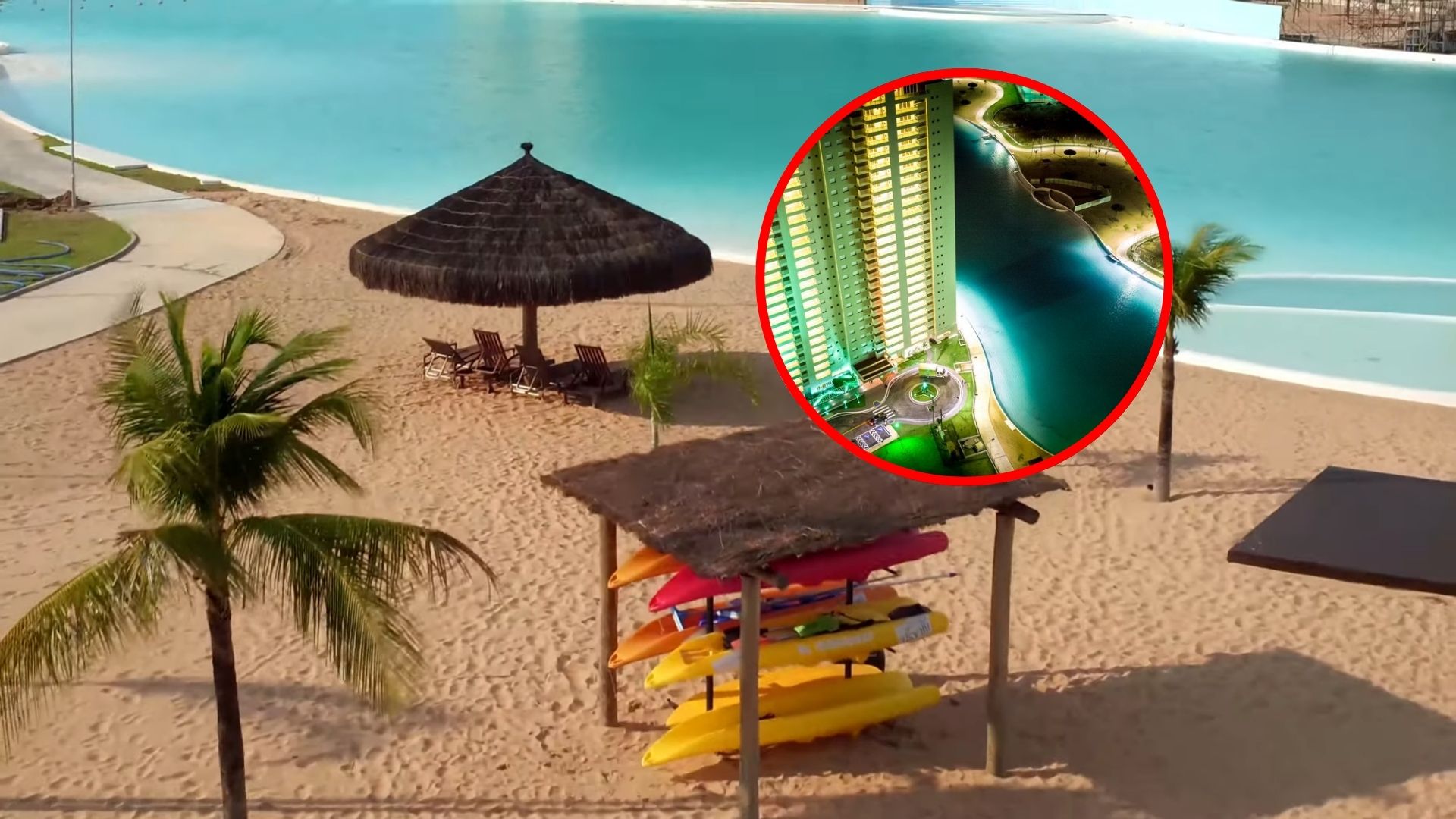

The Largest Pool in Brazil, Installed in a Condominium in Cuiabá, Features Unusual Dimensions, Water Treatment Technology, and an Extensive Artificial Beach, Composing a Leisure Structure That Attracts Interest Due to Its Size and the Solutions Applied.
Giant Artificial Lagoon in Cuiabá
With 20,000 square meters of area and capacity for 47 million liters of water, the largest pool in Brazil is installed at the Brasil Beach Home Resort condominium in Cuiabá (MT).
The artificial lagoon was inaugurated in 2016 and has become the main leisure facility of the development.
The structure has approximately 275 meters in length and 100 meters in width, with sections reaching approximately 3.5 meters in depth, according to data from the condominium.
-
Brazilian Mayor Uses Humorous Sign to Raise Awareness About Littering, Goes Viral on Social Media

-
Award-Winning Japanese Restaurant Reveals It Has Preserved Part of the Same Frying Oil for 66 Years

-
American Youth Transforms from Severe Obesity to U.S. Air Force Enlistment, Losing 90 Kilograms in Two Years
-
11-Year-Old Entrepreneur Sells 60 Homemade Sweets Daily, Mastering Cost Calculation, Social Media Promotion, and Client Negotiation Since Age 7




The volume is equivalent to about 18 Olympic swimming pools.
Estimates presented by the development indicate that the distance from one end to the other can be covered in just over three minutes by swimmers at a steady pace.
The area around the lagoon includes an artificial beach with 12,000 square meters of sand, designed to simulate a coastal environment within the condominium located in the Cerrado region of Mato Grosso.
According to management, the goal is to offer residents rest areas, sandy beach sections, and support points distributed around the water.

Filtration Technology and Operation of the Lagoon
The project was developed by Crystal Lagoons, which is responsible for large artificial lagoons in various countries.
The company adopted its automated filtration, treatment, and recirculation system on site, which uses sensors and continuous chemical control to maintain the transparency and blue color of the water.
According to the company, the method allows for reduced energy and input consumption compared to traditional large volume systems.
The lagoon is used daily by residents for light nautical activities, such as kayaking, stand-up paddleboarding, and pedal boats.
According to residents’ reports, the space also serves as a leisure alternative during periods of high temperatures, common in the capital of Mato Grosso.
Investment and Structure of the Condominium


The Brasil Beach Home Resort received an investment of approximately R$ 170 million during its construction, according to information released by the developer.
The condominium is located in the Ribeirão do Lipa neighborhood and includes residential towers and communal areas distributed around the main lagoon.
International Comparisons and World Records
Crystal Lagoons, responsible for the Brazilian project, has also been involved with large water structures recognized internationally.
Among them are the lagoon at Citystars Sharm El Sheikh in Egypt and San Alfonso del Mar in Chile, both mentioned by the Guinness World Records in different years as some of the largest pools or artificial lagoons in the world.
The lagoon at Citystars Sharm El Sheikh is reportedly the largest ever built by the company.

It occupies about 12 hectares, equivalent to approximately 16 to 17 soccer fields, and uses water drawn from underground saline aquifers, according to official company data.
Filling it completely can take about 22 days, a process that involves pumping, filtering, and continuous recirculation.
Like in other projects by the company, the system used in Egypt was designed to operate with water unfit for human consumption.
Water resource specialists consulted by Crystal Lagoons throughout the development state that the use of brackish or seawater reduces pressure on freshwater sources intended for public supply, provided that treatment and return to the environment meet appropriate environmental standards.
Chilean Case and Supply Method
Before the current record, the title of the largest artificial pool in the world had been attributed to the tourist complex San Alfonso del Mar in Chile.
The lagoon at the Chilean condominium has approximately 1,013 meters in length and occupies about 8 hectares, a size comparable to about 11 soccer fields.
The supply is done with water taken from the Pacific Ocean, which undergoes treatment processes before being returned to the sea within the required environmental parameters.

The Chilean operation includes continuous filtration and monitoring systems, necessary due to the total water volume, which exceeds hundreds of millions of liters.
Maintenance is carried out year-round by specialized teams hired by the development.
Urban Impact and Use of Artificial Lagoons
Large-scale projects like the one installed in Cuiabá follow a trend observed in the real estate market of various countries, where artificial lagoons are used as a central axis of residential and tourist developments.
With the advancement of this model in regions with hot climates and rapid urbanization, experts in cities and housing discuss how structures like these can influence the design of new neighborhoods and urban leisure patterns.
What transformations can these complexes provoke in the way residents utilize communal spaces in large Brazilian cities?