






 Portuguese
  Spanish


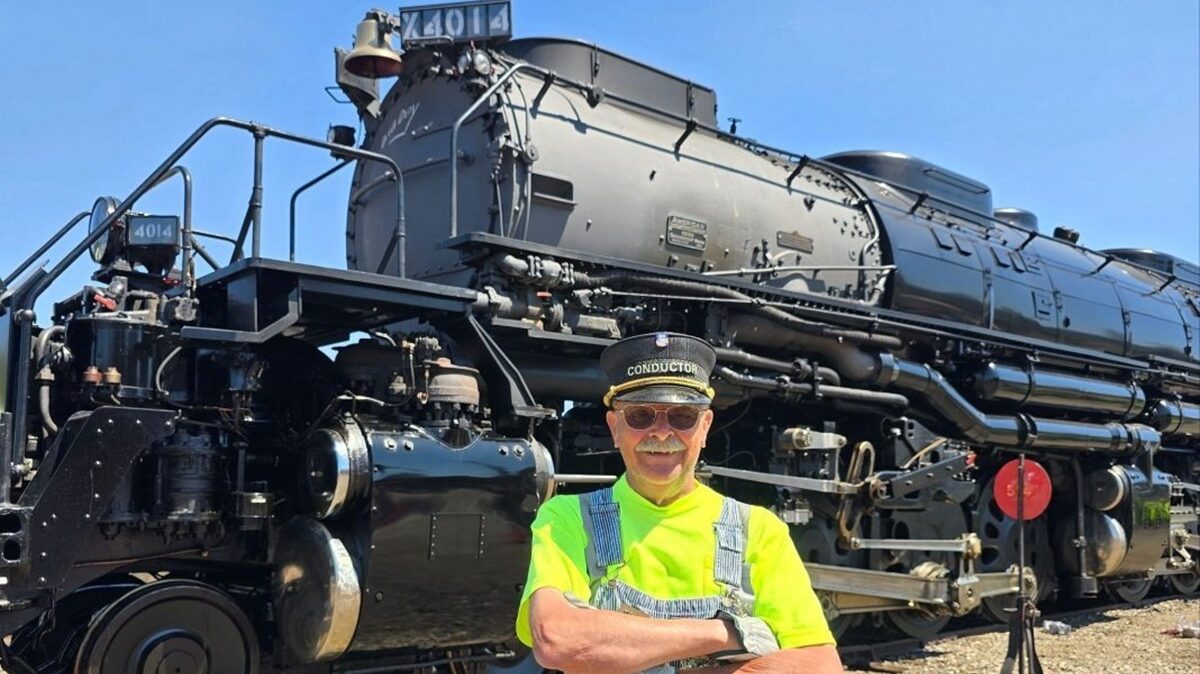


In 1941, the United States presented to the world one of the greatest feats of railway engineering: the Union Pacific Big Boy. With 40.5 meters in length, almost 550 tons, power of up to 7,000 horsepower and a maximum speed of 130 km/h, this steam locomotive revolutionized heavy transport in the mountains, becoming an immortal icon of iron and fire.
When it comes to iron giants, few symbols of railway engineering evoke as much admiration as the Union Pacific Big Boy, considered the largest and most powerful steam engine ever built.
Manufactured in the 1940s, during the golden age of steam locomotives, the Big Boy not only transported colossal loads but also represented the peak of railway innovation before the definitive rise of diesel-electric trains.
The Birth of a Giant
In the late 1930s, the Union Pacific Railroad, one of the largest railway companies in the United States, faced a logistical challenge of enormous proportions: transporting heavy loads, especially coal and agricultural goods, through the steep Wasatch mountains in Utah.
-
Brazil Plans $160 Billion Investment to Revitalize Railways and Reduce Reliance on Long-Distance Trucking

-
Retired Railway Workers in Brazil Preserve Locomotive for 52 Years, Now See It Donated by the Government

-
Railway returns to prominence in Brazil after STF approval: a R$ 25.2 billion project promises to save R$ 9 billion in freight, transport 50 million tons per year, and transform Sinop into a logistics powerhouse for agribusiness.
-
Retired trains leave European tracks and become tons of steel, aluminum, and copper in dismantling yards where recycling exceeds 90%, but batteries, composites, and electronics create a new frontier of railway waste.


Conventional locomotives did not have enough power to tackle the inclines without additional help, which delayed transportation and increased costs.
It was then that Union Pacific commissioned the American Locomotive Company (ALCO) for an unprecedented solution.
The answer came in 1941: the Big Boy locomotive, a steel monster designed to haul hundreds of tons on mountainous routes, eliminating the need for multiple auxiliary machines.

Colossal Dimensions
The Big Boy impresses with proportions that still challenge the imagination today:
- Total Length (with tender): 40.5 meters
- Locomotive Weight: 345 tons
- Total Weight with Tender: 548 tons
- Height: about 5.4 meters
- Fuel Capacity: up to 25 tons of coal
- Water Capacity: more than 95,000 liters
These numbers placed the Big Boy in the category of the largest mobile machines ever built by humanity, rivaling even some warships in terms of weight.
Power and Performance
The secret of the Big Boy lay in its wheel configuration 4-8-8-4, known as “Malet Compound”.
This arrangement included four guide wheels, two sections with eight driving wheels, and four rear support wheels.
This structure allowed the locomotive to better distribute its weight on the tracks and tackle tight curves, even with its monumental size.
The power was also impressive:
- Tensile Force: approximately 135,375 pounds-force (lbf)
- Estimated Power: between 6,300 and 7,000 horsepower (HP)
- Maximum Speed: up to 130 km/h (although the norm was 80 km/h)
With these numbers, the Big Boy could pull consists of over 3,500 tons without assistance from other locomotives. In other words, it was a true freight beast.

The Era of Service
Between 1941 and 1944, ALCO produced 25 units of the Big Boy, numbered from 4000 to 4024. For years, they dominated the mountainous routes between Wyoming and Utah, transporting coal, ore, and various loads.
Despite its brute power, the Big Boy required enormous consumption of fuel and water, as well as constant maintenance.
Still, its reliability and performance became legendary among engineers and machinists. Many claimed there was nothing like it in terms of power and grandeur.
The Decline with the Arrival of Diesel
In the 1950s, the advancement of diesel-electric trains marked the beginning of the end of the steam era. More economical, versatile, and simpler to maintain, diesel engines quickly replaced even giants like the Big Boy.
In 1959, Union Pacific officially retired its units. Some were sent to scrap, but fortunately, eight specimens were preserved in museums and railway parks across the United States.
The Big Boy 4014: A Triumphant Return
Among the preserved locomotives, one gained worldwide prominence: the Big Boy No. 4014. In 2013, Union Pacific announced the complete restoration of this specimen, which had been on display in California since the 1960s.
After a six-year restoration process, the 4014 returned to operation in 2019, becoming once again the largest steam engine in operation on the planet.
Since then, the 4014 has participated in commemorative excursions and special events, attracting crowds of railway enthusiasts and tourists.
Its return symbolizes not only the preservation of a historical icon but also the ongoing fascination these machines ignite.

The Legacy of the Big Boy
More than a colossal machine, the Big Boy represents the pinnacle of steam railway engineering. It was designed to solve a specific problem but ended up becoming an icon of strength and technology.
Its legacy can be measured in three main aspects:
- Engineering: the Big Boy demonstrated how far steam technology could be pushed.
- History: symbolizes the transition between the coal era and the diesel era.
- Culture: it has become a living legend, revered in documentaries, books, and even in collectible miniatures.
The Union Pacific Big Boy was not only the largest steam engine ever built but also the most powerful and emblematic.
Its colossal dimensions, brute strength, and a history marked by challenges and achievements ensure it a place of honor in the global railway memory.
Today, the Big Boy continues to inspire engineers, historians, and train lovers, reminding everyone that the steam era, despite being replaced, left indelible marks on industrial progress and the collective imagination.


