






 Portuguese
  Spanish


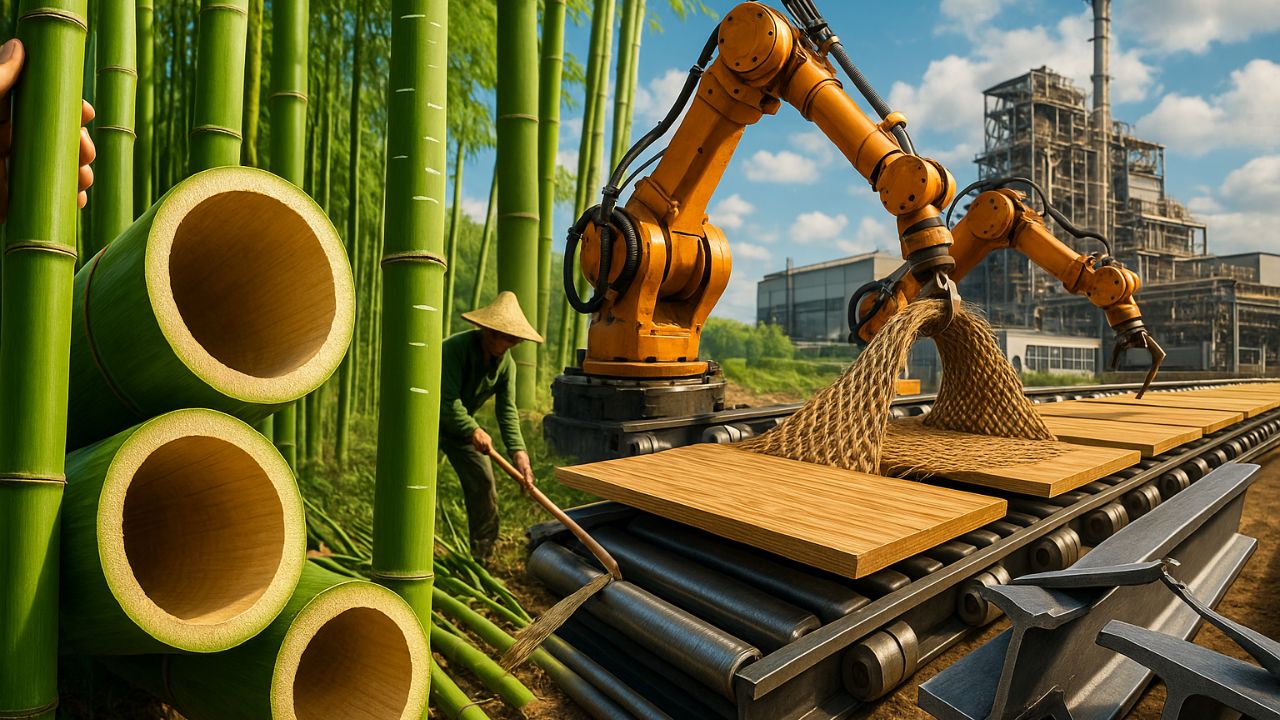


With Ultra-Resistant Fibers and Harvesting That Unites Tradition and High Technology, Bamboo Establishes Itself as the “Green Steel” and Ecological Solution to the Global Plastic Crisis
There is a giant grass with fibers so strong they can be harder than steel, silently transforming the modern industry. We are talking about bamboo, known as nature’s “green steel,” which has shifted from being merely raw material for disposable items to taking center stage in construction, furniture, and textiles. Thanks to its rapid growth and ecological nature, it is gradually replacing wood and plastic in countless fields, generating over US$ 60 billion per year in a global market that continues to expand rapidly.
Few people realize that behind its humble appearance lies a completely modern production chain that combines refined traditional craftsmanship with high-precision machines.
From harvesting, sorting, and treatment to manufacturing and packaging, this plant offers strength, beauty, and sustainability.
-
Workers renovating a playground in northern England uncover 176 World War II bombs buried underground; training artifacts still contained explosives.

-
Brazilian Architect Transforms Waste into Sustainable Homes with Solar Power and Rainwater Systems for 40 Years

-
Security Guard Becomes Doctor at Louisiana Hospital Where He Once Worked, Studied Chemistry Between Shifts

-
Woman Rescued from Luxury Complex in Brazil Worked Without Pay for 55 Years, May Be Entitled to Over $300,000




While plastic waste devastates the environment, from oceans overflowing with bags to microplastics in the food chain, bamboo emerges as a promising alternative to relieve this burden and diversify rural income, especially in Asian countries.
The Record Growth and the Harvesting Challenge

One of the main reasons why bamboo is so sought after is its extraordinary growth rate. Without needing ideal conditions, some species can grow up to 91 cm in just 24 hours, which is approximately the height of a 4-year-old child.
As the fastest-growing plant on Earth, it has an ultra-short regeneration cycle that does not require replanting after harvesting, making it an ideal candidate to replace traditional resources.
Despite being praised as green gold, large-scale harvesting presents unique challenges. Most bamboo grows on steep slopes and rocky terrain where machines can barely reach. In these locations, farmers use traditional techniques, cutting each stalk with curved blades sharp as scalpels.
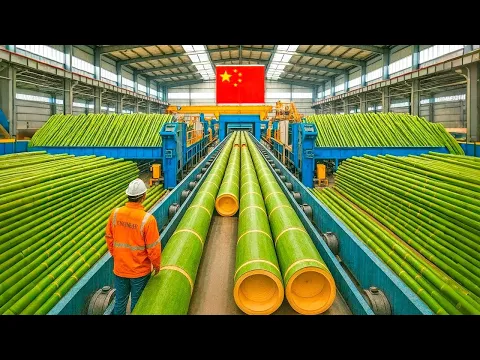
In flat areas, technology has changed the game with specialized harvesters that look like a cross between a combine and a hydraulic crane. These machines process over 150 poles per hour, cutting dense clusters in seconds and preserving freshness for processing.
From Rigorous Selection to High-Speed Shaping
From forests, the raw material goes to sorting stations where the industrial journey really begins. The selection of bamboo has become the first gateway to quality control, where workers detect cracks or mold that machines may not notice.
For the production of items like disposable chopsticks, the process requires a clean and precise cut. Machines act like industrial scalpels, slicing the stalks into uniform pieces, while resistance sensors adjust the pace when encountering harder nodes.
After cutting, surface refinement comes into play. A sanding system with rotating drums ensures that each piece is smooth and free of splinters.
The drying process is equally critical, with temperatures maintained between 70 and 90ºC to extract moisture without causing cracks. In advanced lines, sensors turn off the heating at the exact moment the ideal dryness is reached, preventing mold and ensuring the durability of the final product before automated packaging.
State-of-the-Art Technology for Durable Products and Paper
For reusable products like toothbrushes and utensils, the technical requirements are even greater. Programmed CNC machines adjust the cut for exact curves, while high-speed fabric wheels polish the bamboo to a silky finish, similar to polished steel, eliminating the need for chemical coatings.
Beyond utensils, the plant feeds the paper industry. Giant shredders grind the stalks into cellulose fibers that, after treatment with biological enzymes and chlorine-free bleaching, result in paper with high strength and brightness.
The versatility of the material reaches its peak in the manufacture of furniture and flooring. At this stage, bamboo reveals the strength of its vertical grains. The stalks are treated, dried, and pressed under high pressure and heat, binding the fibers with the natural resin of the plant itself.
The result is dense panels as strong as solid wood, which are then shaped by sensor-guided cutters. From single-use items to building materials, this grass proves that it is possible to combine industrial speed with sustainable consumption.
Do you believe that even the smallest materials, like this grass, can create significant changes for the future of the planet?


Boa tarde.
Bambu muito bonito.
Empresas interessadas entrar em contato.
Preciso vender estes bambus
Tenho Hambu na minha propriedade no Estado de Gouas.
Gostaria de contato de quem compra o Bambu.
Preciso vender eles.
Facil ascesso.
Terreno plano
Simplesmente maravilhosa solução para substituir a madeira e o plástico