






 Portuguese
  Spanish
 3 min of reading


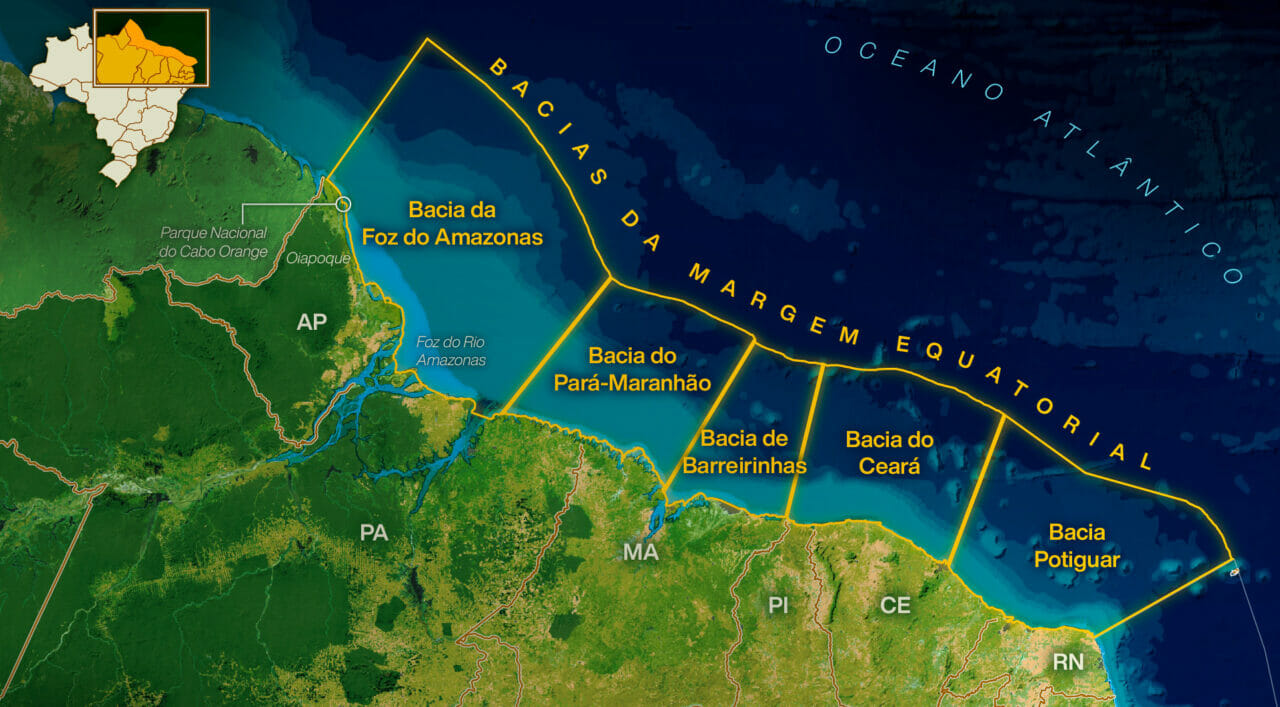
Despite the Billion-Dollar Investments in Oil and Gas, Exploration in the Equatorial Margin Faces Challenges in Obtaining Environmental Licenses and Drilling a Well in Deep Water in the Amazon River Mouth Basin.
The Brazilian Equatorial Margin has stood out as a promising exploratory frontier, attracting significant attention and investments for the oil and gas sector in the country. According to the National Agency of Petroleum, Natural Gas and Biofuels (ANP), the region may receive investments worth R$ 11 billion by 2027, becoming a unique opportunity to leverage the national oil industry.
Promising Potential in the Equatorial Margin
In comparison, this amount surpasses the total planned investment for exploratory campaigns in other areas of the country, estimated at R$ 8.5 billion for the same period.
These figures reinforce the potential of the Equatorial Margin as one of the main areas of interest for oil and gas exploration in Brazil.
-
Oil production grows in Rio, but reserve replacement raises a warning sign

-
Petrobras is expected to complete the drilling of the Morpho well in the Foz do Amazonas in August 2026, the first well in the Equatorial Margin, an oil frontier that the ANP estimates at more than 30 billion barrels and could redraw the map of Brazil.

-
Oil returns to the center of concerns with tension between the US and Iran

-
IEA reduces forecast for global oil demand in 2026 after impacts of the Middle East crisis


However, the scenario for these investments is not entirely devoid of challenges.
Exploratory activities in the region have faced obstacles related to environmental issues, especially regarding the obtaining of environmental licenses for drilling.
The Brazilian Institute of Environment and Renewable Natural Resources (Ibama) recently denied Petrobras’s license application to drill a well in deep water in the Amazon River Mouth Basin in Amapá, citing technical inconsistencies.
Environmental Challenges and the Future of the Oil and Gas Sector in Brazil
The Minister of the Environment, Marina Silva, and Ibama have advocated for the necessity of a Sedimentary Area Environmental Assessment (AAAS) in the region before proceeding with exploratory activities.
This demand aims to ensure that exploration operations are conducted sustainably and in compliance with environmental guidelines.
Despite the challenges, ANP projects the drilling of 91 wells in Brazil between 2023 and 2027, with 63 of them in onshore basins, primarily in the Parnaíba and Amazonas basins, and another 28 in offshore waters, including eleven wells in the Equatorial Margin.
This indicates that the region has the attention of companies in the sector, which are willing to invest in its exploration.
The ANP’s general director, Rodolfo Saboia, at a seminar on the exploration landscape in Brazil, emphasized that the Equatorial Margin has a potential comparable to that of Guyana and West Africa, where significant oil and gas discoveries have been made.
He highlighted the importance of leveraging this window of opportunity to boost the exploration of new energy production frontiers in the context of the global energy transition.
Diversification, Development, and Energy Security
Diversifying exploration areas is essential to ensure the national supply of oil and gas and maintain the country’s energy independence.
Moreover, investments in the oil and gas industry have the potential to generate jobs and foster economic development in different regions of Brazil.
Therefore, overcoming environmental challenges in the Equatorial Margin is crucial for the progress of the Oil and Gas sector in Brazil.
By establishing a balance between the exploration of natural resources and environmental preservation, the country can solidify its position as a significant producer and exporter of Oil and Gas.
Driving economic growth and ensuring energy security in the future.







Be the first to react!