






 Portuguese
  Spanish


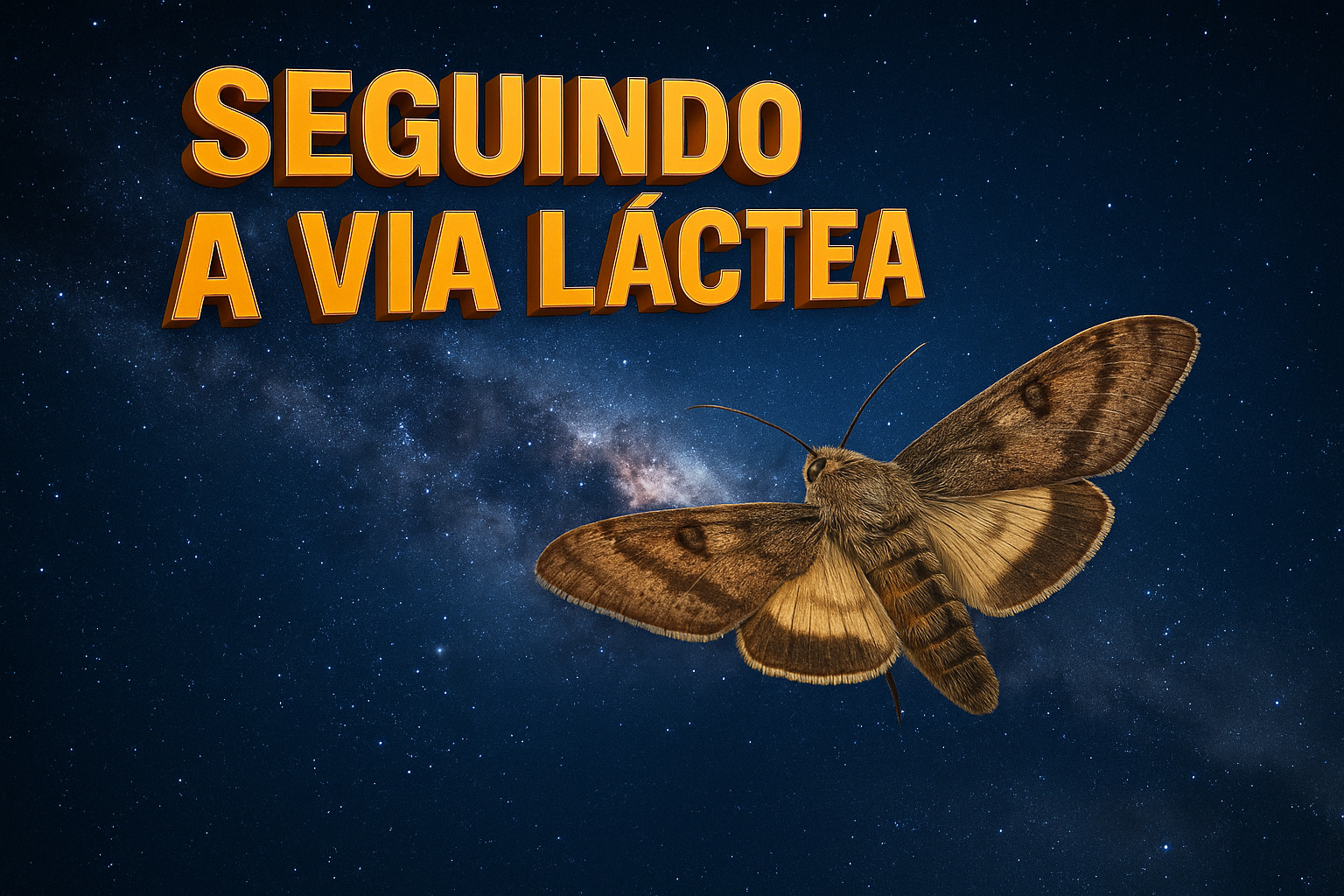


Another Surprising Scientific Discovery Was Revealed in June 2025: An Australian Night Moth Can Navigate at Night Using the Milky Way as a Guide.
Researchers from Lund University in Sweden published a study on June 18, 2025, in the scientific journal Nature revealing that the Bogong moth (Agrotis infusa) can navigate up to a thousand kilometers by combining starlight with the Earth’s magnetic field.
Researchers Discover How Moth Uses Stars for Navigation
Every summer, the Bogong moth departs from the east coast of Australia. Night after night, it flies to the Australian Alps, where it finds refuge in caves, away from the intense heat.
In the autumn, it returns to its original location, where it reproduces and completes its life cycle.
-
NASA Plans to Repurpose Mars Rover for Lunar Mission, Sending a 1-Ton Nuclear-Powered Vehicle to Explore the Moon’s South Pole Without Solar Dependence

-
Early Humans Made Beds Nearly 200,000 Years Ago in African Caves, Study Reveals

-
Japanese Smart Bike Detects Cyclist’s Intent to Turn and Potential Falls
-
METTL3 Protein Found to Play Crucial Role in Breast Cancer Metastasis, Surprising Scientists


Although scientists already knew that the insect used the Earth’s magnetic field for orientation, the new study revealed that stars play an essential role in this journey.
Experiment Reveals Stellar Navigation
Neurobiologist David Dreyer and entomology professor Eric Warrant led the research.
The team placed the moths in a flight simulator equipped with projections of the night sky. By doing so, they observed how the moths reacted to the absence or manipulation of the magnetic field.
When the scientists eliminated the magnetic field, the moths continued to fly in the correct direction, relying solely on the stars. When they rotated the projected sky by 180 degrees, the insect immediately adjusted its route. On the other hand, when displaying a false sky, the flight became disoriented.
This behavior proved that moths not only see a real celestial map but also use it with great precision.
Bogong Moth Impresses the Scientific Community
Eric Warrant highlighted that the Bogong is the first known invertebrate to use stars for long-distance navigation.
Prior to this, only the dung beetle had demonstrated similar behavior, but over shorter distances.
Now, the Australian moth surprises with a capability comparable to that of the monarch butterfly, famous for migrating between the United States and Mexico using the sun as a guide.

Discovery Opens New Paths for Science
This ability impresses scientists because it requires the insect to continuously adjust its navigation, as the sky changes during the night due to Earth’s rotation.
Experts believe that this discovery will expand knowledge about animal navigation mechanisms.
Furthermore, new research may arise, inspired by how the Bogong moth combines visual and magnetic information for orientation.
What Is the Impact of This Discovery for the Future?
The Bogong moth demonstrates that even small invertebrates have developed sophisticated strategies to survive in complex environments.
This type of behavior not only intrigues scientists but may also influence future technologies based on natural navigation.
While new research has yet to emerge, the scientific world is already celebrating this revelation, which places the Bogong moth among the most notable nocturnal travelers in nature.
And you, what do you find more impressive: the moth’s precision in following the stars or its ability to adjust its route as the sky changes? Share your opinion!





Observando a natureza, aprendemos tudo.
A engenharia de Deus