






 Portuguese
  Spanish
  5 min of reading
  0 comments


Discover How The Renewable Energy Market Transforms Consumption, Drives The Economy, And Influences The Future Of Your Home And Business Sustainably And Affordably.
The renewable energy market has grown significantly in recent decades and, therefore, shapes the way we consume and produce energy.
This transformation goes beyond a simple technological trend; it deeply changes the way society understands and uses natural resources.
Thus, much more than solar panels or wind turbines, this market involves innovation, economy, environmental responsibility, and new business opportunities.
-
Brazilian scientists are simultaneously advancing two research projects on clean hydrogen and driving solutions that could transform the energy matrix, enhance industrial competitiveness, and accelerate large-scale emission reduction targets.

-
Advancement in renewable energy: A R$ 150 million project launched by Petrobras and Finep aims to create state-of-the-art electrolyzers for green hydrogen, strengthening national research and preparing Brazil to compete in a billion-dollar energy market.
-
Illiterate or semi-literate grandmothers were trained to repair solar systems, open rural workshops, and light up homes that still depended on kerosene.
-
The world has bet on green hydrogen as the fuel of the future, but now faces the side effect: producing 1 kilogram requires about 9 liters of ultrapure water, and the largest projects on the planet are precisely in the driest regions of the Earth, where water is already scarce for people.





To understand this change, it is important, first of all, to look at the history of energy production.
Since the Industrial Revolution, which began in the 18th century, the world’s energy matrix has long been based on non-renewable sources such as coal, oil, and natural gas.
These fossil fuels powered factories, vehicles, and plants, driving global economic growth.
As explained by the United Nations Environment Programme (UNEP), this dependence caused significant environmental impacts, such as the emission of greenhouse gases and the pollution of natural resources.
Moreover, the traditional model of energy production has proved, over time, unsustainable and vulnerable to the political and economic crises affecting fossil fuels.
Therefore, from the second half of the 20th century, countries began to diversify their energy matrices, seeking security and energy independence.
In this scenario, renewable sources gained prominence because they offer a local and sustainable alternative for energy generation.
The Transition To Clean Energy Sources
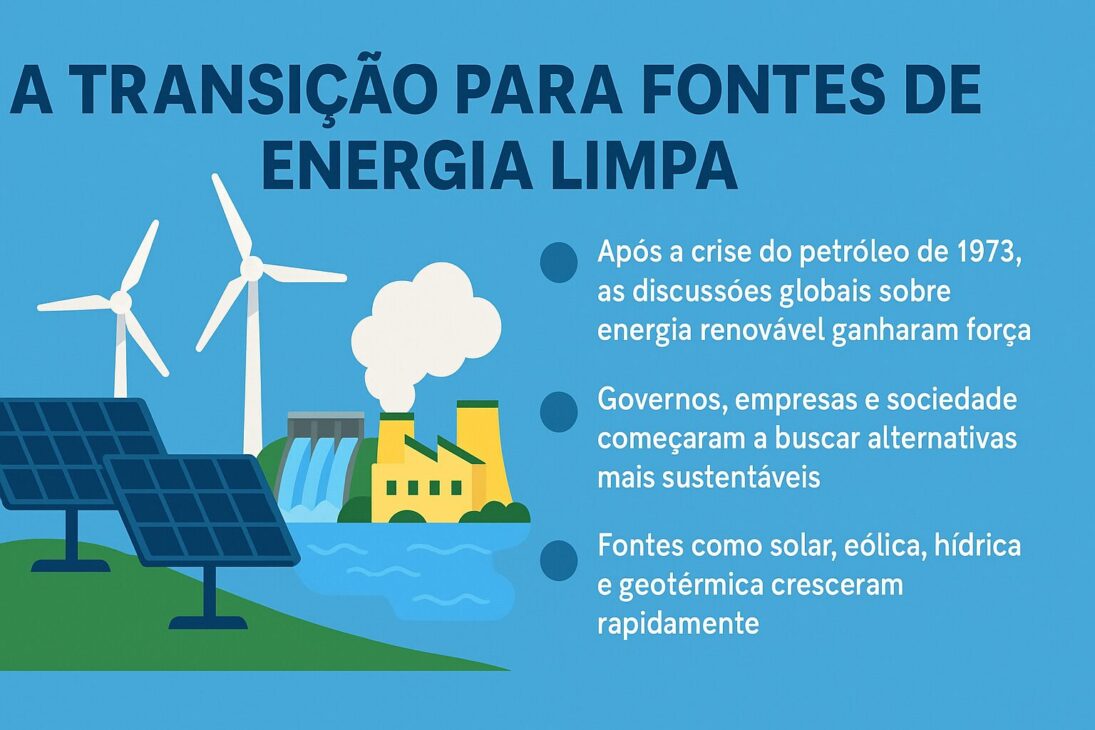
In the decades following the 1973 oil crisis, the increase in environmental damage caused by the intensive use of fossil fuels drew global attention.
As a result, discussions about the environment and renewable energy gained traction at international conferences, such as the Eco-92 (United Nations Conference on Environment and Development), held in Rio de Janeiro in 1992.
According to the Intergovernmental Panel on Climate Change (IPCC), these meetings accelerated policies and incentives for clean energy sources.
Thus, governments, companies, and society began to seek more sustainable alternatives, and the renewable energy market grew rapidly.
Sources such as solar, wind, hydropower, biomass, and geothermal ceased to be viewed merely as environmentally friendly options, becoming economically viable.
Although initial costs were high, technological advances, public and private incentives, and scientific research allowed for significant cost reductions.
According to the International Renewable Energy Agency (IRENA), between 2010 and 2020, the cost of solar photovoltaic energy fell by more than 80%, making it one of the most competitive sources in the global market.
Currently, the renewable energy market goes beyond large plants or government projects. Families are installing solar systems in their homes, small and medium-sized enterprises are investing in clean sources to reduce expenses, and entrepreneurs are creating innovative solutions.
Moreover, technological evolution accelerates this transformation.
New batteries and storage systems facilitate the use of generated energy, while digitalization and the use of artificial intelligence optimize consumption and distribution, making the system more efficient, as highlighted by IRENA in its recent reports.
How The Renewable Energy Market Affects Daily Life
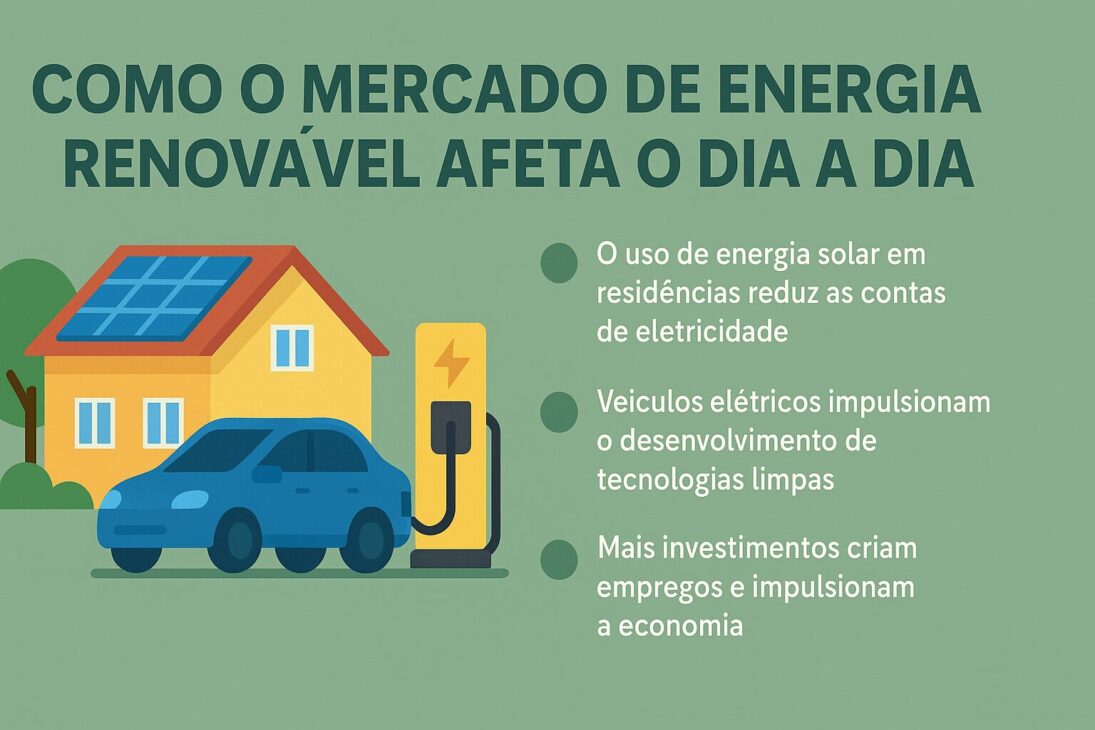
The impact of this market is more present in daily life than one might think. When a home generates electricity through solar panels, for example, the electricity bill can drop drastically.
Additionally, these systems have high durability and require little maintenance.
In regions where traditional energy is unstable or costly, such as rural areas or remote communities, renewable sources represent an efficient and sustainable solution, as indicated by studies from the Ministry of Mines and Energy of Brazil.
In business, the benefits are even more evident. Companies that invest in renewable energy save money and enhance their brands with consumers, who are increasingly attentive to sustainable practices.
The image of a company committed to the environment can be decisive for the customer’s choice, a trend pointed out by market research and sector reports from IRENA.
Moreover, companies gain predictability in costs, energy independence, and the ability to sell surplus generated energy, as explained by the Ministry of Mines and Energy.
Finally, adopting renewable energy encourages conscious consumption. When consumers and companies realize the investment to generate their own energy, they value efficient use more, reducing waste.
Economic Impact And Job Creation
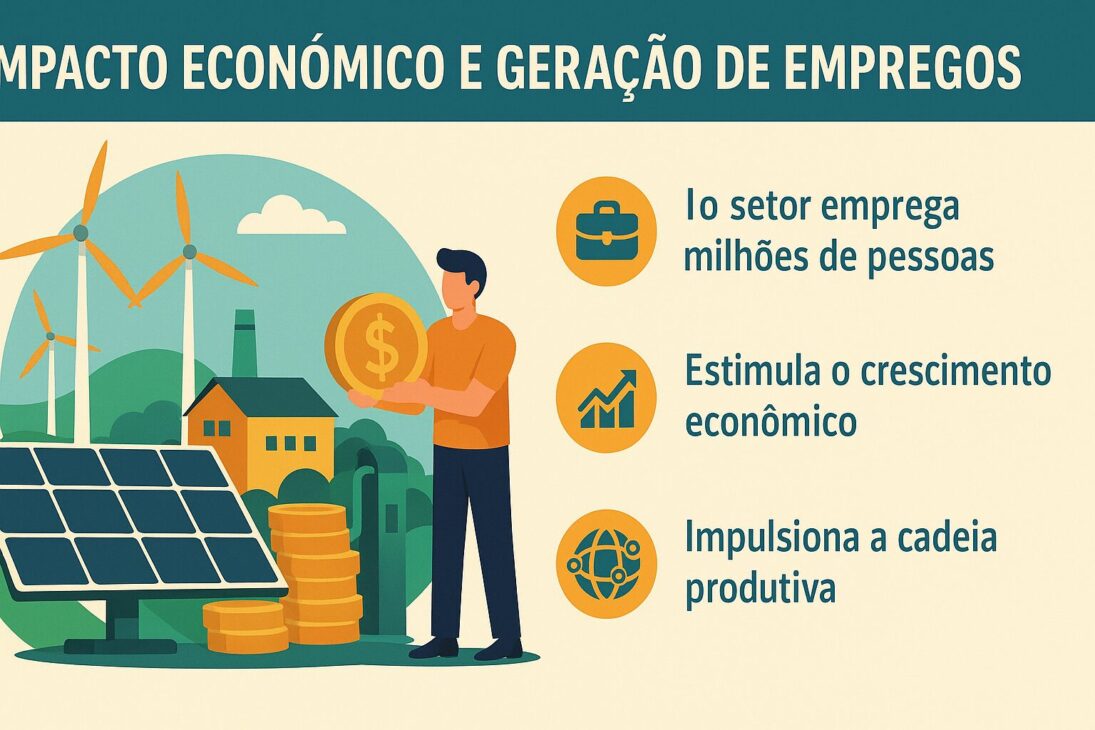
The renewable energy market generates jobs and drives the global economy. According to the International Renewable Energy Agency (IRENA), in 2023, the sector employed more than 12 million people globally, a number that continues to grow.
In Brazil, the potential to generate solar and wind energy is enormous, attracting national and international investments. According to data from the Ministry of Mines and Energy, the country reached, in 2024, the mark of 25 GW installed in solar energy, reflecting the rapid advancement of the sector.
Thus, regions with high solar incidence, such as northeastern Brazil, have become centers of clean energy, boosting regional development and creating new economic opportunities.
In addition to direct jobs, the sector stimulates the production chain, involving manufacturing of equipment, engineering services, research, and development. Therefore, the economy benefits widely, promoting the sustainable growth of the country.
A New Energy Model Is Under Construction
However, the scenario is promising, and opportunities continue to grow.
The energy transition is already progressing, and the renewable energy market plays a central role in this process.
It represents not only a cleaner alternative but also a new way of thinking about consumption, production, and the future of energy in the world.
The impact appears in the reduction of costs, in the valuation of properties and brands, in job creation, in environmental preservation, and in the creation of a more just and balanced system.
Those who wish to keep up with this transformation — whether consumer, entrepreneur, or investor — must stay informed and seek ways to participate actively.
Finally, adopting sustainable practices, investing in renewable sources, and supporting public policies that encourage this sector are concrete steps within everyone’s reach.
After all, the renewable energy market is not just a technological issue, but a choice for the future — and that future has already begun.










Be the first to react!