






 Portuguese
  Spanish
  8 min of reading
  0 comments


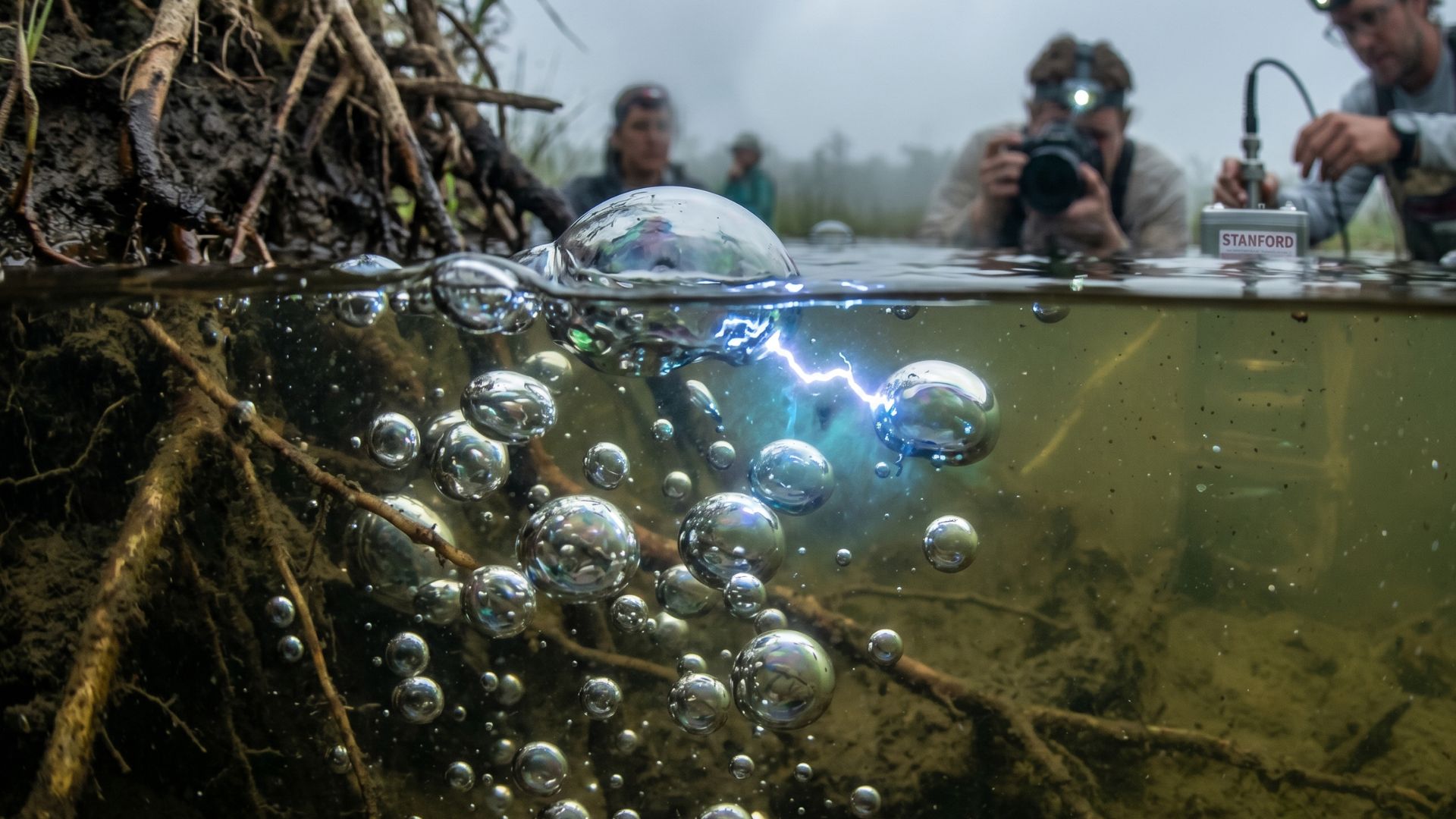
Stanford study published in PNAS explains will-o’-the-wisp: microlightning between methane bubbles in water can ignite flames in swamps and pave the way for new methane destruction technologies.
For centuries, those who crossed swamps and cemeteries at night reported bluish spheres of light floating over the mud. The Welsh poet Dafydd ap Gwilym described the phenomenon in 1340 as “twisted tongues of fire in every valley”, Isaac Newton mentioned the flames in Opticks in 1704, and Shakespeare used the will-o’-the-wisp as an omen of death. In September 2025, a team led by Professor Richard Zare from the Stanford University Department of Chemistry, published an explanation for the phenomenon in the journal Proceedings of the National Academy of Sciences: swamp flames would be ignited by microlightning, spontaneous electrical sparks that jump between microscopically charged methane bubbles in water.
The discovery doesn’t just solve an ancient folklore mystery. The same mechanism could pave the way for destroying atmospheric methane, one of the most potent greenhouse gases, using water, microbubbles, and spontaneous electrical discharges, without resorting to conventional combustion.
Methane is a greenhouse gas up to 80 times more potent than CO₂ in the short term
Before understanding the role of microlightning, it’s necessary to understand why methane concerns climate science so much. Carbon dioxide dominates the debate for being the most abundant greenhouse gas, but methane has a much more intense short-term impact.
-
Brazilian mechanic invented a lamp made from a PET bottle during the 2001 blackout, the idea turned into an NGO present in 30 countries and has already illuminated 40,000 people in 200 communities without electricity in Brazil.

-
The first trillionaire in history, Elon Musk, opens his wallet and pays the equivalent of R$ 306 billion, or US$ 60 billion, for the artificial intelligence programming startup Cursor, in yet another AI investment made through SpaceX, his rocket company.
-
The future of computers may change sooner than expected: Amazon bets on commercial quantum computing within seven years, while qubits, the Ocelot chip, AI, and scientific simulations take center stage in the new race among big techs.

-
What does a Covid-19 vaccine have to do with heart attack and stroke? A study with over 1 million veterans reveals an unexpected link between immunization, the heart, and seniors over 75 years old.




In the first 20 years after being emitted, methane traps heat in the atmosphere with approximately 80 times greater potency than CO₂ for the same mass. Over a 100-year horizon, this potential drops to about 28 times, still a very high climate value.
Methane comes from rice paddies, landfills, livestock farming, oil and gas extraction, swamps, tundras, and ocean floors. Atmospheric methane concentration has tripled since the pre-industrial era, and removing this gas from the atmosphere remains a technological challenge.
Microlightning in methane bubbles explains the will-o’-the-wisp of swamps
The traditional hypothesis for the will-o’-the-wisp stated that methane released by decomposing organic matter found some source of ignition, perhaps phosphine or another flammable gas. The problem is that no explanation stood up well to experimental tests.
The Stanford team started from previous studies on electrically charged water droplets. In these experiments, researchers observed that droplets with opposite charges, when approaching each other, could produce small sparks.

The question became direct: could methane bubbles in water do the same? To test this, scientists created methane microbubbles in a container with water and filmed the process with high-speed cameras, capable of recording 24,000 frames per second.
High-speed cameras recorded electrical discharges between microbubbles
The result observed in the laboratory was clear. As methane bubbles accumulated in the water, electrical sparks appeared, jumping between adjacent bubble surfaces.
When two bubbles with opposite charges approached, electrons jumped from one surface to another, producing an electrical discharge visible in the camera’s recordings. This microlightning carries enough energy to initiate chemical reactions in nearby methane.
The study published in PNAS presented the first direct experimental evidence of the mechanism. It’s not just a hypothesis: the discharges between methane bubbles were filmed under reproducible laboratory conditions.
Methane bubbles become charged due to the gas-water interface
The explanation for the electrical charging of bubbles lies in the very structure of water. On a microscopic scale, water contains positive and negative ions in constant motion.
When a gas bubble forms within water, the interface between liquid and gas creates charge separation. Ions of one sign concentrate in certain regions of the bubble, while other areas acquire an opposite charge.
In microbubbles, this separation becomes more relevant because the surface-to-volume ratio is very high. Each methane microbubble then functions as a small electrically charged structure, capable of generating sparks when it encounters another bubble with an opposite charge.
Water can extinguish fire, but it can also generate sparks at the microscale
Richard Zare summarized the paradox with a direct statement: when there’s a fire, water is used to put it out, but water droplets can create fire. The statement seems contradictory, but it is technically accurate.
Water does not burn. What happens is the generation of electrical discharges at the interface between water and gas, especially when methane microbubbles accumulate in humid environments.


This helps explain why will-o’-the-wisps appear in swamps, flooded cemeteries, and soils saturated by organic decomposition. It’s not enough to have methane: it’s the presence of water and charged microbubbles that creates the electrical condition for ignition.
What Isaac Newton couldn’t know about swamp flames
The will-o’-the-wisp has appeared in scientific literature for centuries, but always as a curiosity without a satisfactory explanation. Newton described faint flames in Opticks, but he did not have instruments capable of observing the process on a microscopic scale.
For a long time, phosphine was one of the most repeated explanations. The idea was that this gas, produced by the decomposition of organic matter containing phosphorus, could spontaneously ignite and light the methane.
Later experiments, however, showed that this explanation was insufficient. The Stanford study advanced because it replaced chemical speculation with visual recording: the 24,000 frames per second camera made an electrical discharge visible that was previously invisible.
Stanford’s discovery could pave the way for destroying methane without combustion
The discovery would be relevant even if it only explained the will-o’-the-wisp. But the climatic implication made the study even more important: if methane microbubbles in water produce sparks that oxidize the gas, perhaps it’s possible to reproduce this process on an industrial scale.
The idea would be to create systems capable of generating high-density methane microbubbles in water, artificially replicating what happens in swamps. Thus, spontaneous discharges could destroy part of the methane before it reaches the atmosphere.
Zare formulated the central question: will it be possible to scale the process and make it commercial and industrial? If the answer is positive, sources such as landfills, waste lagoons, coal mines, and gas leaks could gain a new mitigation route.
Microlightning could be an alternative to flares used to burn methane
Today, one of the most common ways to eliminate concentrated methane is flaring. This process converts methane into CO₂ and water, reducing the immediate climatic impact, as methane is much more potent than carbon dioxide.

The problem is that flaring still generates carbon emissions and requires combustion equipment. Furthermore, not all diffuse sources of methane are easy to capture and burn efficiently.
A system based on microbubbles and water could offer a different route. The promise would be to destroy methane without flame, without direct combustion, and possibly with less generation of climate byproducts, but this still needs to be proven outside the laboratory.
Microlightning can also help explain reactions linked to the origin of life
Richard Zare had already been studying spontaneous chemical reactions in microscopic water droplets. In March 2025, his team published another paper showing that droplets in contact with gases from the primitive atmosphere could produce complex organic molecules.
By spraying water into a mixture of methane, ammonia, nitrogen, and CO₂, researchers observed the formation of compounds such as glycine, an amino acid, and uracil, a component of RNA. The process occurred without extreme heat and without conventional lightning.
This line of research challenges part of the classic interpretation of the 1953 Miller-Urey hypothesis. Instead of relying solely on rare lightning in primordial oceans, micro-lightning between droplets and bubbles could constantly occur where water and gas meet.
Swamps can destroy some methane before it reaches the atmosphere
The discovery can also help explain a finding observed by climatologists: methane emissions from natural swamps appear lower than some models predicted based on gas production in sediments.
Part of this difference is attributed to methanotrophic bacteria, microorganisms that consume methane in soil and water. But another part was not yet fully explained.
The hypothesis suggested by Zare’s work is that micro-lightning can destroy some methane within the water, before the bubbles reach the surface. If this is confirmed in the field, climate models will have to consider a natural methane self-cleaning mechanism.
Climate models may not capture localized methane destruction
Models used by climate agencies calculate how much methane is emitted by different sources and how much is destroyed by natural mechanisms. The main known atmospheric process is the reaction with hydroxyl radicals in the troposphere, which occurs slowly.
What these models did not capture was the possibility of localized methane destruction before atmospheric emission, within water columns, by micro-lightning between bubbles.
This does not eliminate the climate problem, but it can refine inventories and strategies. If certain natural sources have greater self-cleaning than previously thought, mitigation efforts can be more precisely directed towards human sources, such as livestock, landfills, and oil.
Brazil could apply micro-lightning technology to methane from landfills and agriculture
Brazil is among the major global methane emitters, mainly due to cattle ranching, urban landfills, and burning in the Cerrado and Amazon. The country has over 200 million head of cattle and a large generation of organic waste.
Livestock farming accounts for a significant portion of Brazilian greenhouse gas emissions, with emphasis on enteric methane produced in cattle digestion. Swine and poultry waste lagoons also release methane in significant concentrations.
If micro-lightning technology is scalable, waste lagoons and landfills would be natural candidates. Both combine organic matter, water, and the production of methane-rich biogas, creating conditions similar to those the research seeks to artificially reproduce.
What still needs to be proven about micro-lightning and methane destruction
The study published in PNAS demonstrated the mechanism in the laboratory, but there is a large gap between the experimental vessel and a field technology. The actual conversion efficiency still needs to be precisely measured.
It is also necessary to prove how much methane is destroyed per micro-lightning cycle, what byproducts are formed, and how to maintain sufficient microbubble density on a large scale. These points are decisive for any industrial application.
The glow of the micro-flames itself was not visibly reproduced with the naked eye in the laboratory. What already exists is proof of concept: the discharges occur, have been filmed, and can initiate chemical reactions with methane.




Be the first to react!