






 Portuguese
  Spanish


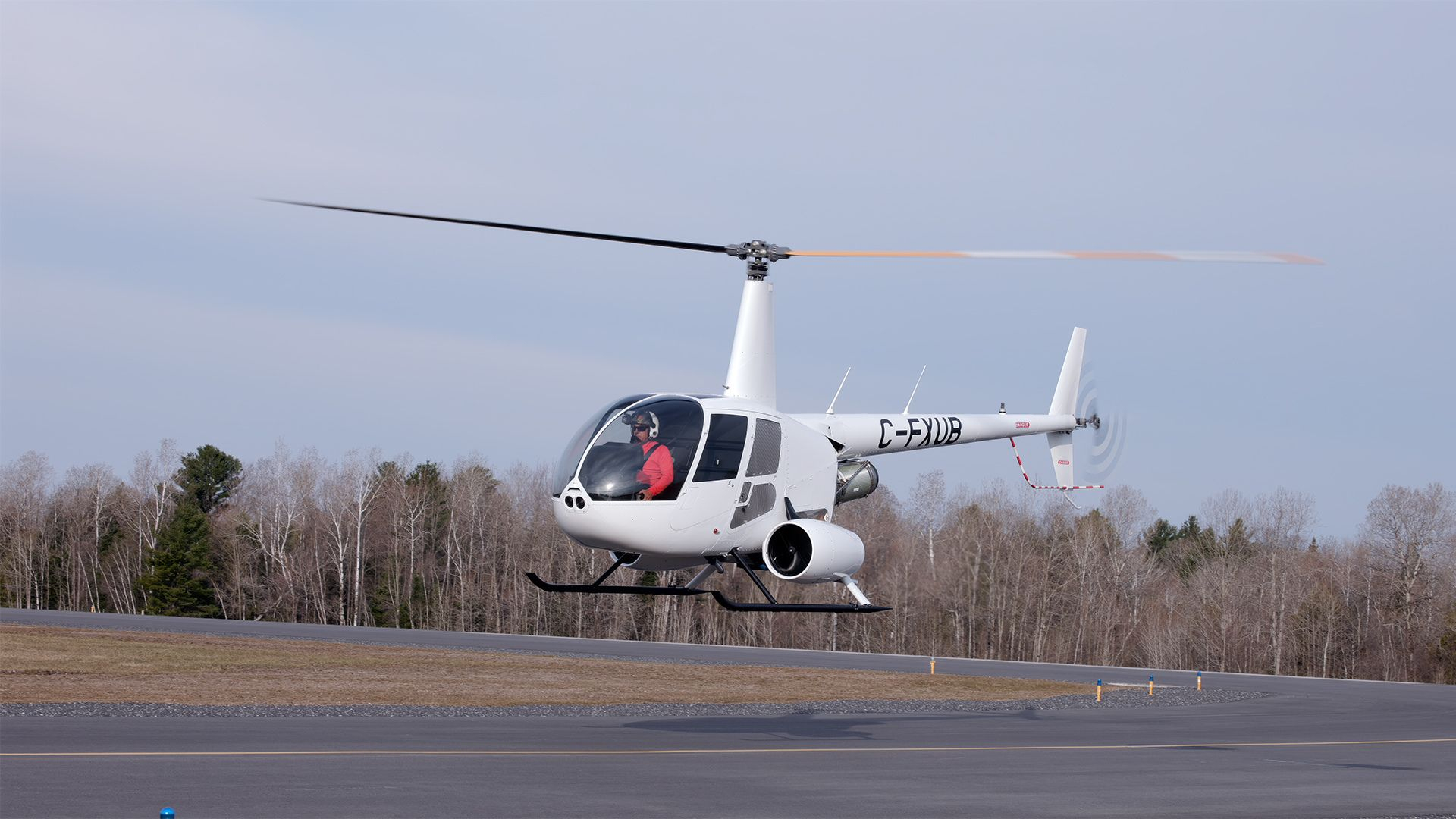

First hydrogen-powered manned electric helicopter completed closed-circuit flight in Canada, validating PEM fuel cell technology, green hydrogen, and focusing on future medical operations, organ transport, emergencies, and emission-free regional logistics.
Unither Bioélectronique’s hydrogen-powered electric helicopter completed the world’s first manned closed-circuit flight at Roland-Désourdy Airport in Bromont, Quebec. The test took place on April 10, 2026, and used green hydrogen with zero emissions.
Test pilot Ric Webb conducted the full demonstration of takeoff, climb, circuit flight, and landing. The aircraft used was a Robinson R44 modified to operate with an electric architecture based on a proton exchange membrane fuel cell.
Flight conducted in Canada
Unither Bioélectronique conducted the test under an experimental license during a mission focused on operational validation of the technology. The electric helicopter progressed from a basic hover flight to a full airport traffic circuit.
-
China Develops Custom 140-Ton Electric Mining Truck with 770 kWh Swappable Battery, Deploys 290 Units in Xinjiang’s Largest Zinc Mine

-
Meta to Launch Arena, a New Prediction App Targeting 3.56 Billion Users, Competing with Polymarket and Kalshi

-
Scientist Challenges Famous Human Evolution Theory, Argues Homo Sapiens Evolved Gradually Over Thousands of Years
-
15-Year-Old American Builds Ocean Generator with PVC Pipe and 3D-Printed Propeller for $12, Wins National Prize, Presents at White House, and Makes Forbes 30 Under 30 List




The aircraft used two low-temperature PEM fuel cells, a MagniX electric motor, and an auxiliary lithium-ion battery. The original Lycoming IO-540 engine of the Robinson R44 was removed to allow for the installation of the new system.
Engineers installed a cylindrical hydrogen tank under the helicopter’s tail. Specialized cooling nacelles were also added to both sides of the fuselage to support the operation of the new electrical architecture.
According to Canadian Advanced Air Mobility, the test represents a turning point for the Canadian aerospace sector. The entity stated that hydrogen flight is no longer just a distant concept and has become part of real and repeatable tests.
JR Hammond, executive director of CAAM, stated that the technology is already flying, learning, and being incorporated into pathways for health, emergency response, and regional logistics. Hammond also emphasized the need for regulatory, structural, financial, and operational advancement.
The test also validated the PEM technology’s ability to meet the high energy demands associated with vertical takeoff and landing flight. The operation used locally sourced green hydrogen during all stages performed in the airport circuit.
The advancements achieved in Canada reinforced the operational expansion plans recently presented by the international aerospace partnership.
Objective focused on medical transport
Unither Bioélectronique is developing the electric helicopter to address logistical challenges related to the transport of manufactured organ alternatives. The company aims to use a scalable, emission-free VTOL network to connect laboratories and patients.
The company reported that organ transport currently operates as a race against time. The company’s proposal is to reduce delays associated with conventional transit and eliminate the carbon footprint of air operations.
Mikaël Cardinal stated that the milestone proves the possibility of conducting manned vertical flights powered by hydrogen and electricity under real conditions. The executive also declared that the company intends to build scalable aircraft and aerial logistics systems.
Project aims to expand technology
The mission is part of Project Proticity, created in 2024 by Unither Bioélectronique in partnership with Robinson Helicopter Company. The collaboration seeks to modernize the Robinson R44 and Robinson R66 platforms for zero-emission applications.
The project also aims to accelerate the official certification of zero-emission helicopters with Transport Canada Civil Aviation and the United States Federal Aviation Administration. Data collected during the flight will be used in future stages of technological development.
According to the information released, the test results are helping in the sizing of the hydrogen-electric architecture applied to the Robinson R66. The model has greater power and will be able to expand cargo capacity and operational range in future missions.
The transition to liquid hydrogen-based systems is expected to enable long-distance medical missions and emergency response operations. The advancements of the electric helicopter are also expected to support activities related to regional logistics and critical health services.
More information at canadianaam.






