






 Portuguese
  Spanish


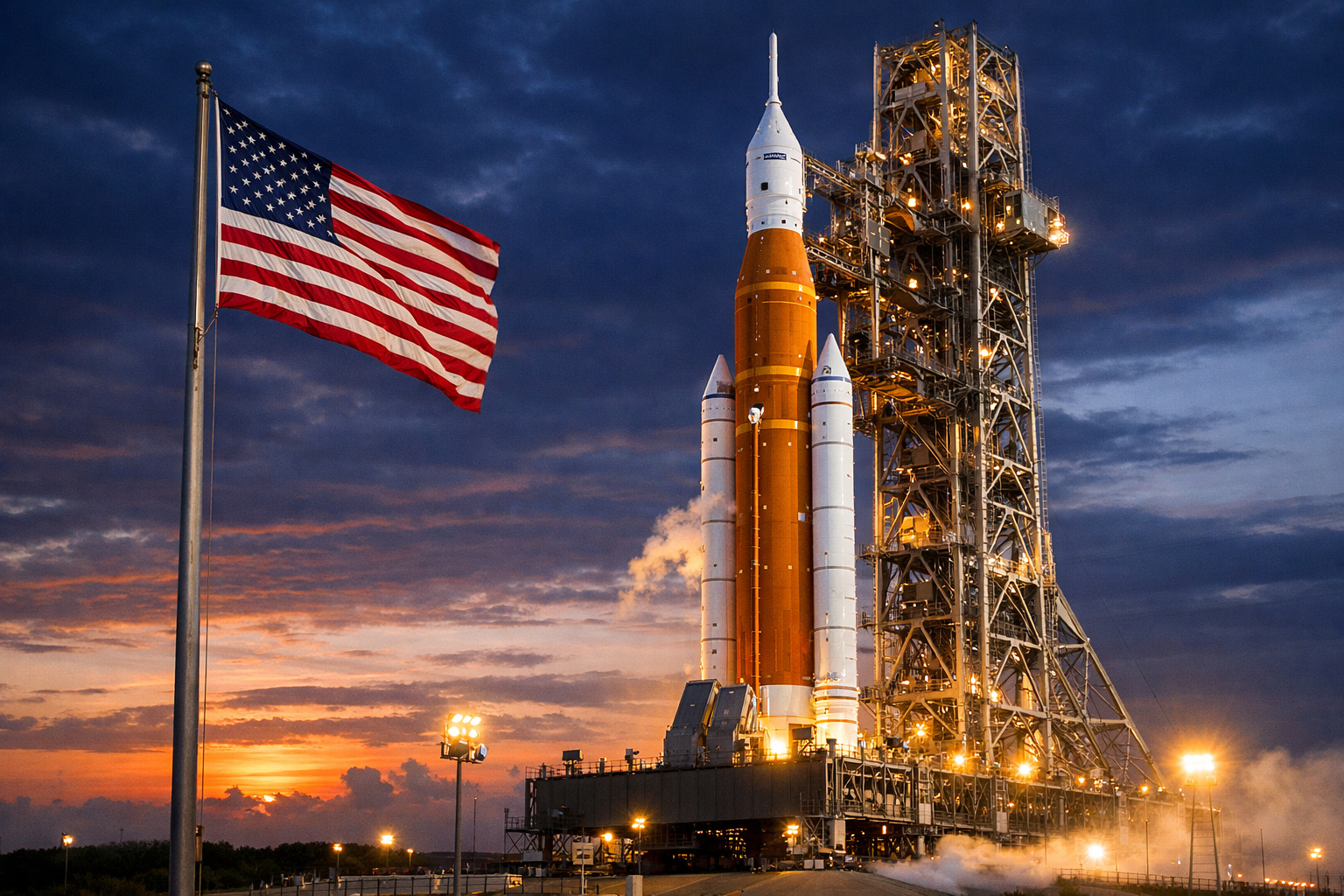


With almost 100 meters in height, the SLS rocket marks the resumption of crewed flights to the Moon and inaugurates a new phase of space exploration, after decades without human missions beyond low Earth orbit

The Nasa’s lunar flyby mission puts the Moon back at the center of human space exploration. The U.S. space agency has begun the final preparations to launch the giant SLS rocket, which will carry astronauts on a historic journey around Earth’s natural satellite, something that hasn’t happened in over half a century. This mission marks a new chapter in the Artemis program and reinforces the strategic return of the United States to deep space.
The information was released by NASA, according to reports published by international outlets and confirmed by the agency itself. The launch could occur as early as February, depending on the final tests at the Kennedy Space Center in Florida.
-
16-Year-Old from Brazil’s Sertão Wins Young Scientist Award for AI Predicting Rainfall with 94.5% Accuracy to Aid Farmers

-
Netherlands Reports First Child Euthanasia Case Since Rule Expansion for Minors

-
Brazilian Innovator Survives Homemade Submarine Dive in Paraty Despite Hatch Leak and False Oxygen Alarm
-
China Develops Custom 140-Ton Electric Mining Truck with 770 kWh Swappable Battery, Deploys 290 Units in Xinjiang’s Largest Zinc Mine



Right in the first paragraph, it is clear that the Nasa lunar flyby with astronauts represents a historic, technical, and symbolic milestone for modern space exploration.
SLS Rocket Impresses With Size, Power, and Technological Complexity
The Space Launch System (SLS) is currently the most powerful rocket ever built by humanity. With a height of 98 meters and a weight of over 5 million kilograms, it even surpasses the legendary Saturn V, which was responsible for the Apollo missions between 1969 and 1972.
Last weekend, the rocket traveled a route of approximately six kilometers to the launch pad, transported by a special vehicle used since the Apollo era and modernized to support extreme loads. The movement gathered hundreds of employees and family members, who followed the transport even during the early morning.
In addition, the SLS carries the Orion capsule on top, designed for long-duration missions in deep space. Unlike the flight of one conducted in November 2022, when the capsule was empty, this mission will be crewed, which requires even more stringent safety standards.
Therefore, NASA engineers conducted extensive analyses after identifying damage to the Orion’s thermal shield during the previous test. These adjustments delayed the schedule but ensured greater reliability for the current mission.
Astronauts Will Take a 10-Day Journey and Make History
The mission will last approximately 10 days and will take four astronauts around the Moon, without landing or lunar orbit. Even so, the feat will be historic. They will become the first humans to travel to the Moon since 1972, when the Apollo 17 mission wrapped up the original lunar program.
The crew will consist of:
- Reid Wiseman, mission commander
- Victor Glover, pilot
- Christina Koch, veteran astronaut
- Jeremy Hansen, Canadian astronaut on his first space flight
Since then, no human has crossed low Earth orbit. Therefore, this mission represents a concrete return to deep space and serves as preparation for future flights, including the planned lunar landing for the Artemis III mission in the coming years.
Meanwhile, NASA is awaiting an SLS fueling test in early February. Depending on the outcome, the agency will have a window of only five days to launch the rocket still in the first half of the month. Otherwise, the launch will be postponed to March.
According to launch director Charlie Blackwell-Thompson, this test “will set the course for launch,” reinforcing the caution adopted by the agency.
Do you believe that humanity’s return to the Moon can accelerate the exploration of Mars or permanently change the future of space travel?






Sim
A tecnologia melhorou muito maís não deixa de ter riscos vamos torcer para que tudo de certo e a viajem e a coleta de dados funcione a contento que os anjos diga amém a humanidade está precisando de ter alguma coisa pra se ocupar e esquecer briguinhas doméstica
Os EUA tem provado que não são confiáveis e, portanto, não acredito que eles estiveram na Lua. Nunca foram em missão tripulada. E não há como provar. É tudo mentira.