






 Portuguese
  Spanish
  6 min of reading
  0 comments


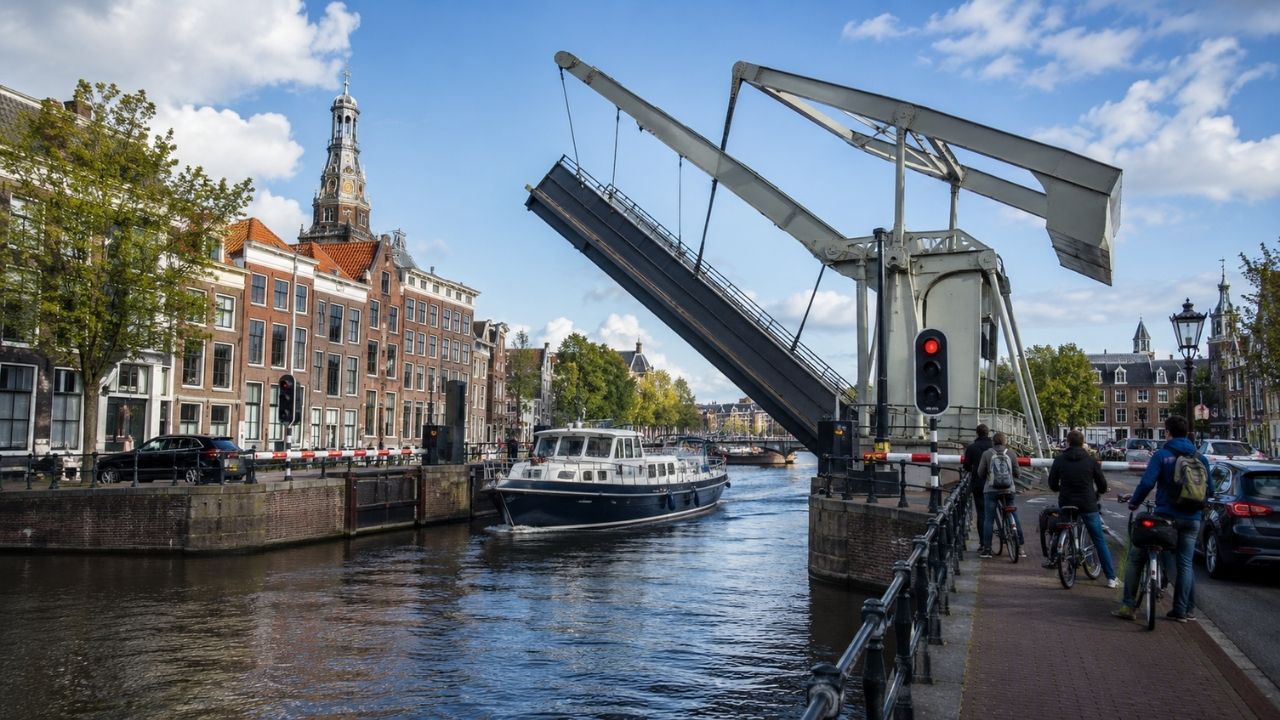
Mobile bridges unite engineering and urban routine in the Netherlands, where streets cross canals, boats share space with bicycles, and operators coordinate sensors, barriers, counterweights, and signaling to open tons of steel at the right moment, without blocking pedestrians, cars, cyclists, or the navigation of the country’s historic canals safely.
Mobile bridges are part of a common scene in several Dutch cities: an apparently normal street is blocked, barriers come down, lights turn on, and in a few moments, the structure begins to move to allow a vessel to pass.
According to the Invisible Structures channel, what looks like a tourist attraction is, in practice, a high-precision urban solution. In a country where canals, streets, bicycles, cars, and pedestrians have shared the same space for centuries, these bridges show how engineering helps the city function without choosing between land and water.
In the Netherlands, water also functions as a path

In the Netherlands, canals are not just historical elements or beautiful landscapes for photos. They are part of the urban logic, transportation, drainage, navigation, and identity of many cities. Therefore, a fixed bridge does not always solve the problem.
-
Bolivian Female Construction Workers Form Association to Combat Discrimination and 38% Pay Gap in the Industry

-
Near Amsterdam, residents buy land and discover they must also build streets, manage drainage, handle waste, and grow food on half their plot.
-
Brazil’s WEG to Open New Factory in China by 2027, Expanding Production of Large Rotating Electric Machines and Low to Medium Voltage Motors in Rugao

-
Chinese Shipyard Secures $1 Billion in Orders for Low-Carbon Container Ships Amid Global Fleet Renewal Efforts


If a bridge were too low, it could impede the passage of boats. If it were too high, it would require long ramps, take up too much space, and could alter the landscape of old city centers. Mobile bridges arise precisely from this difficult balance between land circulation and navigation.
They function as a kind of temporary agreement between two flows. Most of the time, the bridge serves cyclists, pedestrians, and vehicles. When a boat needs to pass, the street stops for a few minutes, and the canal regains its function as a waterway.
This operation shows an important characteristic of Dutch planning: instead of treating water as an obstacle, the country has learned to live with it. The bridge does not eliminate the conflict between street and canal; it manages this conflict with precision.
How tons of steel manage to move without losing stability

The movement of a mobile bridge may seem simple to an outside observer, but it involves calculations, locks, axles, motors, and control systems. In many cases, the secret lies in the use of counterweights, which reduce the effort required to lift or move heavy structures.
In bascule bridges, for example, the deck moves like a large lever. On one side is the roadway used by cars, bicycles, and pedestrians. On the other, there is a counterweight that helps balance the assembly. Without this balance, raising the bridge would require much more force and cause greater mechanical wear.
There are also swing bridges, which do not rise but move laterally to clear the canal. They function as a large piece that rotates on an axis, opening space for the vessel to pass. This model requires clear area around it, as the structure needs to move without encountering obstacles.
Another known type is the lift bridge, where the deck rises almost horizontally, guided by towers, cables, and synchronized mechanisms. In this case, the challenge is to ensure that both sides rise in a balanced manner. Any imbalance can generate undue stress on the structure.
Sensors, barriers, and operators reduce the risk during opening

Before a bridge begins to move, the city receives a sequence of warnings. Lights flash, alarms may sound, barriers descend, and access for vehicles, cyclists, and pedestrians is blocked. This step is essential because a movable structure cannot surprise those who are on it.
Sensors help confirm if the area is protected, if the barrier has descended correctly, if the bridge has unlocked, and if the deck is in the proper position. Each step functions as a safety check before the movement continues.
The operator also plays an important role in this process. They monitor the movement, observe cameras, evaluate signals, consider the position of vessels, and check for safe conditions to open or close the structure. In many places, the bridge does not act in isolation, but within a network of nearby canals and crossings.
This is necessary because a poorly coordinated opening can create a chain reaction. A boat stopped between two bridges, a build-up of cars, or cyclists trying to cross at the last second can turn a short operation into a larger urban problem.
The routine of cyclists and cars depends on precise operation
For those who live in these cities, seeing movable bridges in operation can be part of the routine. The cyclist waits, the pedestrian watches, the driver slows down, the boat passes, and soon after, the bridge returns to its place. In a few minutes, the street is returned to normal flow.
This naturalness, however, only exists because there is a lot of engineering behind it. The bridge needs to open at the right moment, close with a precise fit, lock again, and release traffic only when the structure is safe to bear weight. The most important part is not just moving the bridge, but making it return to the exact correct point.
Wear and tear also needs to be controlled. Humidity, wind, temperature variation, vibration, corrosion, and repeated use require constant maintenance. Motors, cables, sensors, bearings, and hydraulic systems must work together for the opening to appear simple.
When everything goes right, almost no one notices the complexity. But when a bridge fails, the impact appears quickly: cars stop, boats wait, routes change, and a common crossing can become a bottleneck for part of the city.
Why these bridges say so much about Dutch cities


Movable bridges show how the Netherlands transformed a geographical limitation into an urban solution. Instead of completely separating streets and canals, the country created mechanisms to allow both systems to remain active in the same territory.
This logic helps preserve historic centers, keep canals navigable, and avoid major works that could alter the character of old areas. A low, movable bridge can occupy less space than a high, fixed bridge, without blocking boat traffic.
The result is a discreet, yet decisive infrastructure. It appears not just as an engineering monument, but as part of the city’s daily operation. The street exists, the canal exists, and the bridge changes function as needed.
That’s why these structures attract so much attention. They reveal a city that relies not only on avenues, tracks, or sidewalks, but also on water, vessels, and mechanisms capable of reorganizing urban space in a few minutes.
When the street stops for the water to continue its journey
The movable bridges of the Netherlands impress because they showcase engineering that works silently to resolve a daily conflict: allowing people to cross the water without preventing boats from continuing to navigate the canals.
In the end, each opening is a small negotiation between haste, safety, tradition, and mobility. The street stops, the canal takes priority, and then everything returns to its place as if nothing had happened. Do you think this system is efficient for cities intersected by water, or would it depend on overly expensive maintenance? Leave your opinion in the comments.





Be the first to react!