Portuguese
  Spanish


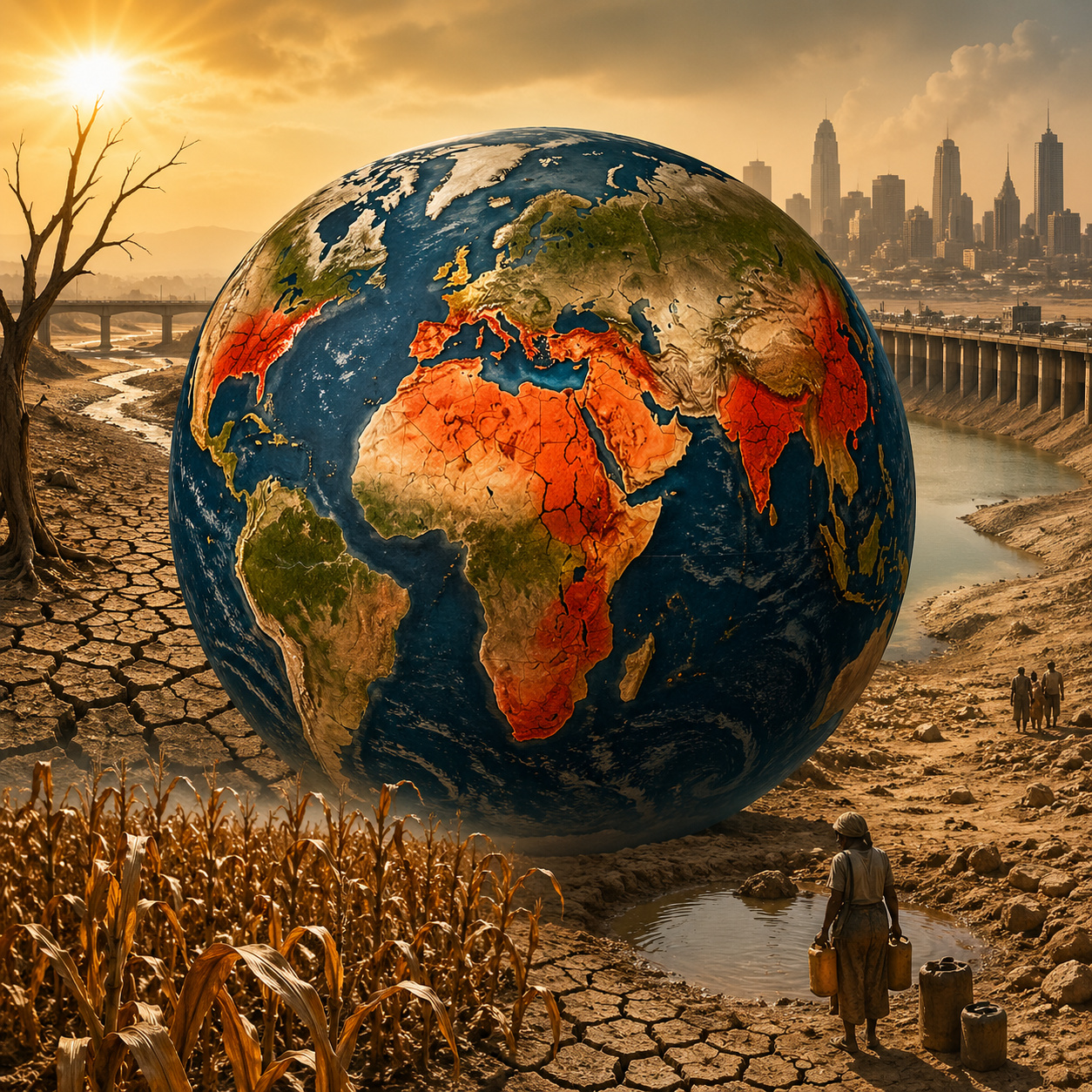


Study indicates that large regions of the planet may face persistent droughts until 2100, with increasing risk of water scarcity and pressure on rivers.
On September 23, 2025, a study published in Nature Communications raised the alert level on global water security by indicating that almost all regions of the planet may enter a scenario of severe and persistent droughts by the end of the century. The research used 100 ensemble members of the CESM2-LE model for the main probabilistic analysis and added simulations from CNRM, linked to CMIP6, to test the sensitivity of the results in different climatic and socioeconomic scenarios.
The work shows that the future problem will not only be the decrease in rainfall, but a deeper alteration in the balance between water supply and demand. To arrive at this picture, the authors combined indicators of balance between precipitation and evapotranspiration, river flow, and water scarcity associated with consumption, concluding that water shortages tend to become more continuous, prolonged, and structural, with increasingly shorter recovery intervals between critical events.
The central point of the study is that future water scarcity tends to be continuous and prolonged, and no longer episodic as in traditional drought events.
-
Canada Builds 6.2-Hectare Containment Box to Trap 615,000 Cubic Meters of Toxic Sediment in Lake Ontario

-
NASA Plans Telescope That Can Be Repaired by Robots 1.5 Million Kilometers from Earth
-
U.S. City Faces Dilemma as Study Warns of Sinking Land and Rising Seas: Invest in Flood Defenses, Restore Wetlands, or Relocate?
-
4,000-Year-Old Stone Towers Discovered Across Sardinia, Puzzling Archaeologists About This Mysterious Civilization


India, China, United States, and the Mediterranean concentrate the most critical scenarios of water stress
The analysis highlights specific regions where the risk of persistent drought is highest. These include India, China, the United States, Mediterranean countries, and parts of Africa, areas that combine high water demand with increasing climate vulnerability.
These regions concentrate large populations, extensive agricultural areas, and already stressed water systems, which amplifies the impact of the projected changes.
The combination of population density, intensive water use, and climate change creates a high-risk scenario for supply and production.
Future droughts tend to be longer, more frequent, and harder to reverse
Unlike traditional droughts, which occur in relatively predictable cycles, the study indicates that future droughts may present more complex characteristics.
Events tend to last longer, occur more frequently, and have shorter recovery intervals between episodes. Furthermore, the reduction in water availability may become structural in some regions, ceasing to be a temporary event.
This pattern transforms drought into a persistent state, with cumulative impacts over time.
Rivers and water systems enter stress zone with demand exceeding supply
One of the most critical aspects highlighted by the study is the imbalance between water supply and demand. In many regions, consumption already approaches or exceeds the natural replenishment capacity of water resources. With the increase in temperature and reduction in rainfall, this imbalance tends to intensify.
Important rivers may experience significant flow reduction, affecting supply, irrigation, and power generation. When demand continuously exceeds supply, the water system enters chronic stress, making any recovery difficult.
Climate change alters the water cycle and reduces rainfall predictability
Global warming directly interferes with the hydrological cycle. Increased temperature intensifies evaporation and alters atmospheric circulation patterns, modifying the distribution of rainfall around the planet.


Some regions may face consistent reduction in precipitation, while others experience more intense rainfall, albeit concentrated in short periods.
This irregularity makes water storage and management difficult, increasing the risk of scarcity.
Agriculture and food production move to the front line of the water crisis
The agricultural sector is one of the most dependent on water resources and, therefore, one of the most vulnerable to the advance of droughts.
Reduced water availability can compromise irrigation, affect crop cycles, and reduce crop productivity.
Regions like India and parts of Africa, where agriculture heavily relies on seasonal rainfall patterns, may be particularly affected. Water insecurity can directly translate into food insecurity, with global impacts.
Energy also affected by reduced hydroelectric generation
Water scarcity impacts not only agriculture but also energy production. Many countries rely on hydroelectric plants for electricity generation. The reduction in reservoir levels can limit production capacity and increase reliance on alternative sources.
Furthermore, the use of water in industrial processes and for cooling thermal power plants may be affected.
The impact on energy broadens the dimension of the crisis, connecting water resources to energy security.
Poorer regions face greater difficulty in adaptation
The study highlights that the impacts of persistent droughts tend to be more severe in regions with lower adaptive capacity.
Countries with limited infrastructure, less access to technology, and restricted financial resources face greater challenges in dealing with scarcity.
This includes parts of Africa, South Asia, and Mediterranean regions. This inequality increases the risk of humanitarian crises and social pressures.
Population growth and urbanization increase pressure on water resources
The increase in global population and the expansion of cities intensify the demand for water.
As more people come to live in urban areas, domestic, industrial, and energy consumption grows. In many cases, infrastructure does not keep pace with this growth, increasing the risk of scarcity.

The combination of population growth and climate change creates a scenario of increasing pressure on water resources.
Water management becomes a critical factor to avoid collapse in some regions
Given this scenario, efficient water management gains central importance. This includes measures such as more rational use of resources, reduction of losses in distribution systems, and development of reuse technologies.
Public policies and international cooperation are also fundamental, especially in regions that share river basins. Without changes in management, the risk of water collapse in some regions becomes more likely.
The study’s results are based on different greenhouse gas emission scenarios. In high emission scenarios, the impacts are more severe, with greater extent and intensity of droughts. In mitigation scenarios, the effects still occur, but with less magnitude.
This indicates that the future of water availability is not entirely defined, but depends on decisions made over the coming decades. The global climate trajectory will be decisive for the level of risk faced by different regions.
Given this scenario, is the world prepared for an era of persistent water scarcity?
Projections indicate that drought may cease to be an isolated event and become a continuous condition in various regions of the planet.
With large countries and strategic regions at risk, the impacts can extend beyond water supply, affecting food, energy, and social stability. The central question is whether governments, cities, and economic systems are prepared to face a