






 Portuguese
  Spanish


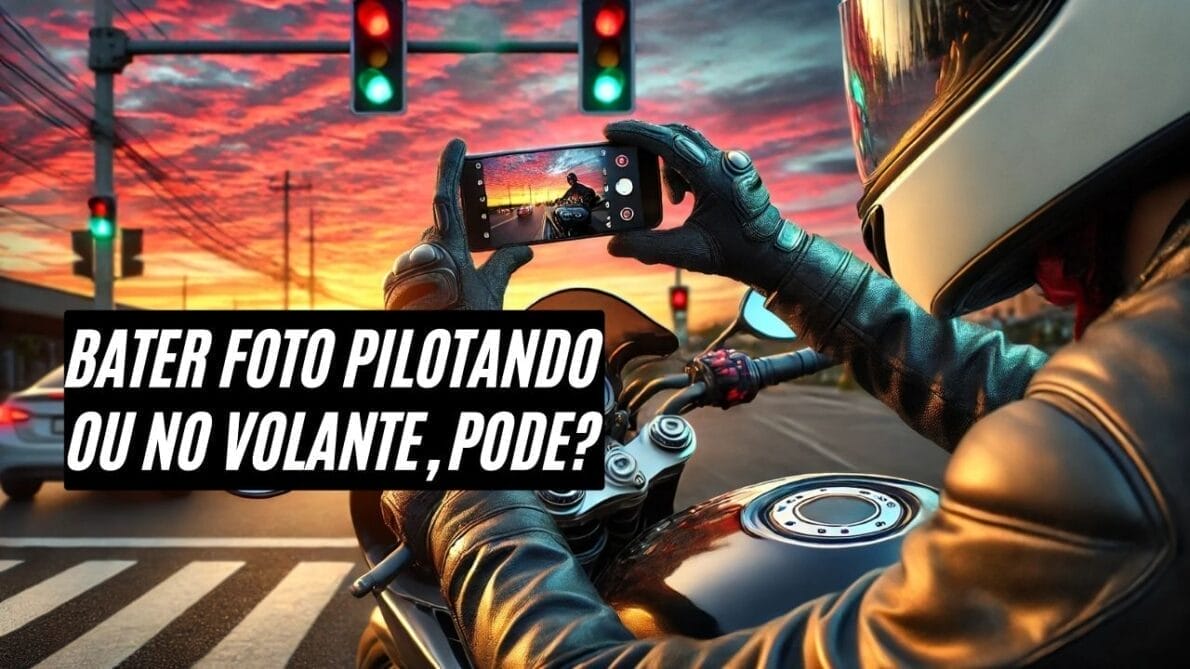

Imagine the scene: you are stopped at a traffic light, a spectacular sunset appears, and you think, “why not capture this landscape?” That’s exactly what motorcyclist Leandro Relli thought in Vila Velha, Espírito Santo. But in capturing the moment, he also captured an unpleasant surprise: a fine for taking a photo at the traffic light. That’s right! Leandro’s case brought to light a national discussion about the limits and interpretations of traffic laws in Brazil.
Leandro, who has the habit of photographing landscapes during his daily routine, was surprised to receive the infraction notification. The fine, amounting to R$ 293.47, claimed that the simple act of handling his cell phone while waiting for the green light constituted a serious violation. Unbeknownst to him, the motorcyclist found himself at the center of a controversy: is it allowed or not to use a cell phone at a traffic light? This specific case raised questions about traffic law in Brazil and whether the current code reflects the everyday behavior of drivers.
What Does the Traffic Law Say in Brazil?
The traffic law in Brazil is quite clear when it comes to the use of electronic devices while driving. According to the Brazilian Traffic Code (CTB), Article 252 prohibits the use of cell phones while driving, considering the practice a serious infraction, with fines and points on the license. This includes handling a cell phone while the vehicle is temporarily stopped at the traffic light. Authorities understand that a driver’s focus must remain on the traffic at all times, even during brief stops.
In Leandro’s case, the fine for taking a photo at the traffic light followed exactly this interpretation. Although he was stopped, the use of the cell phone was interpreted as a distraction. Experts explain that distraction while driving, even during momentary stops, can contribute to accidents, as the driver may delay in noticing movement around them, whether from pedestrians or other vehicles.
-
Brazil’s 2026 Tax Refund: Record 9.58 Million Filers in Largest Payout Ever, But a Key Detail on Priority Recipients Draws Nationwide Attention

-
Itaú Alters Hybrid Work Model, Increasing Office Days from 2028, Prompting Employees to Adjust to New Routine
-
Facing Labor Shortage, Japan Plans to Invest $34 Million to Attract Foreign Workers in Construction, Healthcare, Industry, and Commerce

-
Brazilian City Makes Remarkable Leap, Becomes 4th Wealthiest in the Country with GDP of R$ 134.1 Billion




Why Is Using a Cell Phone While Driving Considered Dangerous?
Research indicates that using a cell phone while driving significantly increases the risk of accidents. The action, which seems harmless to many drivers, is seen by traffic authorities as a real danger and directly conflicts with traffic laws in Brazil. After all, by diverting attention from the road to the cell phone, a driver’s reaction time decreases, which can be fatal in unexpected situations.
Studies show that distraction while driving increases the chances of collisions and pedestrian accidents, a concern that is even more relevant in large urban centers. In São Paulo, for example, the State Department of Transit (Detran-SP) has already recorded over 167,000 fines for using a cell phone while driving between January and August 2024. These numbers reflect the constant rise of this practice and the need for stricter enforcement.
Enforcement: Increasingly Stricter?
With the increasing monitoring technology on the roads, the future of enforcement is expected to become even stricter. Intelligent camera systems, radars, and speed monitoring have evolved to capture, more and more accurately, the use of cell phones while driving. In places like São Paulo, where traffic flow is intense, enforcement also relies on awareness campaigns and signage to educate drivers about the risks.
However, the fine for taking a photo at the traffic light raises a reflection: to what extent is traffic law in Brazil suited to current reality? Leandro Relli’s case illustrates a daily situation that causes divergences, especially among drivers who believe that stops at traffic lights are safe moments to use their cell phones.
Path to Safer Traffic
In light of all this, traffic law in Brazil continues to play a crucial role in road safety, even if, in some cases, it seems too harsh. Leandro’s example raises an alert about the importance of remaining attentive to the rules and, at the same time, rethinking ways to raise awareness and educate drivers about the risks.
Following the regulations and avoiding the use of cell phones while driving is undoubtedly a way to contribute to safer and more humane traffic. Cases like this reveal that, to maintain safety, it is essential to understand the limits of technology in driving – after all, the landscape can wait, but road safety cannot.








