Portuguese
  Spanish


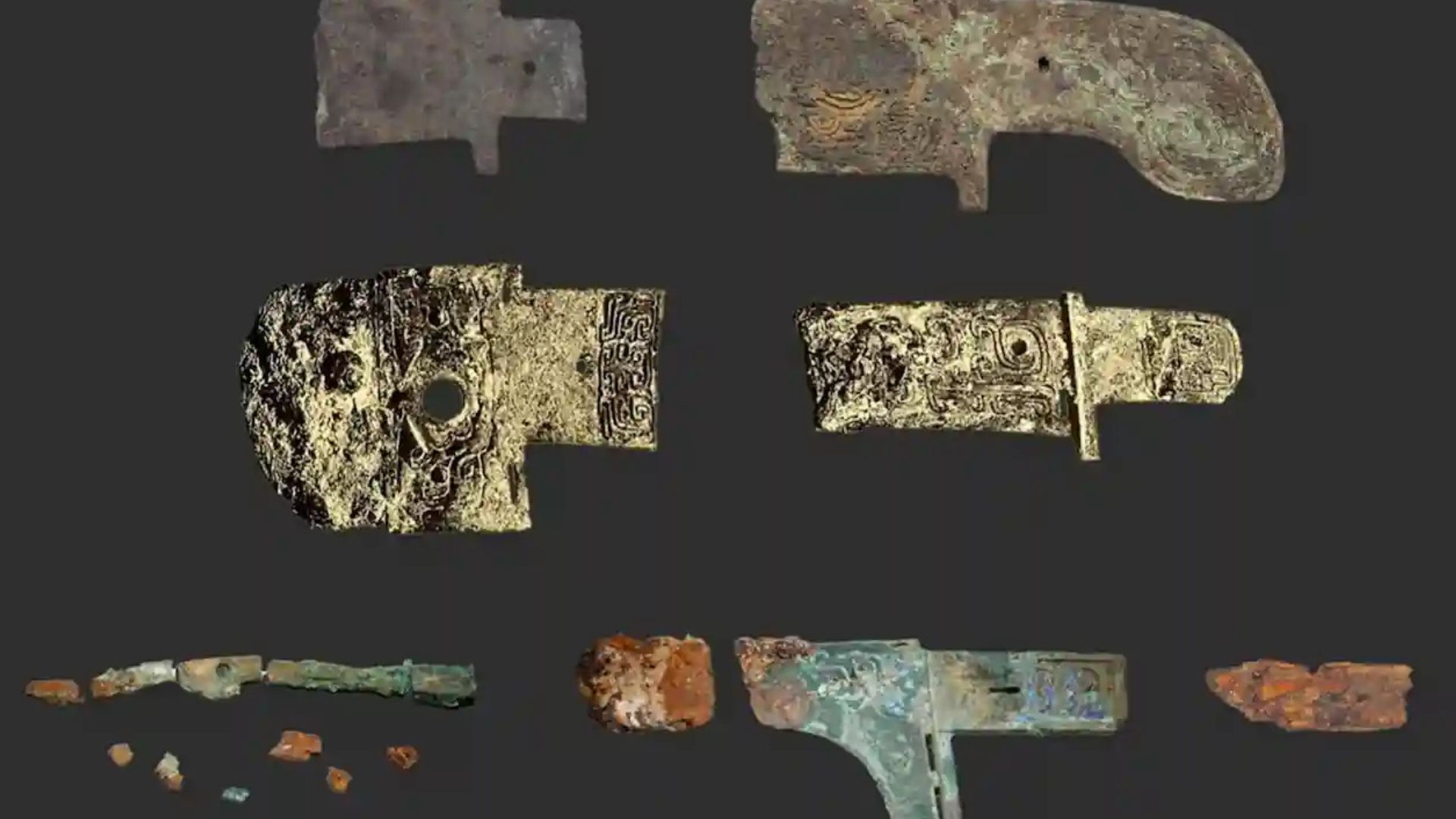

3,000-year-old artifact found in Sanxingdui was made with meteorite iron and reveals a technology used in China centuries before the spread of iron smelting.
A simple corroded tool found among some of China’s most famous archaeological objects has just changed what researchers know about the use of iron in Antiquity. The artifact, cataloged as K7QW-TIE-1, was discovered in Pit 7 of Sanxingdui, an archaeological site known for its gigantic bronze masks, ritual trees, and sculptures that have challenged decades of historical interpretations.
In March 2026, a study published in the journal Archaeological Research in Asia confirmed that the piece was not produced from terrestrial iron ore. Metallographic and chemical analyses demonstrated that it was made with meteoritic iron, material from space and used by a civilization that lived centuries before iron smelting became common in China.
A 20-centimeter piece found among Sanxingdui treasures revealed an unexpected extraterrestrial origin
The object was found during the excavations of Pit 7 of Sanxingdui, one of the famous ritual pits that produced thousands of artifacts associated with the ancient Shu culture, contemporary with the Shang Dynasty. Although it was extremely corroded, researchers managed to reconstruct the piece from three fragments.
-
OnePlus N6 Smartphone to Launch in India with 8,000mAh Battery and 45W SuperVOOC Charging, Lasting Up to Three Days

-
Scientists Plan to Release Air Bubbles Underwater to Protect Antarctica’s “Doomsday Glacier” from Melting

-
Chinese R6000 Drone Combines Airplane and Helicopter Features, Carries Up to 12 People for Multiple Missions
-
In the World’s Most Densely Populated Desert, Families Dig Funnel-Shaped Underground Cisterns to Capture Rare Rainfall and Store Drinking Water for Up to Eight Months



The artifact measures about 20 centimeters in length and has a shape similar to that of an axe, tool, or ceremonial weapon.


When it was discovered in 2021, the state of preservation was so poor that archaeologists removed the entire sediment block for laboratory analysis. Only after years of studies was it possible to determine its true composition.
The location of the piece also drew attention. It was buried alongside ivories, bronze trees, ritual containers, and other objects of high symbolic value, suggesting that it held special importance for the society that produced it.
Chemical analysis showed nickel levels impossible for the technology available at the time
The researchers used metallographic microscopy, X-ray fluorescence, and electron microscopy analyses to study the material. The results revealed a composition rich in iron and nickel distributed in an extremely homogeneous manner.
The examinations identified approximately 77.8% iron and 19.8% nickel, a combination considered incompatible with the metallurgical techniques known during the end of the Shang Dynasty. According to the study authors, artificially producing such a uniform alloy would be beyond the technological capabilities of that time.

The high concentration of nickel is precisely one of the main chemical signatures of metallic meteorites. Therefore, the researchers concluded that the material used to manufacture the artifact came from an extraterrestrial body that hit the Earth sometime before its manufacture.
Sanxingdui used space-derived iron before iron smelting spread across China
The find is particularly important because it belongs to a period when Chinese metallurgy was dominated by bronze.
The researchers highlight that the object was produced before the widespread diffusion of iron smelting in Chinese territory. At that historical moment, meteoritic iron was practically the only source of metallic iron available to many ancient civilizations.
Civilizations from Egypt, Anatolia, and the Near East also used meteoritic iron on special occasions, but discoveries of this type remain extremely rare. In China, only 13 meteoritic iron artifacts had been previously identified.
The Sanxingdui object became not only the first of its kind found in southwest China but also the largest known specimen in the country to date.
The discovery shows that Sanxingdui followed a metallurgical tradition different from the rest of China
Another aspect that caught the archaeologists’ attention was the way the material was used.
In the central regions of ancient China, the rare examples of meteoritic iron typically appear combined with bronze in composite objects. In Sanxingdui, however, the piece was made entirely from the extraterrestrial metal.

According to the study’s authors, this suggests a technological tradition distinct from that observed in northern China during the same period. The discovery broadens the knowledge of regional metallurgical practices and demonstrates that different Chinese cultural centers developed their own solutions for working with rare materials.
The research also expands the known geographical area of meteoritic iron usage, extending this record from the Yellow River basin to the upper Yangtze region, where the Sanxingdui civilization flourished.
The biggest mystery now is to discover which meteorite the metal came from
Although scientists have confirmed the extraterrestrial origin of the material, one question remains unanswered. Researchers have not yet been able to determine which specific meteorite was used to produce the artifact.
New high-resolution analyses are expected to investigate the chemical signature of the metal to try to identify its cosmic origin and reconstruct the path taken by the material until it reached the hands of the Sanxingdui artisans.
More than three thousand years later, an apparently simple tool is revealing that the inhabitants of Sanxingdui did not work only with bronze, gold, and jade.
At some point during the Bronze Age, they also transformed a fragment of a body from space into a ritual object that remained hidden until archaeologists found it again.