






 Portuguese
  Spanish


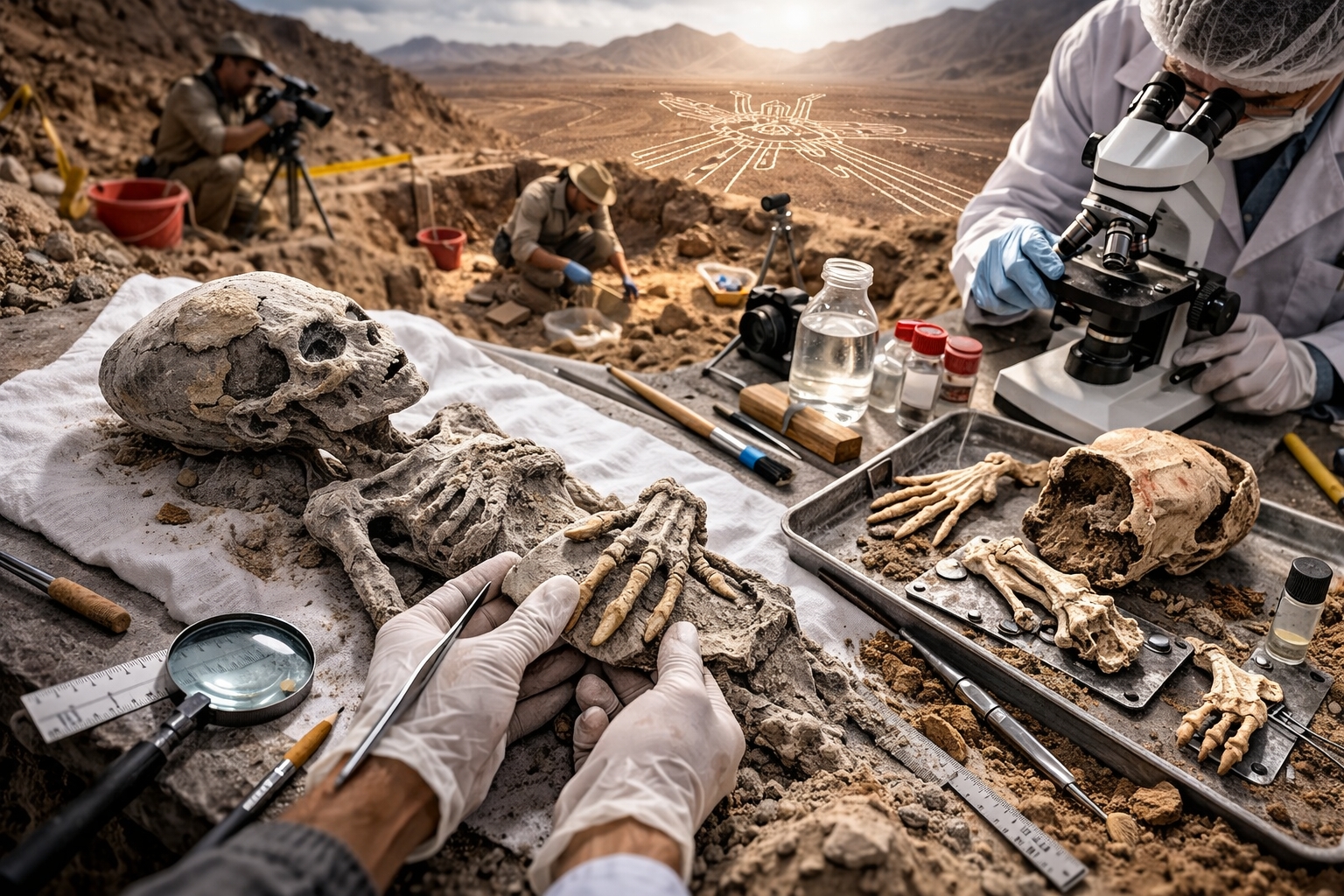
Is The 3-Finger Alien Mummy Real? Five Small Bodies Found Between Nazca and Palpa Took The Political Stage and Promised Proof of Life Outside Earth.
The story begins in a way that confuses any serious investigation: it was not an official excavation that brought the bodies to light. They were grave robbers, the huaqueros, operating in one of the most sensitive regions of Peru, between Nazca and Palpa, near the famous Nazca lines.
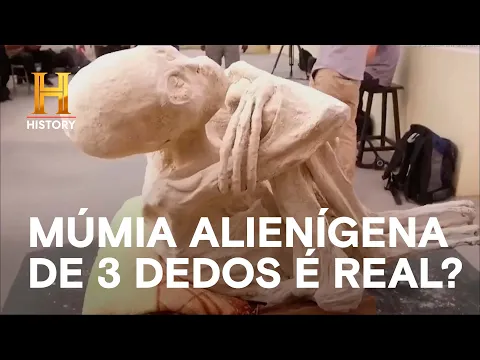
Five small mummies, with human-like appearance, emerged with details that seemed tailor-made to feed the imagination of those looking for signs of life outside Earth. Three fingers on each hand, slender bodies, elongated skulls. That was enough for the case to leave the desert and become a global spectacle.
However, when a finding arises outside the control of the chain of custody, the “definitive proof” industry gains an advantage over science. And what seemed like an ancient mystery soon revealed something else: a modern portrait of exploitation, money, and a struggle for narrative.
-
Brazilian Woman Transforms Ambulance into Solar-Powered Mobile Home for Remote Work and Travel Adventures

-
Oil Company Robots Discover 3,300-Year-Old Canaanite Shipwreck in the Mediterranean, Proving Ancient Mariners Navigated Open Seas by Stars Long Before Historians Thought

-
Facing high rent costs in Brazil, couple swaps apartment for life on a sailboat, reducing expenses significantly.

-
Avoiding the rental cycle, 26-year-old transforms school bus into a solar-powered mobile home for road living, spending up to $35,000 on renovations.



A Finding Out Of Control In A Disputed Archaeological Corridor And Near The Nazca Lines
The region of the finding is no ordinary place. Nazca carries a huge symbolic weight because of the geoglyphs, those drawings in the ground that have crossed decades of theories, including the hypothesis popularized in the 60s by ufologist Erich von Däniken, who related the marks to extraterrestrial visitors.
When the bodies appeared near this setting, the association was almost automatic. Mummies with elongated skulls and three fingers, found in a territory surrounded by stories of “landing sites” and signs in the soil, were ready-made fuel to circulate on social media.
This is the kind of situation that, in any technical field, raises an alert similar to a piece without tracking on a platform: if no one knows where it came from, who handled it, and how it was stored, the risk of evidence contamination rises quickly.
The Strange Anatomy Of Three Fingers And Elongated Skulls That Accelerated The Audience And Blocked The Validation
What captivated the audience the most was not the dating, nor the material chemistry, nor the exact origin. It was the form.
The mummies had humanoid traits but exhibited characteristics outside the human standard, especially the hands with three fingers and the elongated skulls. This visual package is powerful because it resonates with a global imaginary that is already prepared, the “classic model” of extraterrestrial life.
However, appearance is not a diagnosis. And in cases with high potential for fraud, appearance is often the first argument used to push the story before the scientific process truly begins.
From there, the debate divided. On one side, people treating the case as “the greatest archaeological discovery of the 21st century.” On the other, experts demanding the basics that underpin any serious validation: documented origin, reproducible method, and open access to data.

When The Case Leaves Peru And Gains Political Stage In Mexico, The Dispute Stops Being Just Science And Becomes Market
The public turning point came with Jaime Maussan, a Mexican journalist and ufologist. He presented some of the bodies and insinuated that they were not human remains.
Later, in 2023, he brought the mummies to the Mexican Chamber of Deputies, in glass urns, during the Mexican Congress on Unidentified Flying Objects.
This move changed the scale of the case. From niche discussion, it became an international event.
Maussan declared that they were “non-human beings” about 1,000 years old, citing carbon-14 analyses attributed to the Autonomous University of Mexico, according to a report reproduced by the Infobae portal.
He also claimed that the bodies had been found buried in diatomaceous earth mines, a material associated with fossilized algae.
Even with the exposure and noise, there was no official recognition from the Mexican Congress that it involved extraterrestrial beings.
NASA also stated that it had no knowledge of the nature of those bodies, while experts maintained skepticism.
The effect of this, in the real world, is direct. When such a case takes the stage, it not only stirs curiosity.
It stirs money, reputation, and a market that loves loopholes, including the black market for archaeological items.
Three-Finger Mummies In Nazca Were Human And Bird Bones Glued To Metal Plates And A Montage Made To Deceive
The harshest contestation came from groups and experts who view mummies with method and routine, not with bias.
The World Committee on Mummy Studies, an international entity dedicated to the study of mummies, was one of the first to deny the alien origin of the three-finger mummies from Nazca, a stance that was later followed by other researchers.
In Peru, the narrative of fraud gained strength with analyses pointing to montages. According to what you provided, Estrada himself concluded that human bones used in the bodies presented in Mexico, later seized by the Peruvian Ministry of Culture, were glued to bird bones and attached to metal plates, which would indicate deliberate fabrication.
Another name mentioned is the Peruvian medical doctor and physical anthropologist Guido P. Lombardi. The analysis attributed to him goes in the same direction: structures intentionally mounted to create a misleading impression aimed at commercial purposes.
When this kind of detail emerges, everything changes. It is no longer an abstract debate about life outside Earth. It becomes a case about forgery, illegal chain, and exploitation of heritage.

The Peruvian Government Enters The Game And The Case Takes On An Alert Tone About Heritage, Oversight, And Misappropriation
The topic is no longer just curiosity and now touches the State for another reason: suspicions of misappropriation of archaeological assets and allegations about the origin of the remains.
The Peruvian government also denied the existence of non-human remains. The then Minister of Culture, Leslie Urteaga, reportedly declared publicly that no national scientific institution proved the existence of non-human remains, dismissing alien relations, according to a mention attributed to Infobae.
This places the case on a well-known track in regulated sectors. When a product, sample, or evidence emerges outside the official circuit, the damage is not only scientific. It is institutional.
If the hypothesis of forgery and illegal sale gains traction, the pressure will increase for oversight, control of archaeological sites, tracking of materials, and combating the black market.
And then comes a domino effect: more seizures, more legal disputes, more incentives for groups to try to “prove” something quickly before the material is retained.
Dispute Over Three-Finger Mummies: Investigation And Public Narrative

In April 2024, Maussan and a group of American scientists announced a new analysis of the mummies. However, according to what you provided, little was known about the results.
And it is in this vacuum that the controversy remains alive. On one side, the conclusion of the Peruvian Prosecutor’s Office pointing to fraud. On the other, Maussan maintaining authenticity.
When there is a lack of transparency, the debate ceases to be technical and becomes a struggle for audience. And this explains why the topic doesn’t die.
The story has all the elements that captivate: an iconic setting, strange anatomy, a political stage, a promise of definitive proof, and, behind it, suspicion of montage and illegal commerce.
What do you think about this case? Are the three-finger mummies extraordinary evidence or just another example of how frauds can exploit gaps in scientific validation?


-

-

2 people reacted to this.