






 Portuguese
  Spanish


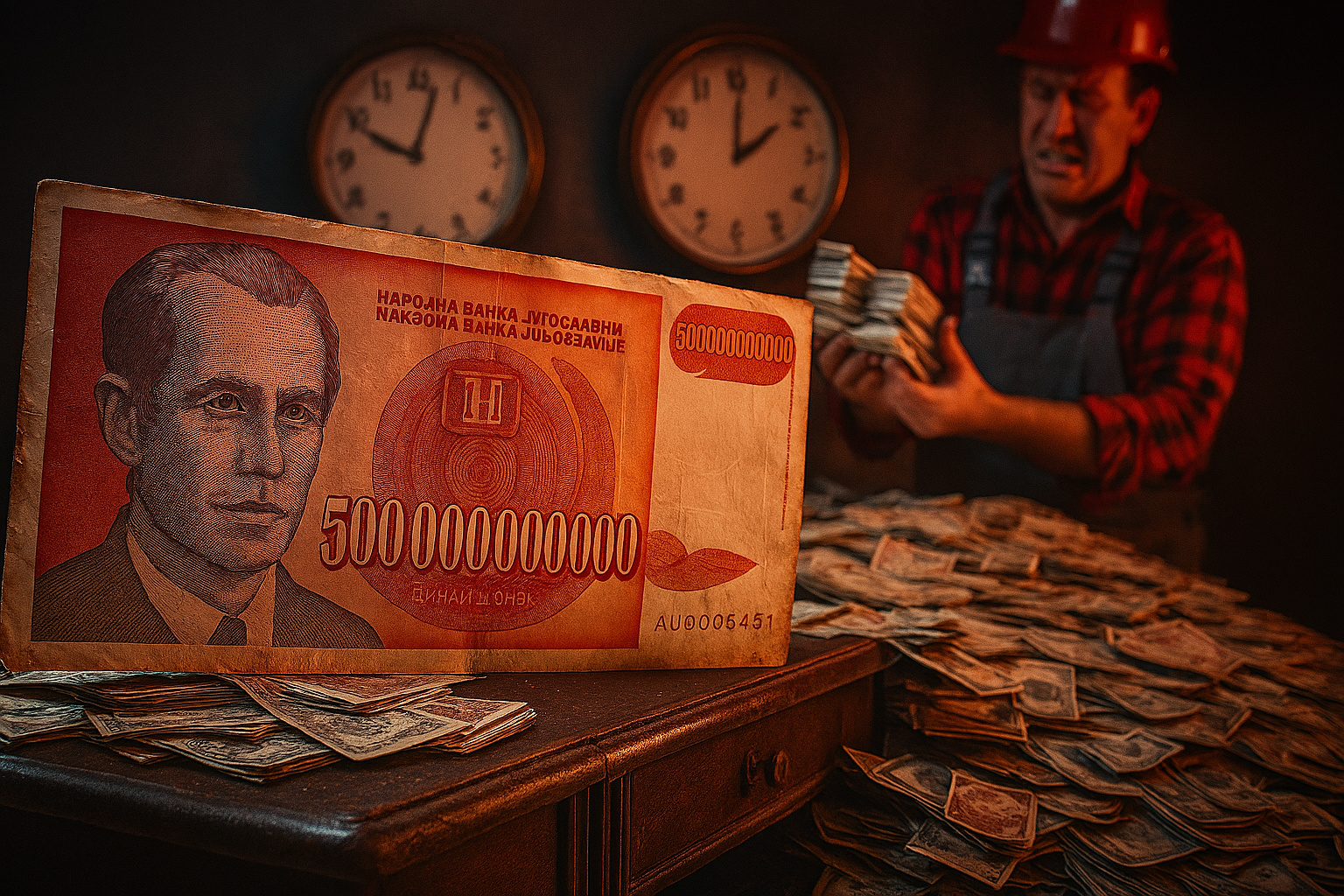


The Hyperinflation of Yugoslavia in 1994 Reached 313 Million% per Month, with 500 Billion Dinar Notes and Salaries Paid Twice a Day.
Few economic episodes of the 20th century were as devastating as the hyperinflation that plagued Yugoslavia between 1992 and 1994. The country, which had already been torn apart by war, territorial disintegration, and international sanctions, experienced monetary collapse of an almost unimaginable magnitude. At its peak, in January 1994, inflation reached 313 million percent in just one month, according to the classic study by Steve Hanke and Nicholas Krus of the Cato Institute.
The result was a surreal scenario: 500 billion dinar notes circulating without real value, empty supermarkets, prices doubling within a few hours, and workers needing to receive their salaries in the morning and rush to the market before, in the afternoon, the money was worth nothing.
The Political and Economic Collapse of Yugoslavia
Hyperinflation did not arise from nothing. It was a direct consequence of a geopolitical collapse. After the death of Josip Broz Tito in 1980, the Yugoslav federation began to decline. Ethnic and nationalist tensions exploded in the early 1990s, leading to the wars in Croatia and Bosnia.
-
US Mayor Goes Undercover as Homeless for a Week to Understand Rising Homelessness, Sparking Debate in His City

-
Teen from Brazil Turns School Snack Sales into Million-Dollar Confectionery Business Projected to Earn Nearly $1.9 Million in 2024

-
Why Do Electrical Outlets and Switches Turn Yellow? Understanding the Impact of Light, Temperature, and Materials on Color Change
-
Former Brazilian laborer and ice cream vendor turns struggling company into $16.5 billion giant with 90,000 employees.


At the same time, the international community reacted to the policies of Slobodan Milošević, president of Serbia, with UN economic sanctions, which isolated the country and cut access to foreign markets and currency.


With the war machine consuming resources and no external revenue, the government took the easiest — and most dangerous — path: printing money on an industrial scale. This political choice, combined with the chaos of war, destroyed any confidence in the local currency.
The Surge in Prices and the Erosion of Daily Life
What happened starting in 1992 was an impossible-to-contain spiral. By October 1993, monthly inflation had already reached 19,810%, but that was only the prelude.
In January 1994, the phenomenon reached unprecedented proportions: inflation hit 313 million percent that month. To put it in perspective, this meant that prices doubled every 34 hours.
The impact on daily life was brutal. Salaries paid in the morning lost value before the end of the workday. Companies began making two daily payments so that their workers could rush to the market, where prices were adjusted multiple times a day. Families exchanged what they had for tangible goods like food, clothing, and even cigarettes.
The Bills of Billions and Trillions of Dinar
The most striking symbol of the crisis was the notes issued by the National Bank of Yugoslavia. First came the million dinar notes, then billions, until they reached 500 billion dinars, an amount that in itself seemed to come from fiction. Soon after, even trillion dinar notes appeared.
But these papers did not represent real wealth. On the contrary, the cost of printing was often higher than the purchasing value of the note itself. In no time, people stopped believing that this money could serve as a medium of exchange.
The Social Weight of Hyperinflation
Hyperinflation is one of the most cruel economic crises because it destroys not only the economy but also social organization. Lifelong savings disappeared in a matter of months. The middle class was annihilated.
Merchants and farmers began to refuse to sell products in dinars, accepting only German marks, US dollars, or even bartering.

In the streets of Belgrade and other Serbian cities, it was common to see people carrying bags and suitcases full of worthless notes. Money ceased to be a symbol of purchasing power and became a physical burden.
Historical Comparisons: Germany, Hungary, Zimbabwe, and Venezuela
The Yugoslav crisis fits into a short list of extreme hyperinflations documented in history. The most severe occurred in Hungary in 1946, when daily inflation reached 207%.
In Germany in 1923, families used marks notes as wallpaper or fuel for stoves. More recently, Zimbabwe, in 2008, issued notes of 100 trillion local dollars that could not even buy a loaf of bread.
In Latin America, Venezuela experienced a similar situation between 2016 and 2021, when the government had to cut 14 zeros off the Bolívar, yet still could not restore confidence in its currency.
All these experiences show the same pattern: when governments resort to rampant money printing to finance deficits or wars, the population pays the price in misery and social collapse.
The End of Hyperinflation and the New Dinar
The end of hyperinflation in Yugoslavia only occurred in January 1994, with the introduction of the New Dinar, a currency backed by the German mark. This external anchor restored some credibility to the system, but the social and economic costs had already been devastating.
The episode left bitter lessons: trust in currency is the foundation of any economy. Without it, salaries, savings, and contracts become irrelevant.
The Yugoslav hyperinflation radically demonstrated how monetary policy can implode a country when used as a tool for political survival instead of a means for stability.
The Yugoslav case is remembered today as a warning for governments and societies. It proves that:
- Unbacked Currency and Trust Become Just Paper Without Value.
- Economic Sanctions Combined with War Can Accelerate the Destruction of an Economy.
- Middle Classes Are Always the Most Affected, as they lose both savings and purchasing power.
Looking at recent crises like Venezuela or the current inflationary pressure in emerging countries, the history of Yugoslavia continues to resonate as a warning: when money loses its function, life in society collapses.
And you, dear reader: have you ever imagined needing to receive your salary twice a day and desperately rushing to spend it before, in a few hours, it is worth absolutely nothing?


