






 Portuguese
  Spanish
  3 min of reading
  0 comments


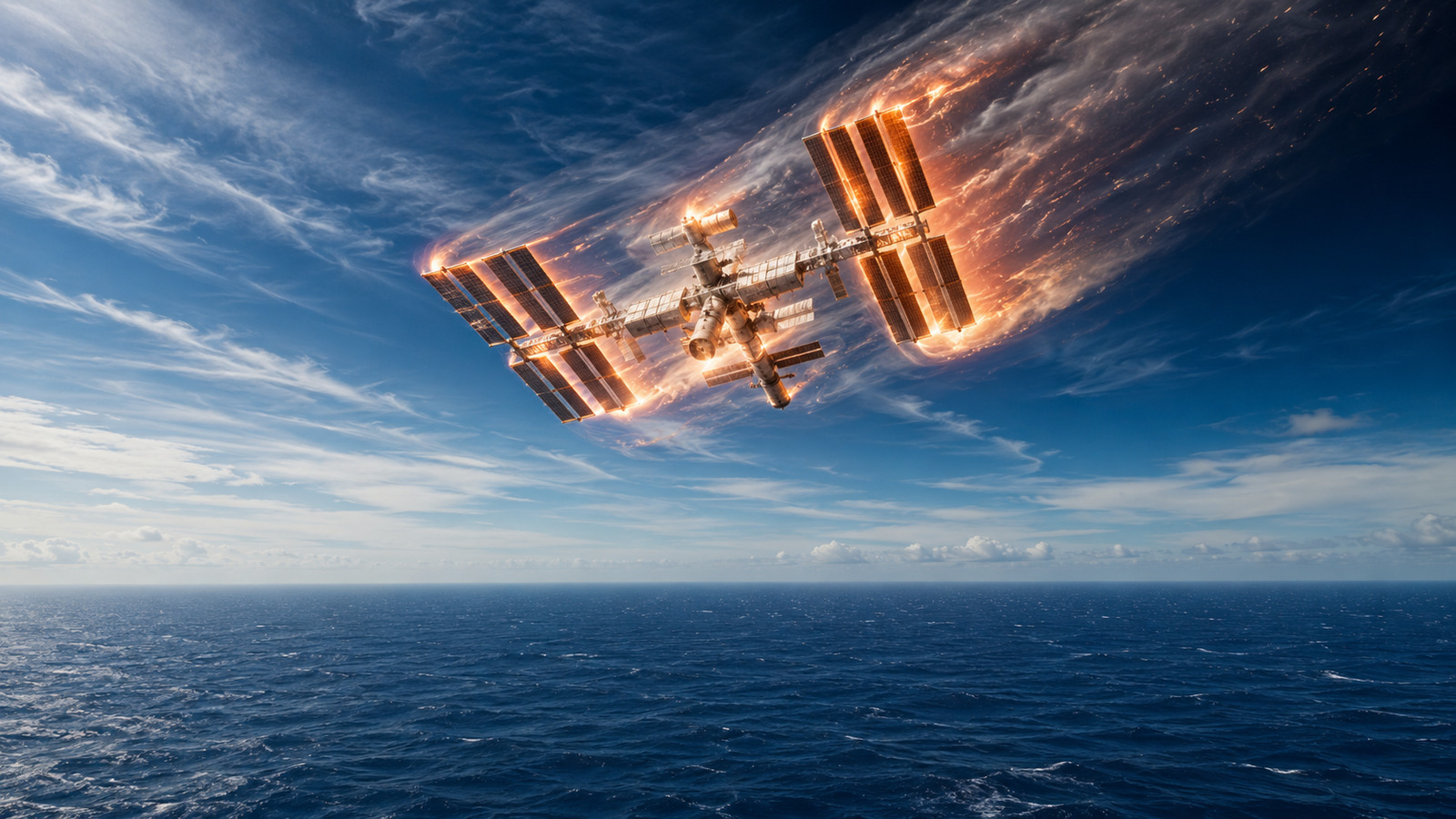
Far from any landmass, Point Nemo has become the planet’s main space cemetery, receiving debris from satellites, spacecraft, and orbital stations, while the ISS already has a planned destination for 2031
Point Nemo, an isolated area in the Pacific, has become the final destination for orbital debris since the 1970s due to its distance from any land and its ability to reduce risks over inhabited regions. This place is expected to be the destination of the International Space Station very soon.


The point furthest from any land
Officially called the oceanic pole of inaccessibility, Point Nemo is located in the part of the planet furthest from landmasses. The solitude is so extreme that, at times, the closest humans are in orbit.
This distance has transformed the region into a safe route for the controlled disposal of space objects. NASA and ESA use the location to direct debris from spacecraft, satellites, and orbital structures at the end of their operational life.
-
Helicopter Drops 180 Tons of Sand and Gravel on Swedish River to Revive Ecosystem Damaged by Decades of Exploitation

-
Brazilian Company Launches Retro Smartphone with 48 MP Camera, T9 Keyboard, and Privacy Features for Social Media-Free Use

-
Self-Taught Chinese Farmer Builds 5-Ton Submarine from Scrap, Launches It in Anhui River
-
Invisible Induction Technology Enables Wireless Power for Blenders, Coffee Makers, and Air Fryers, Reducing Countertop Cables




The topic was covered by SpaceToday, which has 2.3 million subscribers and explained how the strategic point became known as the world’s largest space cemetery.
Why Point Nemo has almost no life
Point Nemo is considered a biological desert. The region is isolated in the South Pacific Gyre, where currents hinder the entry of essential nutrients to sustain biodiversity.
A NOAA study confirms that life there is almost non-existent due to this extreme isolation. Without sufficient food and far from coastal ecosystems, the seabed has become a silent resting place for human technology.
Factors include swirling currents that prevent the arrival of organic material, a depth of about 4 km, crushing pressure, and distance from natural nutrient sources.

How satellites are guided to the South Pacific
Disposal at Point Nemo depends on precise mathematical trajectory calculations. When a space object reaches the end of its mission, flight controllers activate engines so that atmospheric re-entry occurs over the South Pacific.
During the descent, much of the structure burns up from the heat of friction. Only resistant parts, made of titanium or stainless steel, survive the fire before sinking into the dark waters.
This process prevents dangerous debris from falling into inhabited areas. Therefore, the remote location has become a practical solution for dealing with orbital equipment that cannot remain in space.
What already rests on the ocean floor
Since the 1970s, hundreds of space objects have been brought down in this region. Point Nemo holds a metallic part of human exploration, with remnants ranging from small satellites to large orbital laboratories.
The most famous structure linked to the site is the Mir Station, a legendary Russian station. It was fragmented and sunk with calculated precision after decades of orbital operation, becoming the most iconic landmark of this space cemetery.
The planned destination for the International Space Station
The International Space Station has its retirement planned for around 2031. According to NASA’s plans, the ISS will be guided directly to Point Nemo, in an operation described as unprecedented.
Due to the colossal size of the ISS, the maneuver will be a challenge for modern space engineering. The largest object ever built by man in space is set to become an underwater monument in the Pacific.
With information from BMC News.




Be the first to react!