






 Portuguese
  Spanish


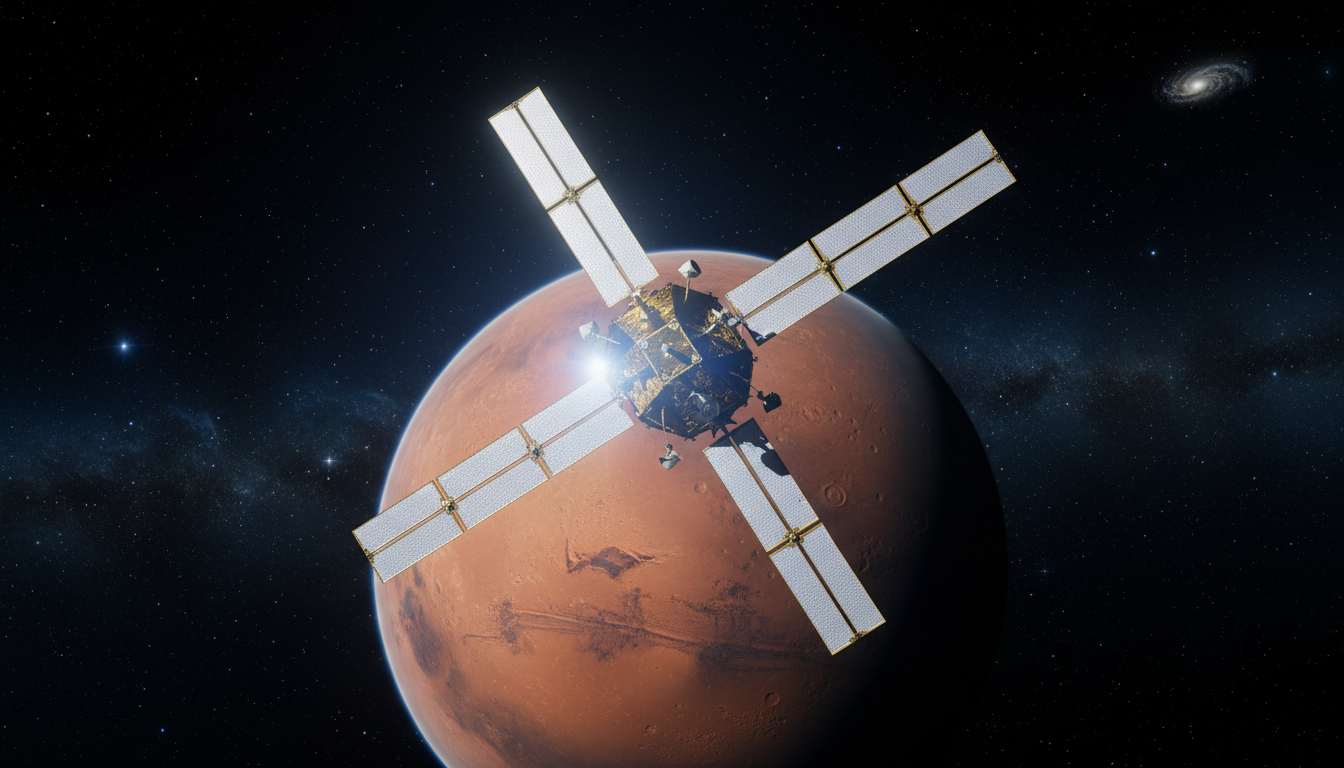

NASA probe accelerates at 19,848 km/h around Mars to reach a metallic asteroid in the belt between Mars and Jupiter. The flight began in 2023 and arrives at its target in August 2029.
NASA’s Psyche probe performs a gravitational slingshot maneuver this Friday, May 15, 2026, as it passes 4,500 km above the surface of Mars.
As published on May 8 by NASA Science.
According to the mission team at JPL (Jet Propulsion Laboratory), the probe currently reaches a speed of 19,848 km/h. The flyby alters its trajectory towards asteroid 16 Psyche, in the main belt.
-
Brazilian Student Invents Low-Cost Rainwater Harvesting System Using Recycled Materials, Showcased at World’s Largest Science Fair

-
Italy Considers Next-Gen Nuclear Reactors for Warships, Aiming to Boost Naval Autonomy and Join Elite Maritime Powers

-
Extreme Heat in Antarctica Sets Record 15.4°C at Esperanza Base in June, Raising Concerns Among Scientists with Temperatures 20°C Above Normal, Rain Instead of Snow, and Unusual Melting Transforming the White Continent’s Landscape
-
UFG’s Innovative Use of Air Conditioner Drip Saves 400 Liters of Water Daily in Brazilian Public Building


According to Lindy Elkins-Tanton, the mission’s lead scientist, the maneuver is free in energetic terms. Mars’ gravity replaces fuel and pushes the probe out of its initial plane.
4,500 km from the Martian surface
Firstly, the approach distance is about 4,500 km, or 2,800 miles in Anglo-Saxon measurements.
For example, it’s roughly the straight-line distance from Rio de Janeiro to Buenos Aires.

According to JPL, the flyby lasts only a few hours at its closest point.
In fact, the probe traverses the Martian system before the next orbital window. The team plans to capture thousands of images of the planet during the approach.
In other words, Mars becomes a “field test” for the multispectral camera that will be used on the final target.
Psyche probe’s trajectory: 3.6 billion km to the asteroid belt
According to JPL, the probe was launched on October 13, 2023, from Cape Canaveral. Since then, it has covered an initial fraction of the total 3.6 billion km journey.

According to NASA’s technical document, the propulsion system uses xenon ions in Hall thrusters. In parallel, enormous solar panels generate the electricity needed for continuous acceleration.
Consequently, acceleration is slow but constant. The solar-electric method allows for prolonged maneuvers with low consumption.
In fact, compared to chemical rockets, the spacecraft uses 10 times less fuel mass for the same delta-v.
Asteroid 16 Psyche: exposed planetary core
On the other hand, the target asteroid, 16 Psyche, is located in the main belt between Mars and Jupiter. According to Smithsonian Magazine, the body contains between 30% and 60% metallic iron and nickel.

In other words, it’s the type of composition expected in a planetary core, not in a belt rock.
In fact, the main theory is that 16 Psyche is the exposed core of a planet that never fully formed.
To understand the scale, the asteroid measures about 220 km on its longest axis. Its shape is irregular, resembling an elongated potato.
Furthermore, other probes have recently targeted asteroids. The Chinese Tianwen-2 mission studies an Earth quasi-satellite asteroid with a similar objective of collecting samples.
Why they say 16 Psyche is worth US$10 quintillion
According to calculations reported by scientific journals, the theoretical market value of the metals in 16 Psyche is US$10 quintillion. This figure is equivalent to US$10 followed by 18 zeros.
In fact, the number assumes that all the metal could be brought to Earth and commercialized at current prices. On the other hand, the logistics for this are currently non-existent.
In turn, NASA makes it clear that the Psyche mission is scientific. The stated intention is to understand how planetary cores formed during the formation of the Solar System.
In parallel, crashing the global price of iron by extracting an entire asteroid would be an undesirable side effect.
According to NASA, this scenario is hypothetical and not within the scope of the current mission.
Psyche probe arrives in August 2029, after 6 years of flight
According to NASA, the Psyche probe arrives at asteroid 16 Psyche in August 2029. The total journey lasts about 6 years of continuous ion propulsion.

According to the schedule, the probe will orbit the asteroid for at least 26 months. This interval allows for mapping the entire surface across various spectra.
In other words, the probe will remain in orbit around the target until at least 2031. Consequently, data will begin arriving on Earth in 2029 with a latency of minutes.
Consequently, the contrast with previous missions is direct. NASA’s Artemis II mission, which takes astronauts to lunar orbit, flies in much shorter windows.
Why study an exposed planetary core
Indeed, the interior of planets remains inaccessible by direct exploration. Cores like Earth’s lie thousands of kilometers beneath the crust, under extreme pressure.
According to the scientific team, 16 Psyche could be the first opportunity to physically study a core. In comparison, all current models rely on indirect seismology.
On the other hand, scientific debate still exists. According to Phys.org, some researchers argue that 16 Psyche is another type of metallic object never before cataloged.
Consequently, the mission could change the foundation of what we know about planetary formation.
Comparison: the probe’s flyby in numbers
- 4,500 km altitude at the closest point to Mars
- 19,848 km/h speed during the flyby
- 3.6 billion km total trajectory until 2029
- 30 to 60% metallic iron and nickel in 16 Psyche
- US$10 quintillion in theoretical value of metals
- 26 months of planned orbit around the asteroid
In turn, in comparison, the DART mission, which deflected a small asteroid in 2022, lasted less than 12 months. Psyche’s scale is different.
Indeed, it is NASA’s first probe to use Mars as a slingshot to reach the main belt.
Caveat: the probe’s flyby has a short window
According to JPL, the approach window lasts only a few hours. Image capture is planned for the central interval.
On the other hand, part of the plan depends on everything going right. If the guidance system fails, the slingshot maneuver could introduce trajectory error.
Will Brazil one day have an interplanetary probe with its own instruments? The Psyche mission shows what is needed: long-term budget, ion propulsion technology, and a scientific multispectral camera.
Even so, NASA’s schedule has been met so far. Scientific returns will begin arriving from August 2029.


