






 Portuguese
  Spanish



A scientist analyzed millions of observations from automatic cameras on four continents and found 282 meteors forming an unknown shower until then. The discovery reveals the existence of an asteroid invisible to telescopes that is disintegrating near the Sun, with an orbit five times closer to the star than that of Earth.
An asteroid that no one knew existed is breaking apart near the Sun, and the proof of this is 282 meteors that a scientist found hidden among millions of observations collected by networks of automatic cameras in Canada, Japan, California, and Europe. The study, published in March 2026 in the Astrophysical Journal, reveals a completely new meteor shower, formed by fragments of this unknown asteroid that follows an extreme orbit, approaching the Sun nearly five times more than Earth’s orbit. The intense solar heat is literally cracking the asteroid’s surface, releasing trapped gases and causing it to disintegrate, scattering fragments through space that eventually hit our atmosphere as shooting stars.
The discovery is exciting for a reason that goes beyond basic astronomy. The parent asteroid of the new meteor shower remains invisible to traditional telescopes, which means there is an object near Earth that could only be detected indirectly, by analyzing the fragments it scatters through space. For planetary defense, NASA’s NEO Surveyor mission, set to launch in 2027, will be the ideal tool to locate this dark asteroid hiding near the Sun. In the meantime, the 282 meteors serve as fingerprints of an object that no one can see.
How a scientist found an invisible asteroid using meteor cameras
The method used to detect the unknown asteroid is ingenious. Around Earth, thousands of automated astronomical observatories continuously photograph the night sky, capturing meteors that cross the atmosphere. The researcher analyzed millions of these observations looking for patterns that indicated a common origin, a set of meteors coming from the same direction, with similar speeds and compatible orbits.
-
Tesla injected an additional $250 million into the German factory, doubled the battery cell target, and opened its own production line for startups.

-
No more TV stuck on the wall: Samsung The Freestyle+, the new projector with over 400 lumens projects on walls, floors, and ceilings, bringing cinema to any corner of the house.

-
A Japanese governor single-handedly stalled the construction of the world’s fastest train for nine years, and only now has he agreed to allow a tunnel excavated at a depth of 1,400 meters.
-
Almost 1 billion euros, two gigafactories, and a million-dollar public investment, Chinese company aims to turn Spanish city into Europe’s new battery hub.



Among the millions of records, 282 meteors stood out as a distinct cluster that did not belong to any known meteor shower. The analysis showed that they all followed an extreme orbit connecting them to a point very close to the Sun. When meteors share such similar trajectories, it is a sign that they were recently released by the same celestial body. Initially, the debris released by an asteroid travels very close to each other, like a drop of concentrated dye in a flow of water, and only disperses over thousands of years due to the gravitational action of the planets.
What the analysis of the meteors revealed about the unknown asteroid

The way the 282 meteors fragmented upon entering the Earth’s atmosphere provided valuable information about the asteroid that originated them. The fragments are moderately fragile but more resilient than materials from comets, indicating that the parent body is a rocky asteroid, not an icy comet. This distinction is crucial because asteroids and comets formed in different regions of the Solar System and carry distinct chemical compositions.
The discovery suggests that the asteroid is undergoing a process called thermal fracturing. The extreme heat near the Sun creates stresses on the rocky surface that open cracks, release gases trapped inside the asteroid, and cause fragments to break off, spreading throughout the object’s orbit. This mechanism is likely the same one affecting the asteroid Phaethon, the parent body of the famous Geminid meteor shower, which occurs every year in December.
What differentiates this asteroid from a comet and why it matters
The distinction between asteroids and comets is central to understanding the discovery. Comets are icy objects that come from the farthest regions of the Solar System and release dust when their ices sublimate as they approach the Sun, generating the characteristic tails visible in telescopic images. Asteroids, on the other hand, are dry and rocky, formed closer to the Sun, and typically do not exhibit visible activity.
However, there is a growing category of objects that challenge this division. Asteroids like Phaethon and the new body discovered through the 282 meteors are “active asteroids”, rocky objects that release dust and fragments not by sublimation of ice, but by thermal fracturing, impacts, or excessive rotation. Understanding how many active asteroids exist near Earth is vital for planetary defense, as each of them may be generating fragments that could eventually cross Earth’s orbit.
Why the discovery is important for planetary defense
The science of meteors is often seen as a curiosity, but it has serious practical implications. The 282 meteors reveal the existence of a near-Earth asteroid that is completely invisible to traditional telescopes, a reminder that there are objects in space that may pose a risk and that we simply cannot see with current technology. Meteor observations serve as an exceptionally sensitive probe that detects objects that escape direct observation.
The NASA NEO Surveyor mission, scheduled for 2027, is specifically designed to find dark asteroids close to the Sun as revealed by the study. The space telescope dedicated to planetary defense will use infrared sensors capable of detecting the heat emitted by asteroids that reflect little sunlight, exactly the type of object that the progenitor of the new meteor shower seems to be. Until the NEO Surveyor is operational, the asteroid will remain invisible, and its existence will only be known by the fragments it scatters.
What the new meteor shower tells us about the Solar System
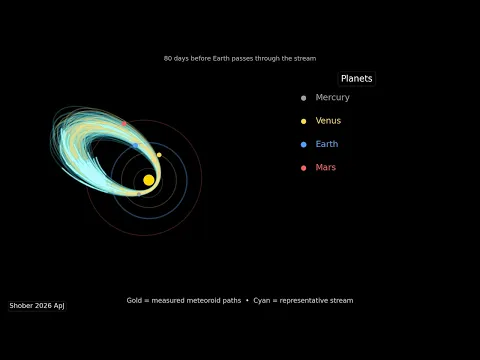

Each meteor shower is a fossil record of an event that occurred in space, sometimes thousands of years ago. The new shower discovered by the study tells the story of an asteroid that got too close to the Sun and began to disintegrate, releasing fragments that now cross Earth’s orbit at regular intervals. By studying these fragments, including their composition, strength, speed, and trajectory, scientists can deduce characteristics of the original body without ever having observed it directly.
The discovery also reinforces the idea that the diversity of meteorites found on Earth originates from processes like this. Asteroids that break apart near the Sun produce fragments with varied compositions that eventually fall to our planet, contributing to the variety of space rocks that researchers find and analyze in laboratories. The Solar System is more dynamic than it seems: objects are constantly being created, destroyed, and recycled on timescales that exceed human existence.
An unknown asteroid is breaking apart near the Sun and has created a meteor shower that no one knew about. Did you know that shooting stars can reveal invisible objects in space? Share your thoughts in the comments.


