Portuguese
  Spanish


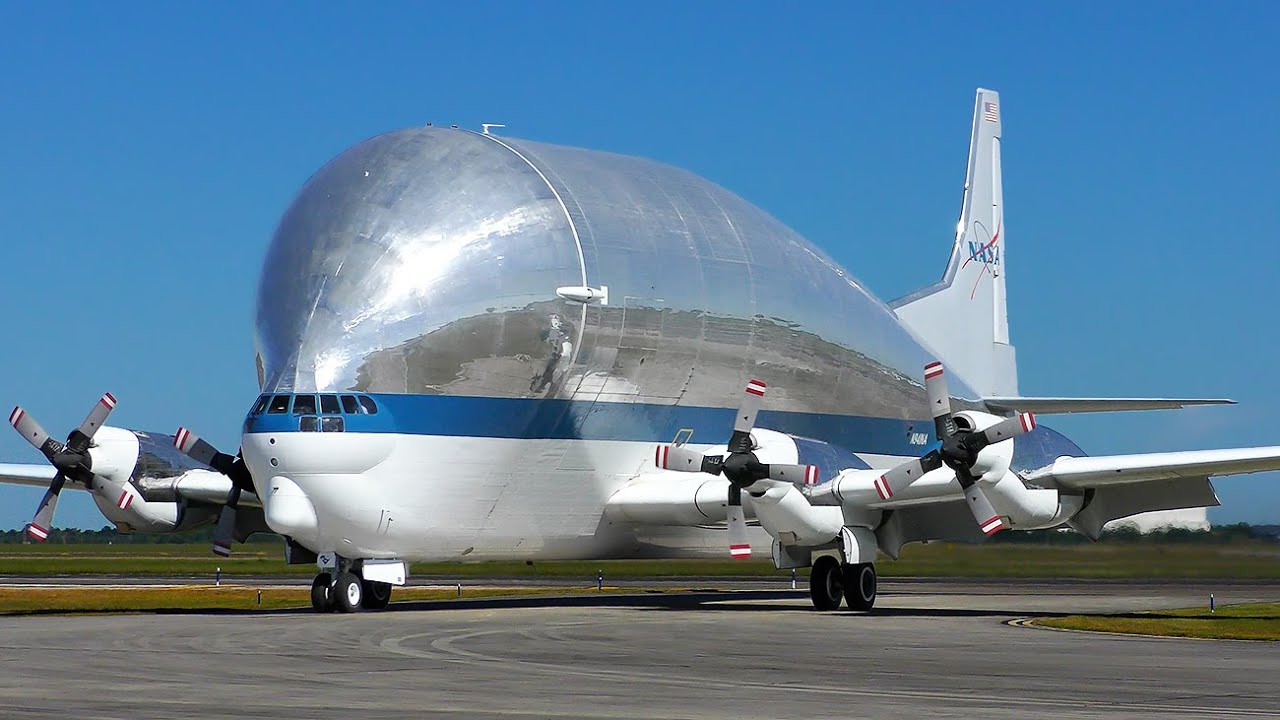


NASA’s Super Guppy transports giant parts with expanded fuselage, hinged nose, and a compartment larger than many cargo planes.
Long before modern cargo planes were made to transport giant aerospace parts, an almost disproportionately-looking aircraft was already crossing the skies carrying components that wouldn’t fit on roads, in tunnels, over bridges, or in conventional planes. The Super Guppy, operated by NASA, became one of the most unusual cargo planes in aviation history by combining an inflated fuselage, a hinged nose with a 110-degree opening, and an internal compartment 111 feet long by 25 feet in diameter, approximately 33.8 meters by 7.6 meters, according to the space agency itself on a page updated on January 22, 2024.
The look seems straight out of an experimental project: a gigantic belly on relatively small wings, creating the silhouette that transformed the plane into one of the most recognizable machines in space logistics. But behind the strange appearance lies a highly specific function. NASA states that the Super Guppy emerged as a response to a critical problem of the space race: transporting enormous rocket and spacecraft parts when shipping by land or barge could be slow, limited, or practically impossible.
Super Guppy was born to solve a problem that trucks and ships couldn’t handle
The development of the Super Guppy is directly linked to the growth of the American aerospace industry in the 1960s and 1970s.
-
California Startup Develops Giant “Space Sling” to Launch Vehicles at Mach 6, Reducing Fuel Use and Enabling Thousands of Satellite Deployments

-
ChatGPT Alerts FBI to Prevent Planned Murder of 8-Year-Old in Brazil’s Espírito Santo
-
Scientists Discover 125-Million-Year-Old “Pregnant Fossil” with Preserved Embryos and Microscopic Larvae Inside Mollusk in England

-
17-Year-Old Justin Bernstein Develops Bacteria to Produce Glass on Arctic Ice to Reflect Sunlight, Wins $50,000 U.S. Scholarship




As rockets and space modules increased in size, ground transportation began to become unfeasible for certain parts. Components that were too wide or too tall couldn’t pass through bridges, tunnels, power lines, and road curves.

Furthermore, sea transport could take weeks, compromising extremely expensive schedules for space programs. The solution found was radical: create an airplane specialized in transporting absurdly sized cargo.
Inflated fuselage creates an internal compartment larger than many apartments
The most impressive element of the Super Guppy is its fuselage. The structure was expanded to form a gigantic internal compartment, capable of accommodating parts that simply wouldn’t fit in conventional cargo planes.
According to NASA, the compartment is approximately 33.8 meters long and 7.6 meters in internal diameter.


For comparison, many urban apartments have a total area smaller than the internal volume available in the aircraft. The Super Guppy was not designed to transport extreme weight like a traditional military cargo plane, but rather extremely voluminous and unusually shaped objects.
Hinged nose opens 110 degrees to allow entry of giant parts
Another impressive technical detail is the loading system. The front part of the aircraft opens sideways at an angle of approximately 110 degrees, functioning as a huge hinged door.
This mechanism allows components to be inserted directly from the front of the plane, which is essential for long and delicate parts. According to NASA, this system was developed precisely to reduce operational complexity in loading large aerospace structures.
The opening process visually transforms the aircraft into something even more unusual, almost like a fuselage “split” in half.
Project origin dates back to the Guppy aircraft family
The Super Guppy is part of the so-called Guppy family, a series of aircraft originally developed from the Boeing Stratocruiser cargo plane.
Engineers deeply adapted the original aircraft, enlarging the fuselage and altering its structure to create internal space far above the traditional standard.
The first version, called Pregnant Guppy, was developed in the 1960s. Later came more advanced models, including the Super Guppy.
The concept proved so efficient for aerospace transport that it continued to be used for decades.
NASA used the aircraft to transport rocket parts and space program components
Throughout its operation, the Super Guppy participated in logistical missions related to American space programs.
NASA used the cargo plane to transport rocket components, structural modules, and parts associated with different aerospace projects.
Aircraft of this type are critically important because many space components are too large for conventional transport, yet too delicate for improvised solutions.
In many cases, moving parts by plane drastically reduces travel time compared to ships or special trailers.
Air transport of giant cargo became a strategic sector of the aerospace industry
The concept pioneered by the Guppy helped inspire other aircraft specialized in oversized cargo.
Decades later, manufacturers like Airbus and Boeing developed their own cargo planes to transport giant aircraft parts between factories spread across the world.

Modern examples include the Airbus Beluga and the Boeing Dreamlifter. All follow a similar logic: they were not created to carry the greatest possible weight, but rather parts with dimensions outside the traditional standard of commercial aviation.
Super Guppy continues to be used in specific NASA operations
Despite the project’s age, versions of the Super Guppy continue to be used in some specific operations linked to NASA.
According to the American space agency, the aircraft still participates in logistical missions involving special aerospace components.
This shows how extremely specialized solutions can remain useful for decades when they meet very particular needs of aerospace engineering.
The biggest challenge was not flying, but fitting the cargo inside the plane
Curiously, in many cases the most complex operational challenge was not making the plane fly, but rather correctly accommodating the cargo. Space components have irregular shapes, great structural sensitivity, and require specific fastening systems.
Furthermore, any excessive vibration during transport can compromise extremely expensive and delicate parts.
This transformed the Super Guppy into much more than a “big plane”. It became a specialized logistical platform for cargo practically impossible to transport otherwise.
Machine became a symbol of an era when the space race demanded extreme solutions
The Super Guppy was born in a period when the American space race pressured the industry to solve unprecedented problems at an accelerated pace.
Moving giant components between factories, test centers, and NASA facilities was a completely new challenge for air logistics. The solution found ended up generating one of the strangest and most fascinating aircraft ever built.
Today, even in an era dominated by modern aircraft and advanced digital systems, the Super Guppy continues to attract attention precisely because it seems to defy the visual logic of traditional aviation.
And perhaps that’s exactly what makes the aircraft one of the most impressive machines ever created to transport cargo that simply doesn’t fit into the conventional world.