






 Portuguese
  Spanish
  7 min of reading
  0 comments


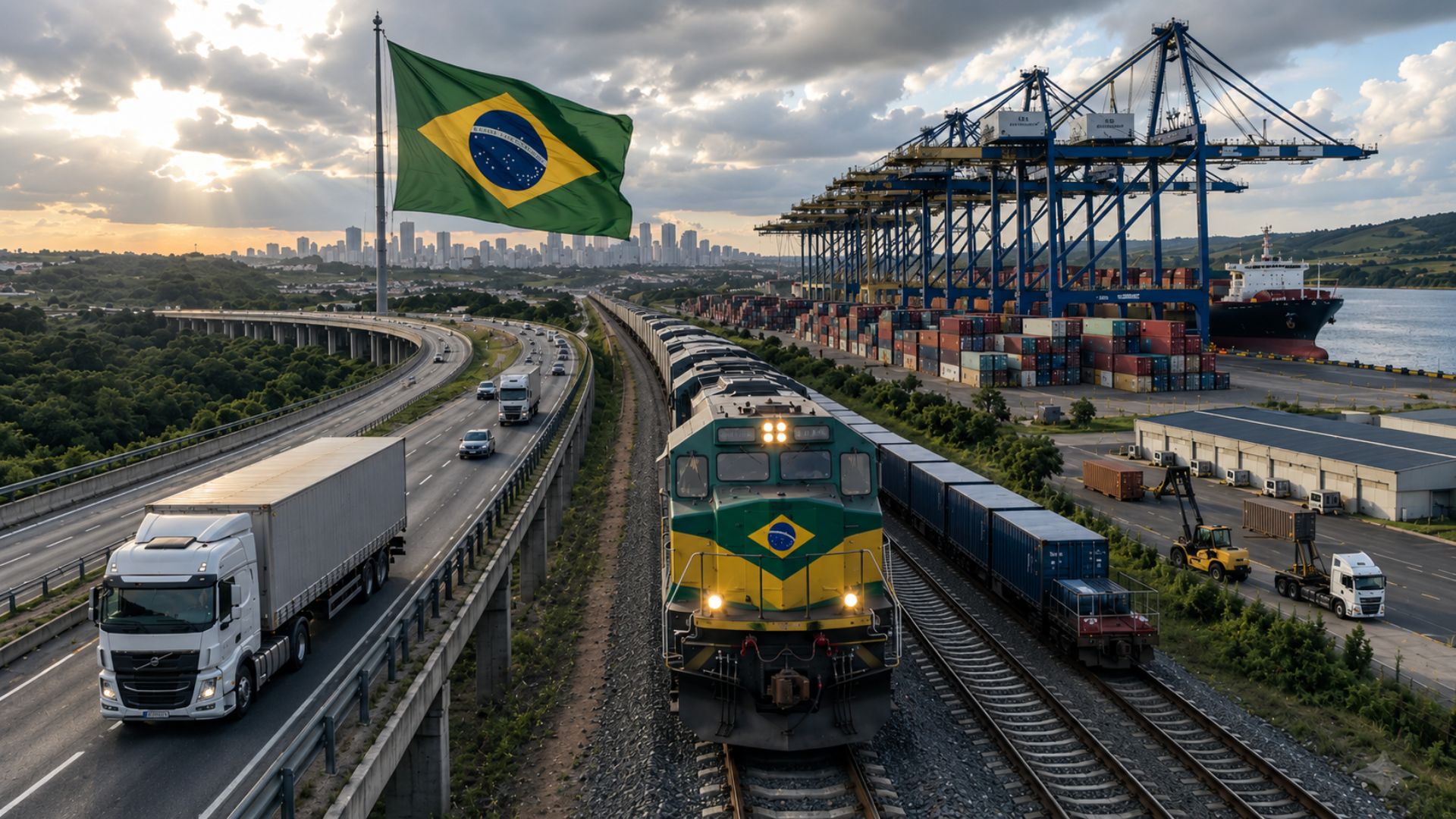
Investments in road and railway concessions should expand logistics corridors, attract private capital, and change the country’s transportation matrix, according to the Minister of Transport, George Santoro, in an interview with Real Time, from the Times Brasil channel, published on May 29, 2026.
The Minister of Transport, George André Palermo Santoro, stated that the federal government is preparing a new cycle of concessions in highways, railways, and logistics terminals, with a forecast of R$ 396 billion in investments over four years.
The statement was made in an interview with the Real Time program, from the Times Brasil channel, in a video published last Friday (29).
According to the Ministry of Transport, the portfolio of road concessions includes 35 projects and should increase private participation in corridors considered strategic for the flow of national production.
-
Government wants to pay up to R$ 8,000 to more than 2,300 traditional families in over 100 communities in Acre and Amazonas for environmental services provided to the Amazon.

-
Coal mine purchased for $2 million in Wyoming, the Brook Mine holds rare earth elements and critical minerals estimated at up to $37 billion, in an asset that the US is competing for with China.

-
In the year Brazil won the World Cup, gasoline cost R$ 1.77, the cheapest car was worth R$ 13,000, there were no flex-fuel cars, SUVs were rare, and no Chinese brand sold a single vehicle in the country.
-
Neighboring Balneário Camboriú will receive a R$ 1 billion airport with 225 hangars, an area of 2.2 million m², a technology park, and an export zone that promises to transform the economy and generate thousands of jobs.


The department reports that between 2023 and May 2026, 23 auctions were held, with R$ 260 billion in contracted investments for more than 11,300 kilometers of highways.
Rota dos Sertões opens a new stage in the Northeast
In the interview, Santoro highlighted the concession of the so-called Rota dos Sertões, a corridor formed by sections of BRs 116 and 324 between Feira de Santana, in Bahia, and Salgueiro, in Pernambuco.
According to the minister, the project has special significance for connecting an economically growing region in the Northeast to railway and port alternatives.
According to the Ministry of Transport, the concession foresees more than R$ 8.5 billion in investments to modernize the section, considered important for regional supply, cargo transportation, and population mobility.
The project includes about 502 kilometers of extension and passes through municipalities in Bahia and Pernambuco. Santoro said that Salgueiro should function as a logistics integration point due to the connection with the Transnordestina Railway.
According to him, this junction can allow cargo transported by road to continue by rail to ports in the Northeast, creating a new export route.
“The Northeast section is innovative because Salgueiro is a very important logistics hub,” said the minister to Real Time.
He added that the Matopiba region, formed by areas of Maranhão, Tocantins, Piauí, and Bahia, has expanded its agricultural production and demands more efficient corridors for export.
Government bets on standardization to attract investors
Santoro attributed the increase in the number of auctions to changes in economic, legal, and regulatory modeling.
According to the minister, the standardization of notices and contracts reduced the project structuring time, which previously could take up to seven years and now, according to him, is around two to two and a half years.
According to the minister, the predictability of the portfolio also increased the interest of national and foreign groups.
He stated that 17 new groups started participating in the auctions since the beginning of the current administration and that sovereign funds have returned to observing Brazilian projects.
The minister also commented that the department adopted a strategy of presenting the portfolio in meetings with investors in Brazil and abroad.
For him, the combination of legal security, a clearer risk matrix, and technical governance made the projects more competitive.
Santoro said that the agenda is not limited to highways. The government also plans auctions for railway terminals, railway concessions, and public calls to expand integration between modes.
The idea, according to him, is to build logistics corridors capable of connecting production areas to different ports.
Railways enter the center of the strategy


In the railway sector, the minister stated that the government is preparing eight auctions by the end of 2026, with more than 9,000 kilometers of projects and long-term contracts.
According to Santoro, the expansion of tracks is necessary to reduce historical bottlenecks and provide more alternatives for freight transport.
The minister assessed that the railway privatization of the 1990s left gaps because it did not foresee sufficient investments in the contract.
According to Santoro, the operational network was reduced over time, which increased dependence on a few corridors and concentrated cargo in certain ports.
Among the projects mentioned are the Malha Oeste, the Southeast railway arc, the East-West corridor, and the Açailândia-Barcarena link in Pará.
According to the minister, these works can expand railway access to ports in the Southeast, Northeast, and North Arc.
“The goal is to provide logistical options to the producer,” said Santoro. According to him, the cargo needs to be able to follow the most efficient port, not just the available corridor.
This diversification, in the minister’s assessment, tends to reduce costs and increase the competitiveness of Brazilian exports.
Goal is to increase rail participation to 35%
Currently, according to Santoro, the railway mode accounts for about 23% of cargo movement in the country, while road transport concentrates approximately 60%.
The government’s goal is to increase the participation of railways to 35% within eight years. “From 23 to 35 is an increase of more than 50%,” said the minister in the interview with Real Time.
The same goal was published by Times Brasil in a report on the interview, highlighting the government’s expectation to expand the presence of rails in the Brazilian logistics matrix.
Santoro noted that railway projects require more maturation time than road works.
According to him, railways depend on more complex engineering, with specific requirements for curves, inclines, and layout.
Moreover, operation only begins when entire sections are completed. The minister stated that the government has assumed part of the risk of prior licensing of railway projects.
According to him, this change aims to provide more security to the investor, as the concessionaire would assume risks after this initial stage.
Sustainability weighs in contracts
The environmental agenda was also presented by Santoro as a central part of the new contracts.
According to the minister, the projects of the Ministry of Transport have started to incorporate zero carbon goals and financing mechanisms for infrastructure resilience actions and energy transition.
He stated that, in road concessions, up to 3% of revenue can be allocated to environmental initiatives.
In railways, according to the minister, the forecast is for 1% of the invested capital for this type of action. Santoro said there is already more than R$ 1.5 billion per year contracted for sustainability projects.
The minister cited Ferrogrão as an example of a project with potential significant impact in reducing emissions, by replacing thousands of trucks in cargo transport.
According to him, cost-benefit studies indicate a significant potential for carbon reduction if the railway progresses.
BR-319 will have an environmental governance model
In the interview, Santoro also addressed BR-319, the highway that connects Manaus to Porto Velho and is considered the main land connection of Amazonas and Roraima with the rest of the country.
The minister stated that the government seeks to reconcile the road’s recovery with new environmental control measures.
According to him, the most sensitive stretch of the highway crosses a complex area of the Amazon and requires a governance structure involving agencies such as the Brazilian Institute of Environment and Renewable Natural Resources, Federal Police, Army, and other public agents.
Santoro said that the planned solution involves a public-private partnership focused on governance and asset maintenance.
The model, according to him, should include monitoring by cameras, control of vehicle entry and exit, and measures to prevent deforestation around the highway.
The minister stated that the proposal also includes raising the road grade, wildlife crossings, and systems to allow water flow.
In his assessment, the lack of governance was one of the reasons that hindered previous attempts at licensing and executing the project.
Ministry advocates infrastructure as State policy
Santoro took over the Ministry of Transport in April 2026, after the departure of Renan Filho, who left the position due to electoral disqualification rules.
Before that, he was the executive secretary of the ministry and was already following the structuring of the concession portfolio.
In the interview, the minister stated that the credibility of the projects depends less on the political profile of the ministry head and more on how the contracts are structured.
According to him, transparency, governance, and technical criteria are essential to attract private investment in contracts that can last 30, 35, or even 60 years.
Santoro also said that the ministry has sought to work in partnership with state governments, regardless of political alignment.
He cited projects developed with Paraná and Minas Gerais and stated that infrastructure needs to be treated as State policy.
In the end, the minister argued that listening to investors, public agencies, and civil society reduced conflicts and legal actions.
According to him, of the 23 auctions held by the current administration until May 2026, only one faced legal action, which was later resolved.



Be the first to react!