






 Portuguese
  Spanish
  6 min of reading
  0 comments


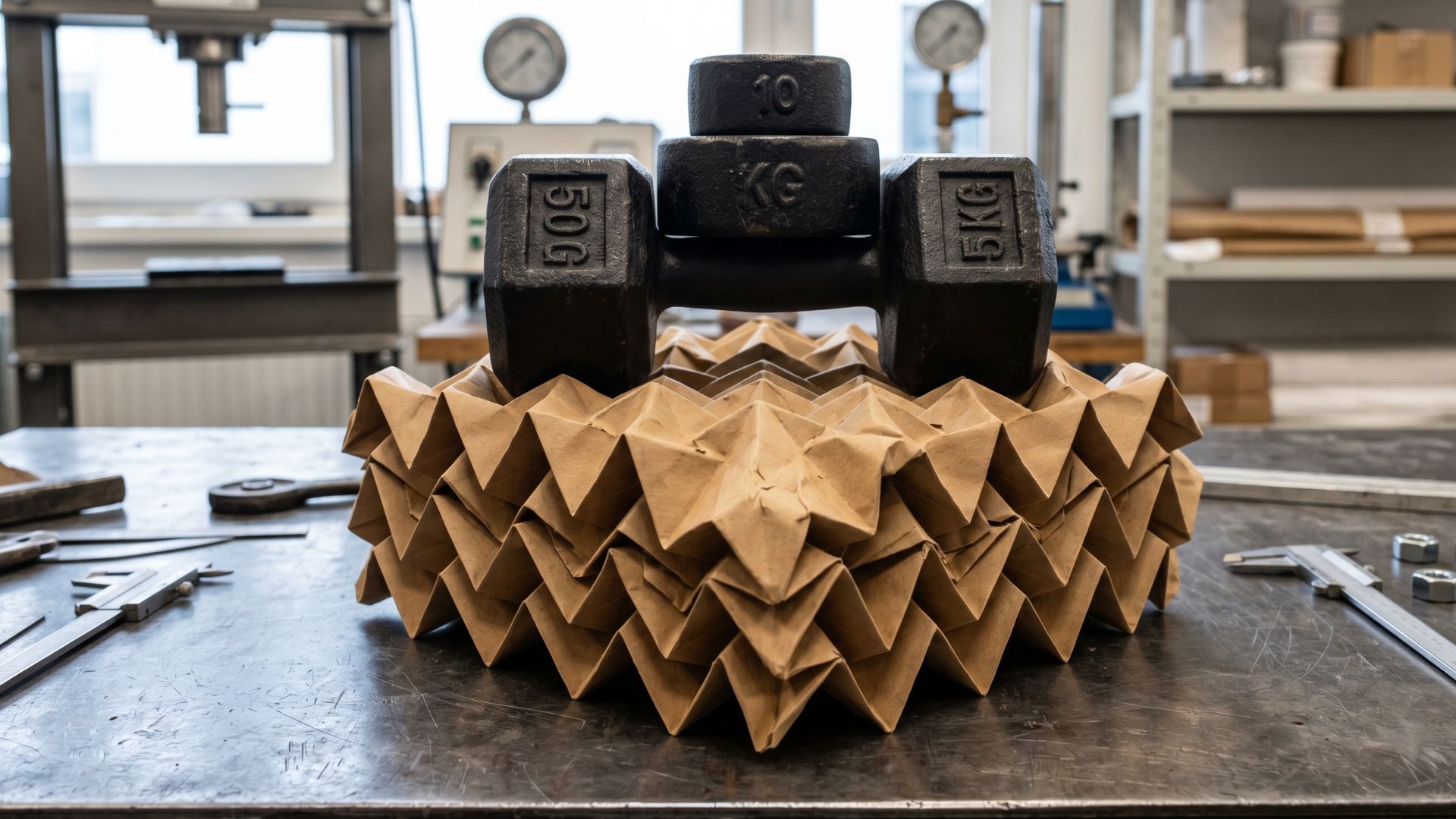
14-year-old student created a Miura-ori origami structure capable of supporting more than 10,000 times its own weight and won a $25,000 prize in the USA.
When it comes to structures capable of supporting large loads, the most common image involves steel, concrete, metal alloys, and advanced engineering materials. But a student of just 14 years caught attention by showing that a simple sheet folded into a specific geometric pattern can achieve surprising levels of strength. Using a variation of Miura-ori origami, he created paper structures capable of supporting more than 10,000 times their own weight.
The person responsible for the project is Miles Wu, a student from New York who turned a long-standing passion for origami into a structural engineering research project. The work won the top prize at the Thermo Fisher Scientific Junior Innovators Challenge 2025, earning the young man $25,000. More than just a school experience, the research opened up discussions on the use of foldable structures in emergency shelters, compact architecture, space engineering, and rapid systems for areas affected by natural disasters.
Miura-ori Origami started as a hobby and became an engineering solution for natural disasters
Miles has been folding origami for several years. Initially, he produced traditional figures of animals and insects, but later became interested in scientific applications of foldable geometries, especially after coming into contact with studies that related origami, engineering, medicine, and space technology.
-
Space technology used to search for water on Mars is now hunting for invisible leaks under the streets of São Paulo, using satellites, AI, and chlorine signals to help Sabesp recover up to 6.7 billion liters of water.

-
Japan sends ship to extract mud rich in rare earths at nearly 6,000 meters deep in the Pacific, attempts to lift 350 tons per day from the seabed, and transforms sediments near Minamitori Island into a strategic weapon to reduce dependence on China.
-
Venus Aerospace promises a rotating detonation hypersonic engine that takes the Stargazer to Mach 9 and crosses oceans in 1 hour, but the flight that made history barely surpassed the speed of sound.

-
Brazilian student creates a cheap formula that makes plants grow up to 90% faster and wins an award in a global scientific competition.




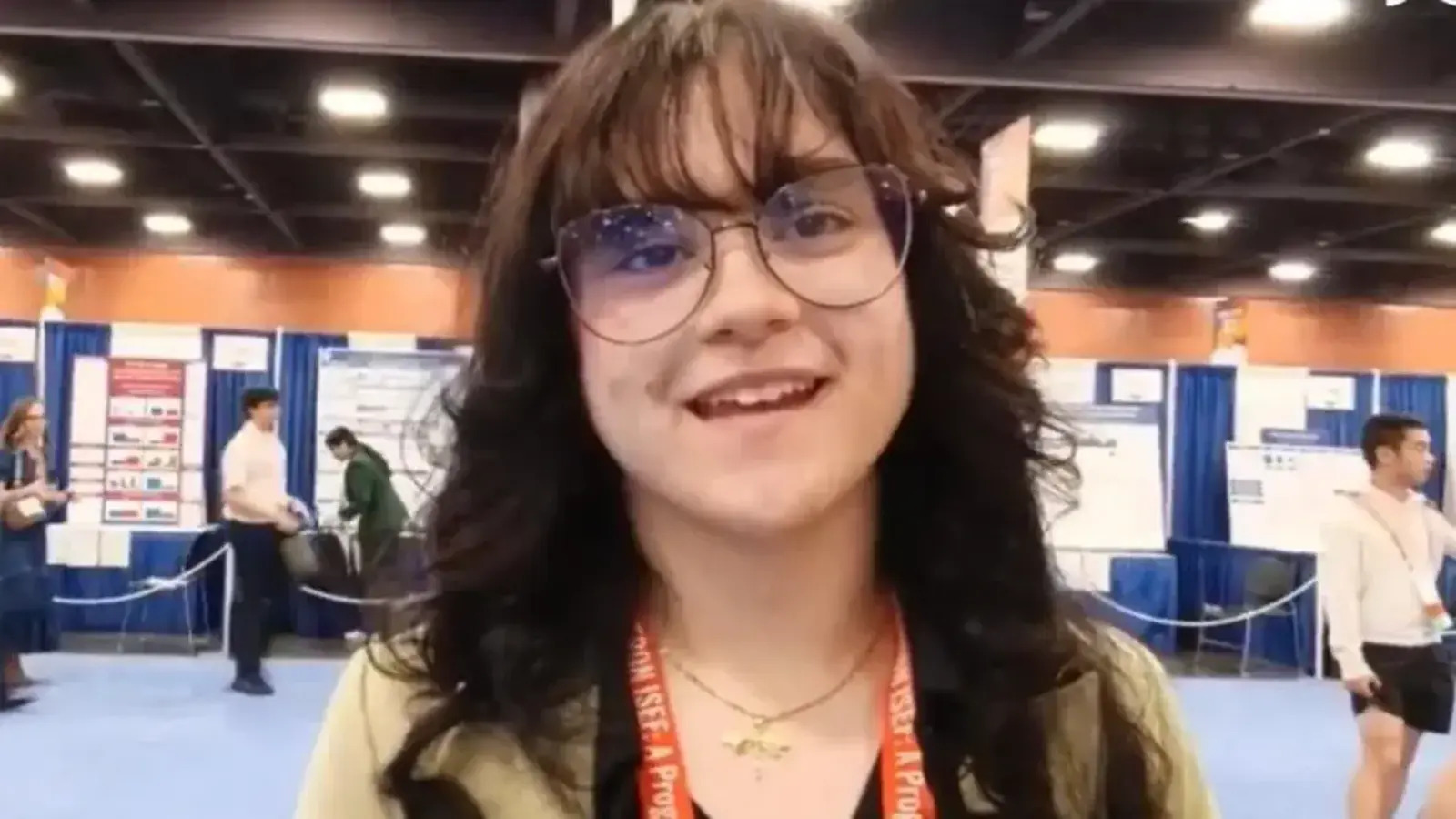


The change of course happened when the student followed major natural disasters, including wildfires and hurricanes. It was at this moment that the central question of the project arose: if origami-inspired structures could help create more resistant, compact, cheap, and quick-to-assemble shelters in emergency scenarios.
The strength of the idea lies precisely in this connection between an ancient technique and a contemporary problem. Instead of treating origami just as art, Miles began to see it as a language of load distribution, structural efficiency, and constructive mobility.
Miura-ori is a fold used in space engineering and compactable systems
The fold chosen by Miles did not arise by chance. The Miura-ori was developed by the Japanese astrophysicist Koryo Miura and became known for allowing large surfaces to be compacted and opened quickly through a repeated pattern of parallelograms.

This type of geometry has already been applied in space engineering, especially in structures that need to occupy little space during transport and then expand quickly. One of the most well-known examples is the use of Miura-ori in satellite solar panels, precisely because of the ability to fold large surfaces into reduced volumes.
This history helped provide a technical basis for the project. By choosing a fold already known for its geometric efficiency, Miles did not start from a random experiment, but from a model that had already demonstrated value in real high-demand applications.
Student set up a home laboratory and conducted 108 structural resistance tests
To test the structure’s resistance, Miles turned his own house into a small experimental engineering laboratory. He created different versions of the fold, varying the width, height, and angle of the parallelograms that form the Miura-ori pattern.

In addition, he used three different types of paper to compare the structural behavior of the pieces. In total, he produced 54 distinct variations and conducted 108 independent tests, a number that gave consistency to the work and allowed for more reliable performance comparisons.
Each structure was positioned between fixed supports, while weights were gradually added until the piece collapsed. This method allowed for clear observation of how small geometric changes drastically altered the fold’s resistance capacity.
Paper structure supported more than 10,000 times its own weight
The result surprised even the author of the research. Initially, Miles believed that the structures would fail using only books as a load. But the models continued to support much more weight than expected.
With this, he needed to increase the level of the tests and started using cast iron pans, stacks of heavy objects, and then gym weights. It was at this moment that the research revealed its most impressive numbers.
At the end of the experiments, the most efficient fold configuration managed to sustain more than 10,000 times its own weight. In engineering terms, this is noteworthy because it shows an extremely high strength-to-weight ratio, something valuable in systems that need to be lightweight and, at the same time, structurally efficient.
Fold geometry was more important than the type of paper
Another important result appeared during the tests. Miles believed that thicker papers would naturally be the best in terms of structural strength. But the experiments showed that the answer was not so simple.
According to the results obtained, regular printer paper presented the best balance between strength and weight. This means that the more robust material was not always the most efficient, because the increase in mass did not always translate into a proportional gain in load supported.
The conclusion reinforces a central idea of structural engineering: in many cases, geometry matters as much as the material. The way a shape distributes forces can be decisive for the final performance of the structure.
Miura-ori origami can inspire strong, cheap, and quick emergency shelters
The main motivation of the project was not just to discover a strong fold. The goal was to investigate if patterns inspired by Miura-ori origami could help develop more efficient emergency shelters for disaster scenarios.

Today, many shelters can be strong or compact, but rarely manage to combine at the same time low weight, ease of transport, quick assembly, and good structural strength. It is precisely at this point that the Miura-ori appears as a promising candidate.
If a foldable structure can distribute load so efficiently even on paper, the logic can inspire future systems made with more advanced materials. This includes everything from temporary shelters to compact structures for use in humanitarian operations, modular architecture, and extreme environments.
Scientific award placed the project among the most relevant in the United States
The impact of the work went beyond the research itself. Miles won the Thermo Fisher Scientific Junior Innovators Challenge, one of the main scientific competitions for elementary and high school students in the United States.
The competition initially gathers about 2,000 students, but only a few dozen advance to the final stage in Washington. It was in this highly competitive environment that the project received the top prize of $25,000.
This recognition shows that the research did not attract attention just because it was done by a 14-year-old. It stood out because it presented a real problem, a clear hypothesis, a consistent battery of tests, and a result with potential practical application in engineering.
Origami engineering is already advancing in satellites, robots, and medical devices
Although many people associate origami only with Japanese tradition and folded paper, this area has become a serious field of scientific research. Today there are studies on foldable structures aimed at satellites, space telescopes, compact robots, medical catheters, biomedical devices, and advanced engineering systems.
These geometries interest researchers because they allow for the creation of structures that drastically change shape and size without losing functionality. In environments where space, weight, and efficiency are critical, this becomes a huge advantage.

The Miura-ori is one of the most well-known examples of this approach because it combines geometric simplicity, great compacting capacity, and quick opening, three highly valued characteristics in technical applications.
Miles Wu’s project shows that a folded sheet can hide advanced engineering principles
The discovery does not mean that paper sheets will replace concrete, steel, or structural alloys. But the results clearly demonstrate something that engineering has observed for a long time: the way a structure distributes forces can be as important as the material with which it is built.
By transforming an ancient Japanese folding technique into an award-winning structural engineering project, Miles Wu showed that a simple folded sheet can hide principles capable of inspiring future solutions in emergency shelters, compact architecture, and foldable systems used even in space exploration.
The value of the project lies precisely in this. It does not deliver a ready-made solution to the market, but shows that a well-formulated question, combined with consistent testing and a good understanding of geometry, can open real paths for the engineering of the future.


-

1 person reacted to this.