Portuguese
  Spanish


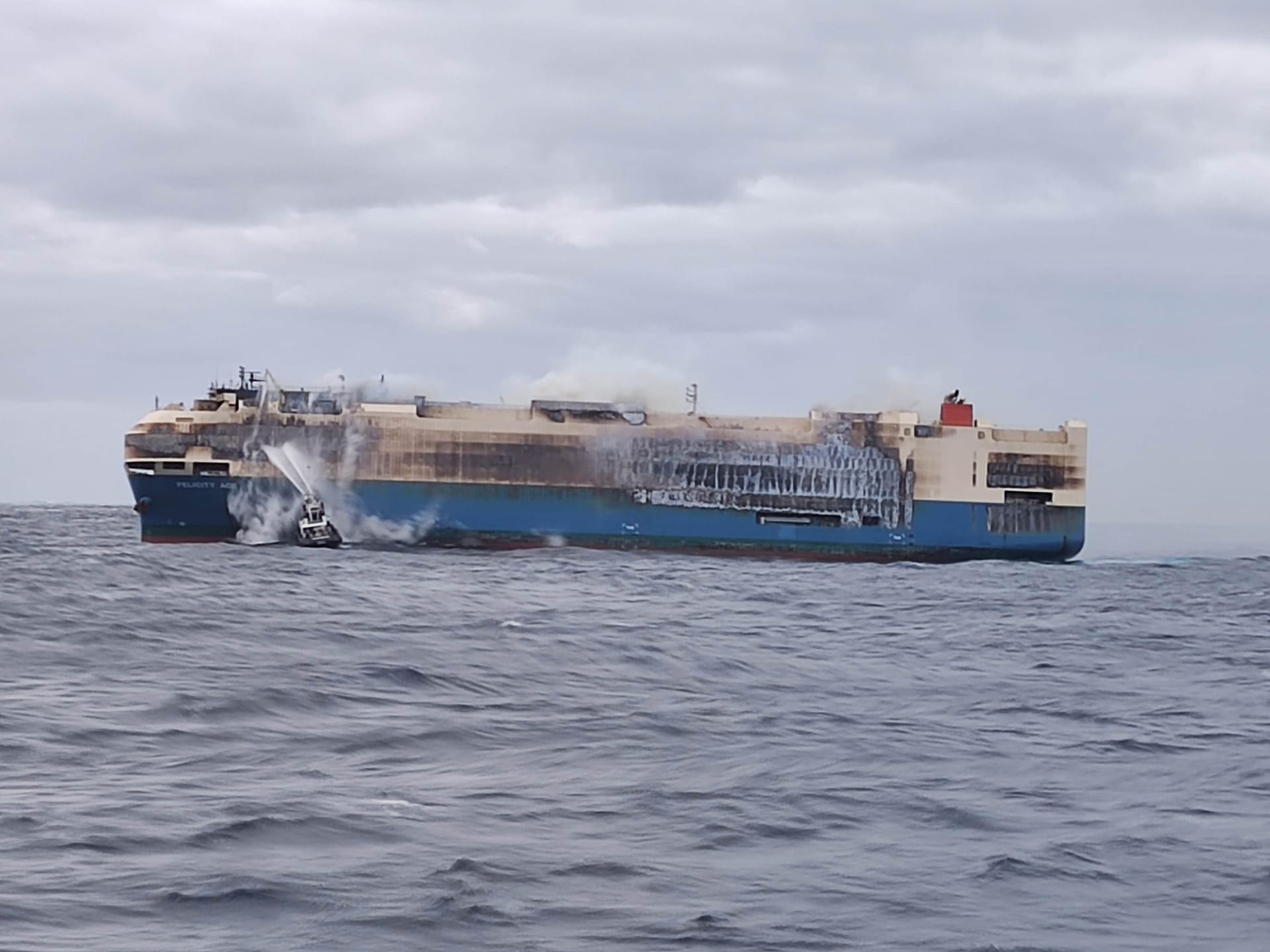

The Burning of Volkswagen Electric Vehicle Batteries Complicates Efforts to Fight the Fire on the Drifting Ship Felicity Ace in the Atlantic Ocean
The latest photos published by the Portuguese Navy of Felicity Ace show the cargo ship still burning near the Azores Islands, in the middle of the Atlantic Ocean, after a fire on the main deck that has been uncontrollable for almost five days, with nearly 4,000 cars on board, from various brands of the Volkswagen Group, including 1,100 Porsche models, 189 Bentley units, and an undetermined number of Audi and even Lamborghini cars from the Volkswagen Group.
Also Read
- Production at Toyota’s factory in SP is in full swing, generating 150 job vacancies and exporting 45,600 2.0L engines to North America
- The use of gas (CNG or Biomethane) as fuel comes to save consumers’ money and becomes a better alternative to replace gasoline and diesel in light and heavy vehicles, also reducing pollution
- After being sued for plagiarism by Volkswagen for shamelessly making an electric copy of the iconic Beetle, a Chinese automaker challenges VW and announces the launch of the Chinese electric Beetle in the Asian market for March
- In contrast to Ford, which stopped vehicle production and closed all factories in Brazil, Volkswagen exceeds five thousand employees in its industrial complex, with one thousand hires since the start of the pandemic
Its crew is safe, but the ship is still drifting near the Azores. The lithium-ion batteries of the Volkswagen electric cars are preventing the fire from being extinguished.
Watch Below the Video of the Rescue of the Crew Aboard the Burning Ship Felicity Ace


The Dutch company contracted to rescue the ship, SMIT Salvage, assures the Wall Street Journal that the presence of a large number of batteries is complicating the efforts, as the fire spreads quickly and cannot be extinguished with water alone.
-
OPEC+ Boosts Oil Supply by 188,000 Barrels per Day in July 2026, Leading to Price Drop from $112 to $89 per Barrel in Under Two Months

-
TotalEnergies Signs 20-Year Deal to Purchase 2 Million Tons of LNG from Alaska, Boosting Project Viability
-
Turkey Deploys Çağrı Bey Drilling Ship to Explore New Oil Frontier Off Somalia’s Coast
-
Golden Pass LNG Ships First Liquefied Gas Cargo from the U.S., Completing $10 Billion QatarEnergy and ExxonMobil Investment



Pouring Water on Decomposing Lithium May Favor the Spread of the Fire on the Ship
Pouring water on decomposing lithium may favor a more violent combustion, promoting oxidation. Additionally, there is a danger that the substance making up the batteries may leak, contaminating the waters.
“The cars are electric, and part of the fire comes from batteries that are still connected,” a company spokesperson told the Wall Street Journal.
The fire on the 60,000-ton ship is still active, although “diminished in intensity,” says João Manuel Mendes Cabeças, the captain of the closest port to Faial Island, in the Azores.
If the fire is extinguished and the ship remains in a condition to be moved, it may be towed to the Bahamas or a port in Europe to assess the damage caused by the flames. But as long as the electric cars of the Volkswagen Group, whose batteries are catching fire, cannot be isolated, the flames will continue to spread on the vessel.
It is Unknown Whether the Ship’s Cargo, Composed of 3,965 Vehicles from Porsche, Bentley, Audi, Lamborghini, and Volkswagen, Was Affected by the Fire
At this time, it is unknown whether the ship’s cargo, composed of 3,965 vehicles from various brands of the Volkswagen Group, was affected by the fire.
Meanwhile, spokespeople for the Volkswagen Group brands have avoided providing details about the models on board, but the fact that most are equipped with batteries may mean that there are many Porsche Taycan, Audi e-tron, and Volkswagen I.3 and ID.4 on board (among others).
The Felicity Ace, flying the Panamanian flag, chartered by Mitsui OSK Lines Ltd., traveled from the German port of Emden, where Volkswagen has a factory, to the American port of Davisville, south of Boston. The ship, which departed Emden on February 10, was scheduled to arrive at Davisville, Rhode Island, on Tuesday, February 22, but is still drifting about 90 miles southwest of Faial Island (Azores).