






 Portuguese
  Spanish


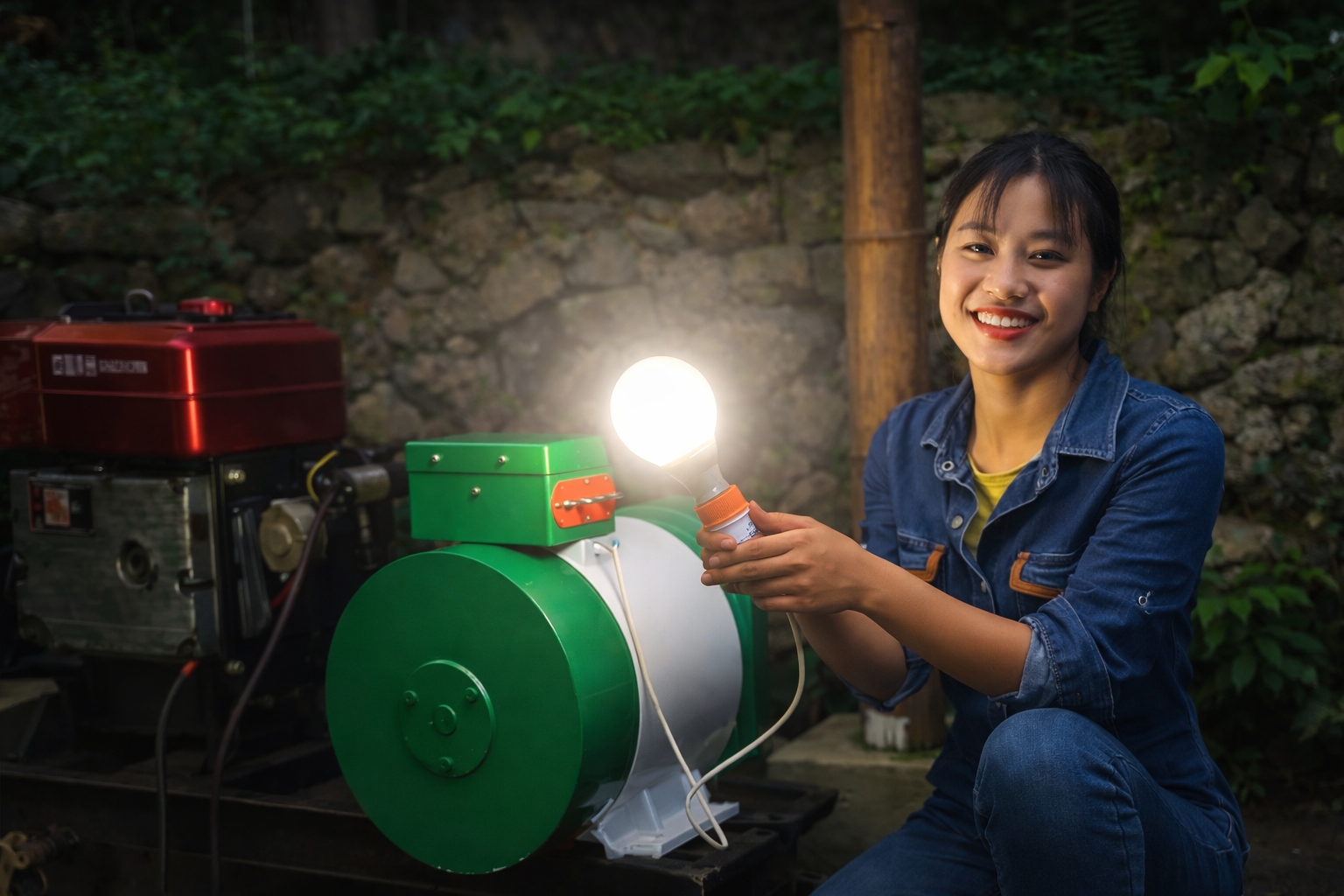


Watch The Step By Step Construction Of A Hydroelectric Power Plant Built By A Girl In 7 Days Without Giant Machines Or Concrete
Genius Girl Builds Hydroelectric Power Plant In 7 Days! It all starts with stacked stones by the side of a narrow watercourse, wood resting on the ground, and a slanted plastic tube. Seven days later, a light turns on in the middle of dense vegetation. And it’s not symbolic. It’s real electricity, generated right there, in front of those who have always lived in darkness.
She didn’t have a monumental dam. She had a natural slope in the terrain. She didn’t have an electrical grid. She had water flowing continuously. And that was enough.


A Girl Uses Her Physics Knowledge To Build A Hydroelectric Power Plant In 7 Days By Diverting The Water Flow
The first step was simple and decisive: organize the flow.
-
Goodbye traditional vacuum: Samsung surprises and launches 2-in-1 robot with steam, AI that recognizes floors and stains, self-cleaning station, hot air drying, automatic emptying, water refill, and app control.

-
Brazil is transforming acerola waste discarded by the pulp industry into an ambitious and surprising project that could forever change the way the country utilizes one of the most invisible by-products of the fruit sector.
-
Scientists have created a colossal digital twin to predict tsunamis in real time, a simulation of 55.5 trillion unknowns run on 43,520 GPUs that reduced 50 years of calculation to 0.2 seconds and could change the defense of coastal cities.
-
Brazil anchored 42 floating concrete caissons in the Atlantic, used the world’s largest caisson dock, and erected more than 3.8 km of dikes to shield the Açu superport on the coast of Rio de Janeiro.


She stacked stones side by side, creating a small barrier in the watercourse. Not to block everything. Just to concentrate the volume in a specific point. What was once a scattered flow became a more directed and visibly faster jet.
In the opening created between the stones, she positioned a cylindrical plastic tube. The end was partially submerged to ensure constant entry.
The downward slope did the rest of the work: it created enough height difference to increase the internal speed of the water.
According to the International Energy Agency, micro-hydroelectric generation systems depend precisely on two basic factors: flow and height difference.
Even small drops can generate energy when the flow is continuous and well-directed.
That’s exactly what she did. She adjusted stone by stone until the flow was stable and aligned with the tube. No side leaks. No dispersion. Without this step, the turbine wouldn’t move.

The Handmade Turbine That Transformed Water Into Rotation
At the end of the tube, she built a small structure with wood and metal parts. Inside, she installed a propeller with visible blades positioned directly at the water outlet.
When the jet hit the blades, the rotation began.
The propeller was connected to a metal shaft that passed through the structure. This shaft, in turn, was coupled to a small generator with a metal casing.
The impact was immediate. The water hit. The propeller spun. The shaft began to rotate continuously.
She noticed vibrations. She adjusted the shaft fitting in the support to reduce friction. She repositioned the wooden structure. Tightened screws. Ensured alignment.
According to the U.S. Department of Energy, hydropower is a direct result of the conversion of the kinetic energy of water into mechanical energy, which then transforms into electricity through a generator. There’s no mystery. There’s applied physics.
That’s exactly what happened there, on a compact scale.
The Moment The Light Turned On
Two simple wires came out of the generator. Nothing sophisticated. They were manually connected to a socket attached to an improvised structure.
Twisted wires at the terminals. Organization was done above ground to avoid direct contact with water.
When the rotation reached sufficient speed, the light turned on.
And it stayed on as long as the flow continued stable.
There was the concrete proof that the girl’s genius was not an exaggeration. The circuit was direct: turbine, shaft, generator, wires, light.
Nothing more.
According to the World Bank, millions of people in rural areas of Asia still live without reliable access to electricity.
Decentralized solutions, like micro-hydropower plants, are pointed out as viable alternatives for remote communities. What she built follows exactly this logic.
The Wooden Base Construction Built By The Girl Ensured Stability
For everything to run continuously, the setup needed to stay firm.
She manually cut boards and built a rectangular support resting on stones and firm ground. Screws went through the parts, uniting the base and sides.
The metal shaft passed through the central point of the structure, aligned with the tube outlet.
This detail made a difference.
Without a stable base, the vibrations caused by water pressure would displace the turbine. With additional lateral reinforcements, the setup gained stiffness.
The rotation became predictable. Constant.
Girls Make The Adjustments That Made The Difference

Nothing worked perfectly on the first attempt.
She altered the tube’s inclination. Adjusted the position of the stones. Observed the behavior of the shaft. Repeated the process several times.
Each change altered the intensity of the jet hitting the blades.
More flow meant more rotation. More rotation meant more energy in the generator. And the light responded at the same moment, increasing or decreasing intensity according to the speed of the shaft.
This cycle of trial and error demonstrated something important: practical understanding of the relationship between water flow, mechanical torque, and electricity generation. It wasn’t luck. It was observation.
When The Force Of Water Became Light

With the system stabilized, the light stayed on while the water followed its natural path through the tube.
The contrast was strong. Dense vegetation all around. A constant point of light in the midst of the scenery.
The assembly used a plastic tube, a metal propeller, a rotating shaft, and a generator as central elements. Each component fulfilled its function within the conversion process.
The force of the water, organized by stones and guided by natural slope, moved the turbine and powered functional lighting. Without an external grid. Without complex infrastructure.
The girl showed that wood, metal, and continuous flow can be turned into usable energy when alignment and stability are taken seriously.
She didn’t build a giant dam. But she built something essential: energy autonomy in a place where the night has always been longer.
Did This Story Impress You? Do You Believe That Simple Solutions Like This Can Change Entire Communities? Share This Article And Let’s Expand This Conversation.


Achei a criação dessa jovem fantástica,ela é uma mente brilhante e pensar nas pessoas longevas,isso é grandioso demais,parabéns garota e,toda sorte pra você.
Eu acompanho ela na internet, é uma super profissional, faz manutenção geral em todo tipo de motor, é soldadora, cria equipamentos do zero, pintura em motores e equipamentos eletromecânicos, ela pegou um pequeno trator na sucata, fez manutenção geral, deixou como novo e funcionando, essa garota é um gênio.
Que maravilha!
A perseverança é a vontade de vencer, são essenciais para o sucesso .
Que criatividade!
Parabéns, menina; vá em frente!
Você será grande cientista.