Portuguese
  Spanish


In the Netherlands, the Ramspol barrier remains hidden at the bottom of the water and only appears when storms raise the level of the canals. With three giant inflatable bags, 240 meters in length and a capacity for 21 million liters, the structure protects vulnerable regions and avoids construction on 115 km of dikes.
It seems impossible.
In a region of the Netherlands where water is never treated as a detail, a structure remains hidden at the bottom of the canals for almost the entire year. Those passing by can only see the landscape, the navigation following its rhythm, and the service buildings on the banks.
But when the wind changes and a storm begins to push water inland, this tranquility turns into an emergency operation. From the bottom of the canal, three enormous rubber bags begin to fill with air and water until they form a barrier 240 meters long and about 10 meters high.
-
Brazilian Submarine Robot “FlatFish” Operates Independently at 3,000 Meters Depth to Inspect Seafloor Pipelines Without Support Vessels

-
Eufy Unveils Omni S2: Advanced Robot Vacuum with 30,000 Pa Suction, Self-Cleaning Mop, AI Obstacle Avoidance, 12-in-1 Station, and Built-In Fragrance Dispenser

-
Swiss Glaciers Lose 10% of Volume in Two Years as Europe’s Largest “Water Tower” Dries Up; Scientists Use “Smart Stones” in the Alps to Gauge Remaining Water Supply for 170 Million People
-
Australia plans massive artificial reef project to protect Gold Coast and save storm-battered beaches from erosion


The structure is the Ramspol barrier, in the Netherlands, considered the largest inflatable storm surge barrier in the world. It was created to do something simple to understand and difficult to execute: prevent millions of liters from advancing over vulnerable areas during high water episodes.
When the water rises, the barrier appears
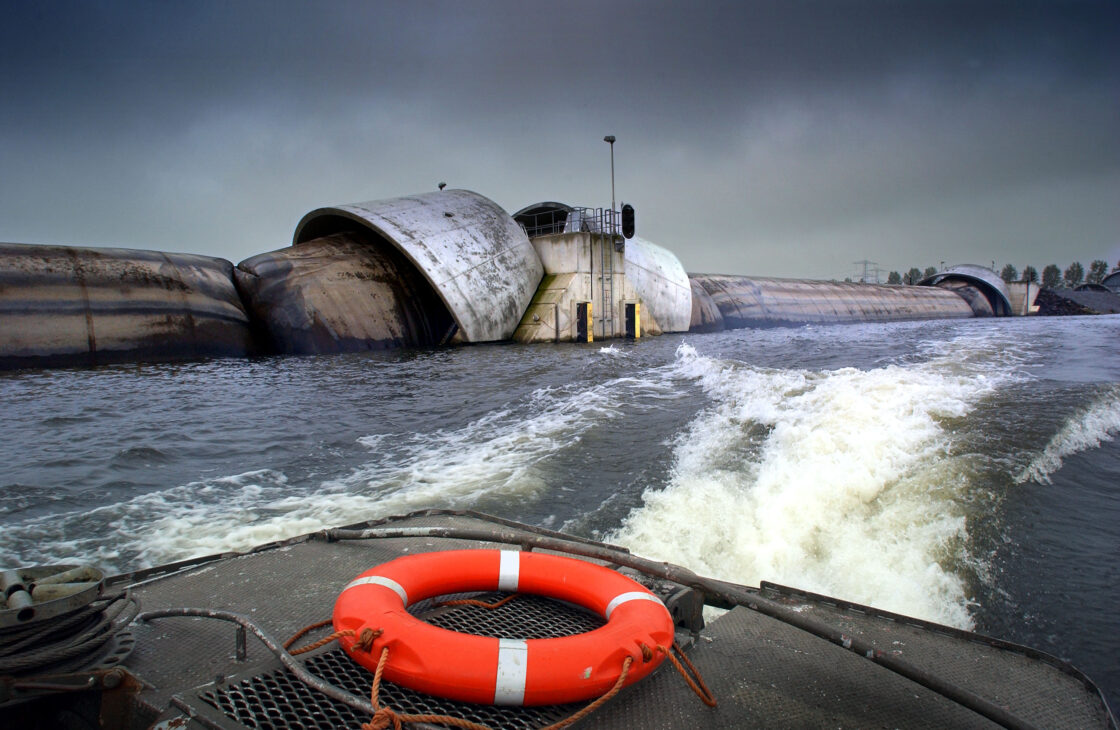
Most of the time, Ramspol does not seem like a monumental work. The three inflatable bags remain empty, folded, and stored in concrete boxes at the bottom of the canals, allowing the normal passage of vessels.
The difference appears when the water level reaches about 50 centimeters above the NAP, the Dutch reference close to the average sea level, combined with strong northwest wind and current towards the interior.
At this moment, the system can be activated. In about an hour, the bags begin to rise, filled with a combination of pumped air and water. What was once hidden transforms into a temporary wall.
According to Rijkswaterstaat, the official Dutch agency responsible for infrastructure and water management, the Ramspol barrier is part of the country’s set of six storm surge barriers.
The solution that avoided 115 km of dike construction
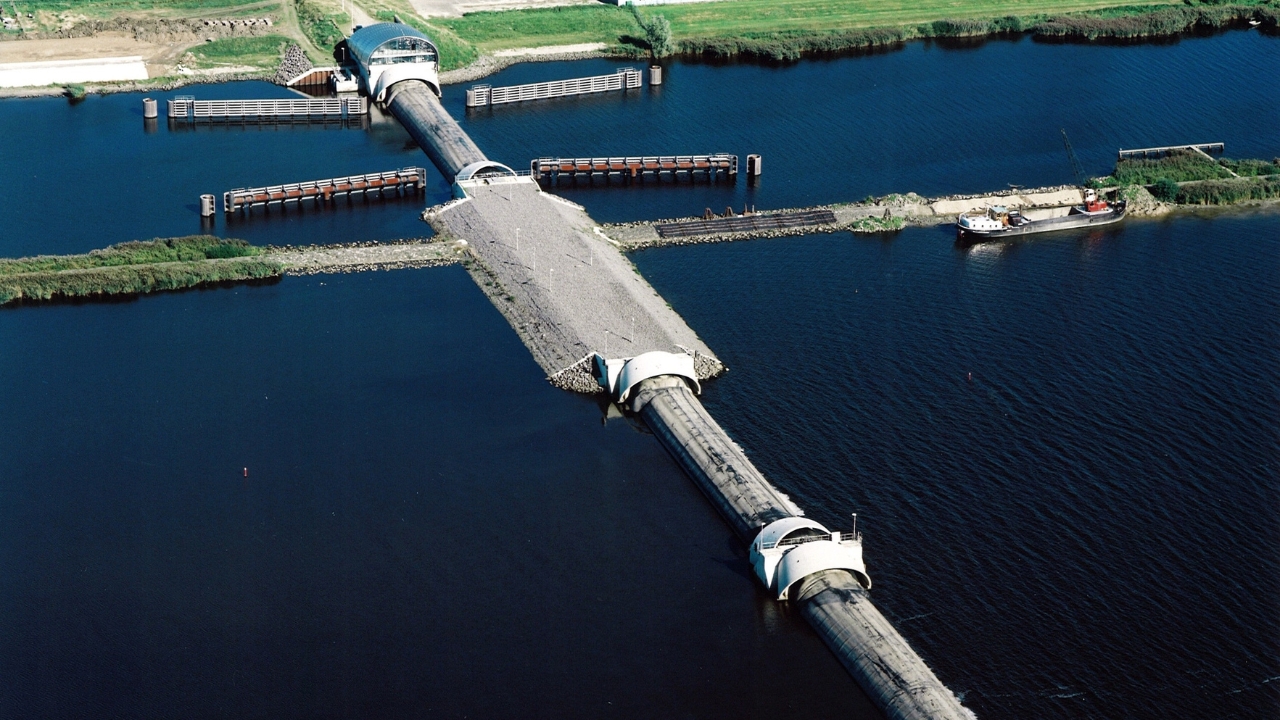
The problem behind the structure was larger than a single channel. The barrier protects areas around the Ketelmeer, Zwarte Meer, Noordoostpolder, and parts of Overijssel against high water levels caused by storms.
Without this type of protection, the traditional path would be to reinforce or elevate long stretches of dikes. In the case of Ramspol, the inflatable solution avoided the need to elevate about 115 km of these structures.
That’s when Dutch engineering chose an unusual path. Instead of a heavy metal gate, the answer came in three rubber bags, each 80 meters long, anchored to the canal bed.
Together, they reach a total capacity of approximately 21 million liters. The size is impressive, but what makes the system striking is precisely the contrast: a giant structure that disappears when not in use.
Three giant bags instead of traditional gates
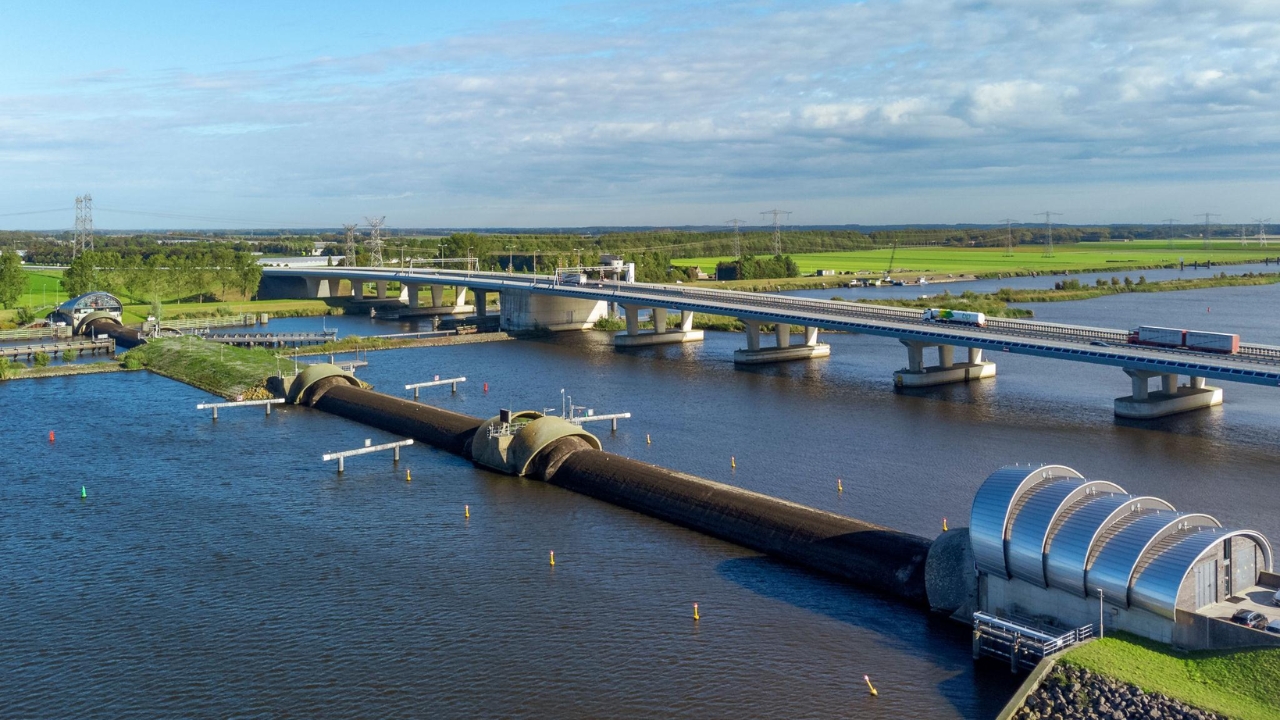
The barrier was completed in October 2001, according to DMC, a company linked to the technical project. The Rijkswaterstaat records that it has been in operation since December 2002 and began to be managed by the agency in July 2014.
The bags are made with reinforced rubber membrane. A technical study on the project indicates that the material is 16 mm thick and uses reinforcement with aramid and nylon, a necessary combination to withstand pressure, water movement, and wave effort.
The operation was also designed to reduce complexity. The barrier does not rely solely on water nor solely on air. It uses both. Air helps to raise the structure, while water contributes to giving weight and stability to the set.
When the risk passes, the bags are deflated and folded again at the bottom, releasing navigation. The defense disappears but is ready to return.
Annual tests show that the structure remains alive


Ramspol is not a decorative piece of engineering. It closes on average once or twice a year, in addition to tests, according to the Rijkswaterstaat.
In December 2023, during storm Pia, the barrier was closed to protect the region against elevated water levels. In December 2024, the NL Times, an English-language Dutch newspaper, also recorded the closure of the structure during an episode of strong winds and high water.
Every year, at the beginning of the storm season, the system undergoes a test closure. In 2025, this procedure was scheduled for October 7, with temporary interruption of navigation.
During these inspections, specialists analyze the fabric of the bags, assess their elasticity, and check internal systems. The official forecast cited by the Rijkswaterstaat is that the material will remain in good condition until approximately 2042.
A work that only appears at the limit
The Ramspol barrier draws attention because it reverses the logic of large flood control works. It does not impose itself on the landscape every day. It waits, hidden, until the water shows signs of threat.
Behind the curious image of a giant “airbag,” there is a direct response to an old problem in the Netherlands: living in a territory where controlling water is a matter of survival, planning, and technology.
More than an engineering curiosity, Ramspol shows how an unconventional solution can protect cities, avoid massive dike constructions, and transform an almost invisible structure into a decisive defense when the storm arrives.