Portuguese
  Spanish


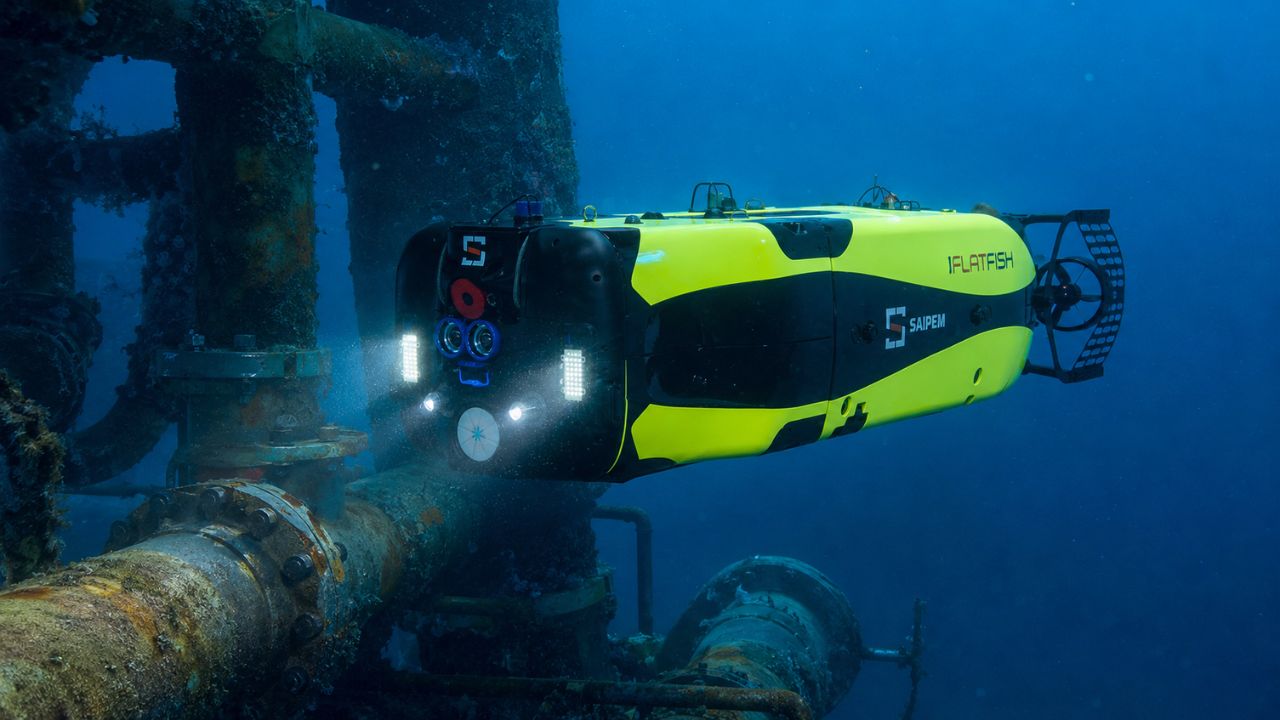

FlatFish, Brazilian AUV developed by SENAI CIMATEC and Shell, recharges at the seabed, operates without cables, and is expected to operate in the Campos Basin.
The inspection of pipelines and equipment in deep waters can gain a more autonomous operation with FlatFish, a Brazilian underwater vehicle created to work at the seabed without relying on constant support from vessels. The technology was developed by SENAI CIMATEC in partnership with Shell Brasil and the German Institute of Artificial Intelligence and Robotics.
The robot is already operating commercially in the Middle East and has a second model for the Brazilian market. The expectation is that the equipment will advance to the Campos Basin, expanding the use of autonomous systems in offshore inspections.
The difference lies in the mode of operation. FlatFish can remain installed at an underwater station, recharge batteries, exchange data via wireless connection, and independently set out to perform monitoring missions on pipelines, risers, umbilicals, and other submerged components.
-
Netherlands Builds Giant 240-Meter Inflatable Barrier That Rises to Protect Cities from Storm Surges

-
Eufy Unveils Omni S2: Advanced Robot Vacuum with 30,000 Pa Suction, Self-Cleaning Mop, AI Obstacle Avoidance, 12-in-1 Station, and Built-In Fragrance Dispenser

-
Swiss Glaciers Lose 10% of Volume in Two Years as Europe’s Largest “Water Tower” Dries Up; Scientists Use “Smart Stones” in the Alps to Gauge Remaining Water Supply for 170 Million People
-
Australia plans massive artificial reef project to protect Gold Coast and save storm-battered beaches from erosion



FlatFish reduces dependence on vessels in offshore inspection
FlatFish was designed to perform visual inspections and monitor complex underwater structures with less need for logistical mobilization. As it does not use umbilical cables, the equipment can operate without the continuous presence of a dedicated surface vessel.
This feature changes the inspection routine in the offshore sector, traditionally associated with the use of divers, cable-connected ROVs, and support ships. By reducing this structure, the system also decreases operational costs and emissions related to the use of diesel boats.
The proposal is to keep a resident robot in the underwater environment, ready to carry out monitoring missions and return to the docking base after completing the work. This logic allows for frequent inspections without repeating all the mobilization required by conventional methods.


The FlatFish project began in 2014, within a partnership between SENAI CIMATEC, Shell Brasil, and the German Institute of Artificial Intelligence and Robotics, known by the acronym DFKI. The technology received funding through research and development programs.
During the evolution of the project, the tests passed through the Bay of All Saints. In 2018, the technology entered the industrialization phase under license from Saipem, within the Hydrone program, aimed at autonomous underwater vehicles.
By 2026, the robot had already conducted tests for Petrobras. This advancement brings the solution closer to commercial use in ultra-deep waters and reinforces the presence of Brazilian technology in a strategic area for offshore exploration.
FlatFish can operate up to 3,000 meters deep
The equipment is an AUV, an acronym used for autonomous underwater vehicles. In the case of FlatFish, the operation can reach 3,000 meters deep, allowing it to operate in areas where direct human access is unfeasible.
The robot moves in different directions and performs inspections with high precision. To do this, it uses optical sensors, acoustic sensors, and high-resolution cameras, capable of generating three-dimensional images of the monitored structures.
This data helps identify anomalies in advance and allows monitoring the condition of pipelines, risers, umbilicals, and equipment installed on the seabed. The goal is to provide technical information for predictive maintenance.
Submarine station allows recharging and data exchange
One of the central features of FlatFish is the ability to remain submerged for up to six months. During this period, the robot is associated with a docking station, called a submarine garage, where it recharges batteries and transmits data via wireless connection.
The operation follows a logic of autonomous round-trip. The equipment leaves the station, executes the programmed mission, and returns to the recharge point without the need for direct human intervention during the cycle.
This architecture allows the system to remain closer to the structures that need to be monitored. As a result, inspections can be carried out recurrently, without always relying on the movement of vessels to the location.

The developers and project partners point to gains in important areas of offshore operation. The main change is the removal of people from high-pressure underwater environments, reducing human exposure to risky tasks.
There is also an economic impact, as the reduction of support vessels in most missions decreases logistical costs. The reduced use of diesel boats also contributes to a smaller carbon footprint for each inspection.
The reported benefits include:
- Operational safety: reduces divers’ exposure to high-pressure environments;
- lower logistical cost: decreases reliance on dedicated support vessels;
- low emissions: reduces the use of diesel vessels during inspections;
- technical data: generates 3D images, wall thickness measurements, and cathodic protection information.
FlatFish changes comparison with ROVs and divers
The difference between FlatFish and traditional methods mainly appears in autonomy. While divers depend on physical limits and ROVs usually operate connected by cables, the resident AUV works without an umbilical and with its own base on the seabed.
In conventional methods, the presence of a launch and support vessel is usually part of the operation. In the resident model, the underwater station takes on part of this role, allowing recharging, temporary storage, and information exchange.
The comparison also involves depth and mission time. Human dives are limited, while ROVs can reach great depths but remain tethered to support infrastructure. FlatFish combines a reach of up to 3,000 meters with prolonged presence in the underwater environment.
Technology integrates into Saipem’s Hydrone program
The industrial advancement of FlatFish takes place within Saipem’s Hydrone program. The initiative brings together autonomous vehicles aimed at deep-sea operations and places the Brazilian robot within a family of solutions for underwater inspection.
The technology has already received recognition in international awards and attracted interest from major global operators. This movement indicates that the resident AUV model is beginning to gain ground in a sector historically dependent on vessels, cables, and complex operations.

FlatFish brings together features that point to a new stage in deep-water inspections: underwater residence, autonomous recharging, wireless data transmission, and the ability to execute missions without umbilical cables.
By replacing part of the traditional logistics with remote operation, the robot reduces human exposure, cuts the need for constant surface support, and generates detailed data for predictive maintenance. The proposal also helps reduce emissions associated with inspections.
With commercial use in the Middle East and development linked to SENAI CIMATEC, Shell Brasil, DFKI, and Saipem, the FlatFish consolidates a Brazilian technology aimed at making offshore operations safer, more efficient, and sustainable.
With information from Monitor do Mercado