






 Portuguese
  Spanish
  5 min of reading
  0 comments


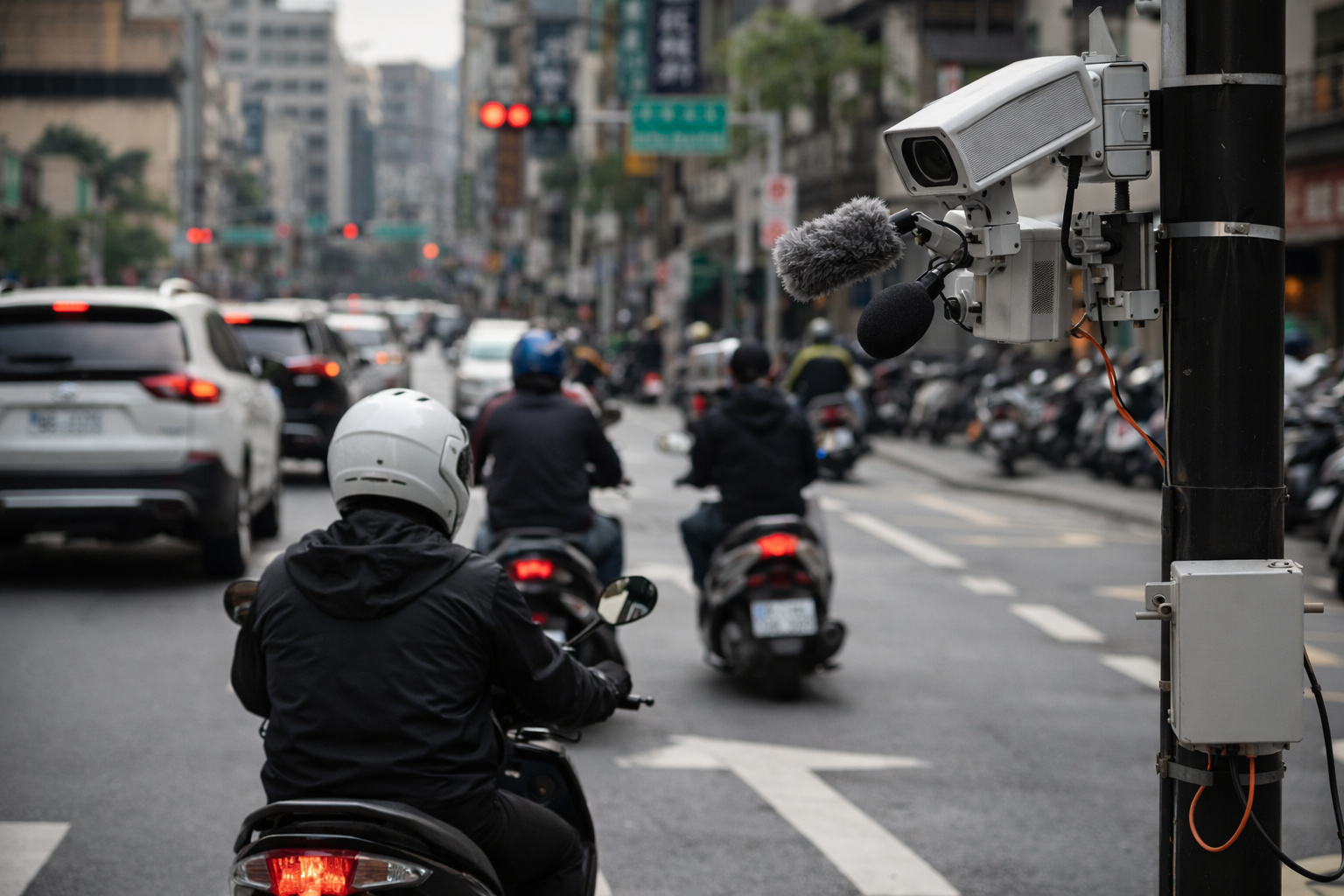
Taiwan implements noise radar that fines illegal exhausts and noisy vehicles, with automated enforcement and penalties that already impact drivers.
Throughout 2025, Taiwan maintained and expanded the use of a monitoring system that goes beyond the traditional focus on speed and dangerous driving: the combination of acoustic cameras with license plate recognition to identify vehicles with illegal exhausts or noise levels above the permitted. The policy is led by the Ministry of Environment of Taiwan, which has been structuring this control model for several years to primarily target modified motorcycles, cars with tampered exhausts, and noisy vehicles in densely populated urban areas.
In practice, the system transforms sound into a measurable infraction. Instead of relying solely on physical checkpoints or complaints, the technology automatically records the noise emitted by the vehicle, cross-references this measurement with the license plate captured by the cameras, and allows authorities to act based on objective data. According to official communications from the Taiwanese government, this model integrates noise detection, visual recording of the surroundings, and vehicle identification to reinforce the enforcement of the Noise Control Act and restrict the use of uncertified exhausts or illegal modifications.
Noise radar: how the technology that turns sound into fines works
The system implemented in Taiwan combines three main elements: high-precision acoustic sensors, cameras for license plate identification, and analysis software that correlates the captured noise with the responsible vehicle.
-
Uber Faces Shareholder Scrutiny as Board Accused of Ignoring Safety, Compliance, and Harassment Warnings Amid Over 3,500 U.S. Lawsuits

-
Ferrari’s First Electric Car Divides Fans, Priced at $630,000, Amid Concerns Over Limited Editions; Brand Clarifies It’s Not Just for Future Perks
-
BYD Dolphin Mini: The Electric Car That Defies Depreciation, Losing Only 3.58% in a Year and Becoming the Best-Selling Retail Model Under $22,000

-
Electric Car JAC E-JS4 Loses $19,000 in Value in One Year, Leading Record Depreciation of Used Cars in Brazil Due to Expensive Battery and New Models


These sensors are capable of measuring sound pressure levels in decibels in real-time. When a vehicle exceeds the permitted limit, the system records the event and associates the noise peak with the image captured at the same moment.
Unlike traditional radars that measure speed, the noise radar measures sound intensity and frequency, allowing it to distinguish between environmental noise and specific exhaust emissions.
After the automatic recording, the data is sent for validation by competent authorities, who confirm the infraction before issuing the penalty.
Modified exhausts are at the center of enforcement
The legislation in Taiwan already included restrictions on modifications to exhausts, but enforcement was limited. With the new technology, the country has begun to require that modified systems be certified and officially registered.
According to government statements, drivers using non-certified exhausts can be fined between NT$ 900 and NT$ 1,800, amounts that can significantly increase if the vehicle fails mandatory technical inspections.
In some cases, when there is recidivism or combination of infractions, the penalties may exceed NT$ 5,400, in addition to the requirement for vehicle regularization.
This change shifts the focus of enforcement: it is not just about speed or driving behavior, but also about environmental and noise impact.
Motorcycles are the main target of the new policy
Taiwan has one of the highest densities of motorcycles in the world, with millions of units circulating daily in cities like Taipei, Kaohsiung, and Taichung.
This scenario has made urban noise a significant public health issue. International studies already associate prolonged exposure to high noise levels with increased stress, sleep disturbances, and cardiovascular risks.
Motorcycles with modified exhausts are responsible for a large part of urban noise, especially at night, which has led authorities to prioritize this type of vehicle in automated enforcement.
From reactive enforcement to continuous and automated system
Before the introduction of noise radar, enforcement relied on in-person operations. Agents had to approach suspicious vehicles and perform manual measurements, which limited the reach of actions.
With the new technology, Taiwan now operates a continuous system, similar to what already occurs with speed radars.
This means that enforcement is no longer sporadic but becomes permanent, significantly increasing the capacity to detect infractions.
Additionally, the system reduces subjectivity, as the measurement is done by calibrated and validated equipment.
Integration with databases and recidivism tracking
Another important advancement is the integration of noise data with vehicle records. This allows for the identification of recidivism patterns and the application of progressive measures.
Drivers who accumulate infractions may be required to undergo additional technical inspections or even face administrative restrictions.
The system transforms noise into a traceable data point, allowing for the tracking of each vehicle’s history over time.
Direct impact on driver behavior
Since the beginning of implementation, Taiwanese authorities indicate a reduction in the use of illegal exhausts in monitored areas.
The effect is similar to that observed with speed radars: the mere presence of the system alters driver behavior.
Drivers begin to avoid irregular modifications or reduce the use of noisy vehicles in areas where monitoring is in place.
Noise definitely enters the urban mobility agenda
The adoption of noise radars marks a structural change in how cities deal with traffic. The focus shifts from just flow and road safety to include quality of life.
The sound emitted by vehicles is now treated as a relevant environmental indicator, just like pollutant emissions.
This movement follows global trends, with European cities testing similar systems to combat noise pollution.
Technology can spread to other countries
Although Taiwan is among the most advanced cases, the concept of noise enforcement has already been studied in other countries. The combination of acoustic sensors and data intelligence paves the way for applications in different urban contexts.
Cities with high traffic density and noise pollution problems are likely to adopt similar solutions in the coming years.
The implementation of noise radar shows that traffic enforcement is entering a new phase, where aspects previously considered secondary are now being monitored rigorously.
Speed, signal running, and cellphone use continue to be central infractions, but now sound enters the equation. The vehicle is no longer analyzed solely by what it does on the road but is also evaluated by the impact it causes on the surrounding environment.
Do you agree that vehicle noise should be enforced with the same rigor as speed?
With technology allowing for precise measurement and punishment of noise, traffic begins to incorporate new rules that go beyond direct safety. This change could redefine what it means to drive responsibly in modern cities.





Be the first to react!