Portuguese
  Spanish


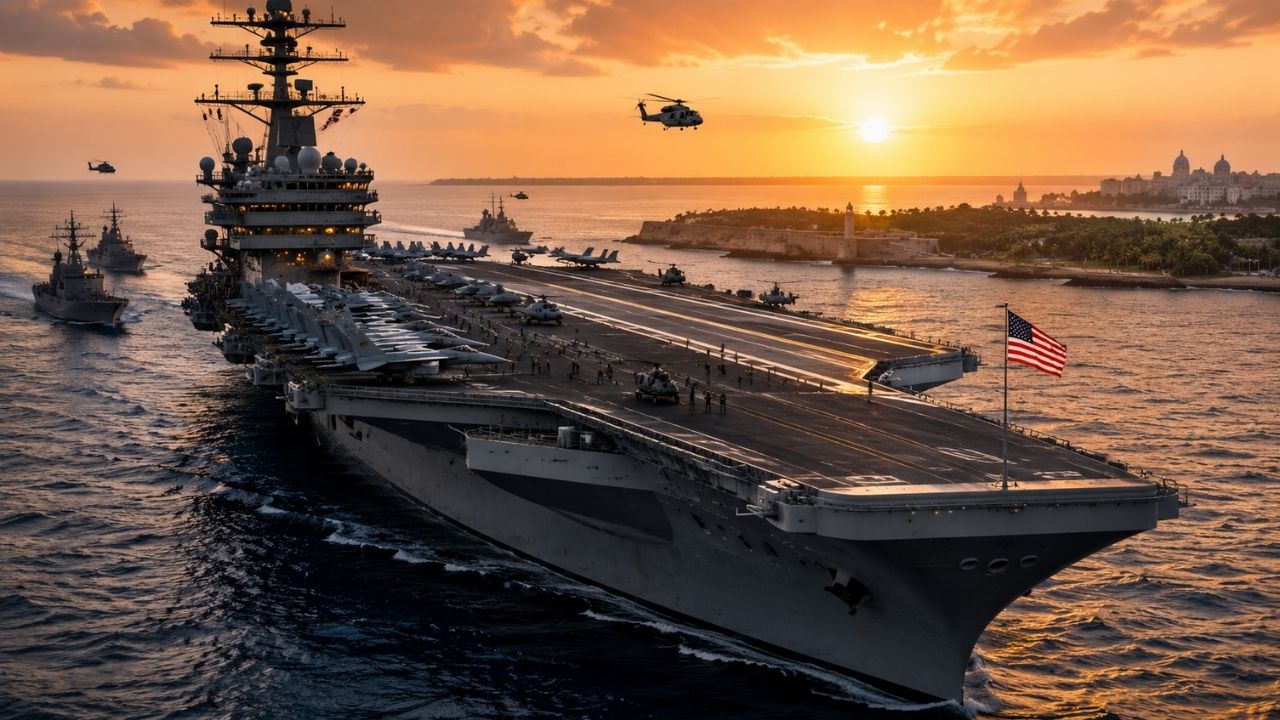

Nuclear aircraft carriers like the USS Abraham Lincoln don’t just represent military power: this type of ship brings together embarked aviation, command, power generation, communication, logistical support, and strategic presence, reigniting the debate about Cuba, the Caribbean, and the United States’ force projection.
According to the Fox News website, Donald Trump mentioned Cuba during a speech at the Forum Club of the Palm Beaches in Florida on May 1, 2026, and, in a way described by the report as seemingly hypothetical, brought up the possibility of moving a large ship, such as the USS Abraham Lincoln, closer to the Cuban coast. Fox itself reported that the White House did not immediately clarify whether the statement indicated any real plan or merely a political declaration.
The statement reignited a larger discussion about the symbolic and operational weight of a nuclear aircraft carrier. More than a warship, this type of vessel functions as a mobile air base, command center, support structure, communication platform, and demonstration of strategic presence.
Trump’s statement on Cuba reignited debate about the real weight of an aircraft carrier

In the statement recorded by Fox News, Trump mentioned Cuba, said the country would have “problems,” and then cited a hypothetical show of force with a large aircraft carrier. The president did not present operational details or formally announce military action against the island.
-
A fossil kept for years in a small museum in Montreal concealed 450-million-year-old soft tissue, a discovery that has only happened once before in history.

-
Engineers spend a decade building a $2.3 million bridge, but the project features a surreal curve, becomes a joke, and ends with seven suspended.

-
7-year-old boy acts without hesitation and saves his 1-year-old brother from drowning in the family pool in Texas: the boy’s courage impressed the sheriff and he may now receive an official police commendation.

-
The forgotten Atari stock that seemed like something out of a movie: millions of sealed cartridges were buried underground and were sold for very low prices.





Therefore, the central point is not to claim that an operation is underway. What the phrase did was bring back into public debate an old geopolitical question: why can the mere presence of a nuclear aircraft carrier near a sensitive region generate so much repercussion?
On the international stage, this type of vessel is used as a sign of reach, readiness, and response capability. Before any concrete action, its presence already communicates strategic interest.
According to the U.S. Navy, aircraft carriers are the center of American naval forces
According to the United States Navy, aircraft carriers are considered the center of American naval forces, and in times of crisis, the recurring question among leaders is where these ships are positioned. The Navy itself states that these vessels operate in missions of maritime control, attacks, security, humanitarian assistance, and disaster response.
This point helps explain why the mention of the USS Abraham Lincoln gained weight. An aircraft carrier is not just a platform with planes. It carries an entire structure of command, aviation, logistics, communication, and support.
When a ship of this size is mentioned in a crisis, the political message usually goes beyond the hull. What appears on the horizon is the ability to deploy a mobile military base to a strategic region.
USS Abraham Lincoln is a Nimitz-class nuclear aircraft carrier


According to the official U.S. Navy page, the USS Abraham Lincoln, CVN 72, is the fifth Nimitz-class nuclear aircraft carrier and was named in honor of the 16th President of the United States.
The Nimitz class is among the largest groups of warships ever built. The Navy reports that Nimitz and Gerald R. Ford-class aircraft carriers are designed for approximately 50 years of service life, with only one major mid-life nuclear refueling.
This characteristic reinforces the strategic autonomy of the ship. A nuclear aircraft carrier can remain on long missions, deploy aircraft, coordinate operations, and sustain military presence without depending on the same resupply logic as conventional vessels.
Floating city gathers thousands of people, water, meals, and continuous operation
The comparison to a floating city is based on scale. In a publication by the U.S. Pacific Fleet about the USS Nimitz, the ship that gives the class its name, the vessel is described as approximately 100,000 tons, 1,092 feet long, with about 5,000 sailors and marines on board, capable of serving 18,000 meals per day and producing over 400,000 gallons of fresh water daily.
These numbers show why the presence of an aircraft carrier causes an immediate impact. It doesn’t just transport weaponry. It carries people, infrastructure, workshops, communication systems, technical teams, support means, and the ability to maintain operations for long periods.
In a region of tension, this combination transforms the ship into a highly visible political and military asset.
Strength is also in communication and presence, not just in weapons
Public debate often associates aircraft carriers only with fighter jets, missiles, and firepower. But their strategic function is broader.
The U.S. Navy states that these vessels operate in maritime security, route protection, power projection operations, and can also offer support capabilities in disaster situations, with helicopters and command, control, communications, and intelligence systems.
Therefore, in an international crisis, the presence of an aircraft carrier also functions as communication. It can signal diplomatic pressure, military readiness, support for allies, or an attempt at deterrence.
In the case of Cuba, Trump’s statement gained repercussion precisely because it mixed a sensitive political declaration with a historical symbol of American naval power.
Fighters and helicopters extend the reach of a mobile base at sea

The main function of an aircraft carrier is to allow aircraft to operate far from land bases. This transforms the ship into a mobile runway on the high seas.
From this platform, fighter jets, helicopters, and support aircraft can operate. These assets are used in surveillance, transport, naval group defense, search and rescue, communication, and rapid response missions.
This capability changes the scale of any crisis. An aircraft carrier can deploy air presence to areas where there is no nearby land base or where military presence needs to be demonstrated quickly.
Therefore, when a political leader mentions an aircraft carrier, the message usually involves the entire embarked complement: aircraft, crew, command, logistics, power, and the ability to remain in the area.
Medical support and crisis response are also part of embarked power
The medical and humanitarian dimension also enters this debate. The U.S. Navy emphasizes that aircraft carriers offer capabilities for disaster response and humanitarian assistance, including helicopters and command and communication systems to support aid distribution.
This does not transform the ship into a civilian hospital, but it shows that it carries medical and operational support structure to attend to critical situations on board and support emergency responses.
This dual function explains part of the platform’s political weight. The same ship that projects military force can also serve as a point of support, communication, transport, and coordination in times of crisis.
Debate on Cuba shows how force projection also acts in the psychological field
Cuba occupies a historical place in United States foreign policy. Therefore, any statement involving the island, the Florida coast, and an American aircraft carrier immediately generates interpretations about sovereignty, diplomacy, regional security, and tension in the Caribbean.
In this scenario, a nuclear aircraft carrier functions as a symbol. It does not need to act to produce a political effect. The mere image of such a structure near a sensitive region already alters discourses, perceptions, and diplomatic calculations.
This is the logic of force projection: showing capability before using capability. In many cases, the goal is to influence decisions, demonstrate readiness, and create pressure without escalating tension into direct confrontation.
Aircraft carriers remain relevant even in the era of drones, satellites, and missiles
The advancement of drones, satellites, long-range missiles, and cyber warfare has raised questions about the future of aircraft carriers. Still, these vessels remain at the center of American naval strategy precisely because they combine various functions into a single platform.
A nuclear aircraft carrier combines aviation, command, communication, logistics, medical support, power generation, diplomatic presence, and endurance capability.
Trump’s statement about Cuba ended up serving as a starting point for this discussion. The focus shifted from just the political phrase to a larger question: what does an aircraft carrier truly represent when used as a military message?
The answer lies in scale. It’s not just a ship. It’s a mobile base, a floating airfield, a command center, a support structure, and a symbol of power capable of changing the tone of a crisis even before any shots are fired.
In your opinion, is the mere presence of a nuclear aircraft carrier near a crisis region still enough to change political decisions, or has this type of pressure lost its force in the era of drones, satellites, and long-range missiles? Comment.