






 Portuguese
  Spanish
  7 min of reading
  0 comments


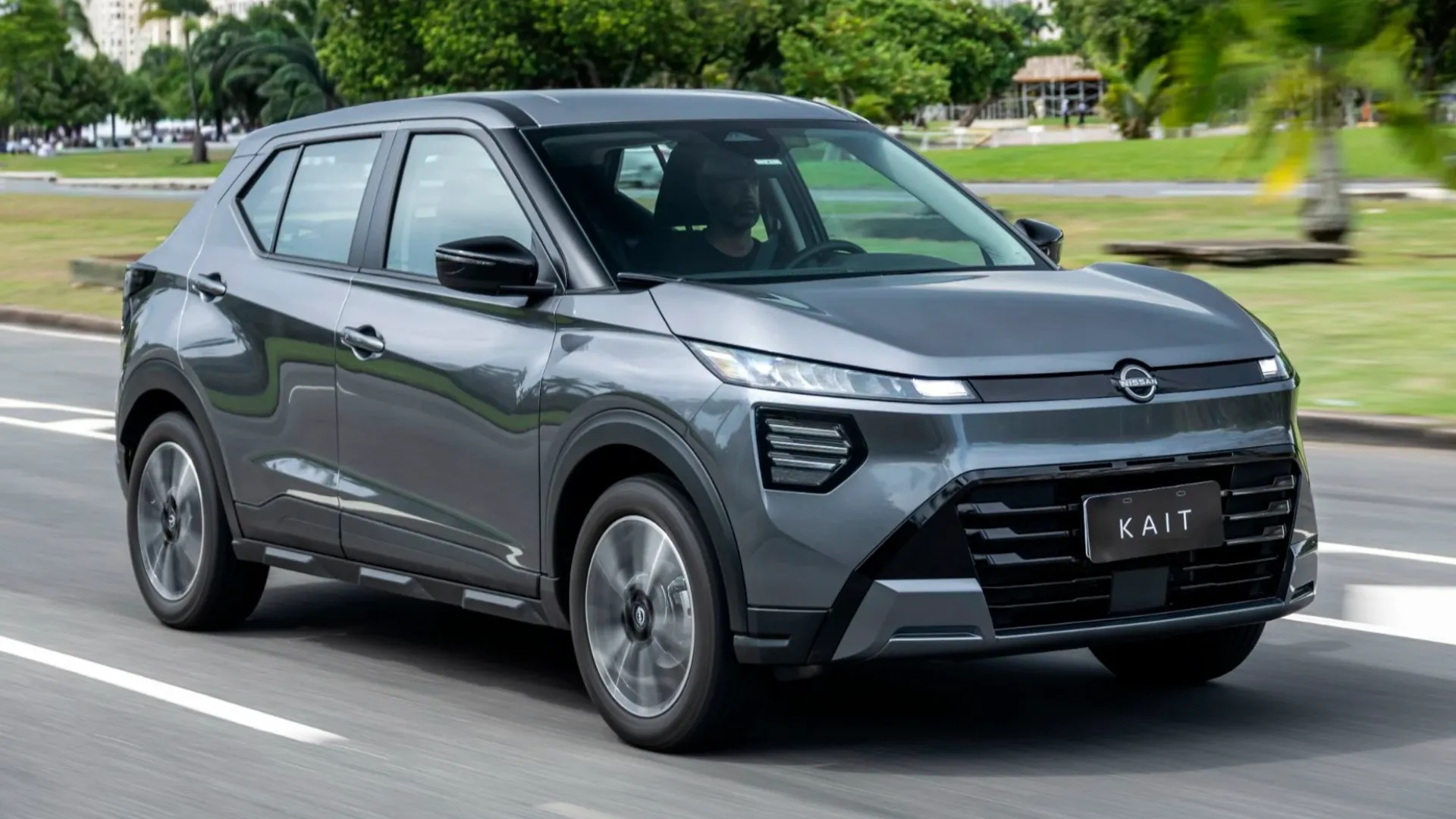
Nissan Kait 2026 bets on fuel consumption of up to 13.7 km/l, installments of R$ 1,599, and autonomy above 560 km to compete in the compact SUV market.
For years, the Brazilian market accustomed consumers to associating economical cars only with extremely compact and simple models. Now, Nissan is trying to occupy a different space with the new Kait 2026, a compact SUV that bets precisely on the combination of relatively low fuel consumption, an elevated driving position, CVT transmission, and a more rational cost of ownership to attract buyers who have given up on traditional popular hatchbacks.
The model gained attention because it appears in promotional campaigns with a price starting from R$ 117,990 and financing conditions involving installments in the range of R$ 1,599, something that immediately caught attention on social media and automotive websites. At the same time, Nissan tries to sell the idea that the Kait delivers an experience closer to a modern SUV without reaching prices that already easily exceed the R$ 150,000 range in larger competitors.
Another point that helped the vehicle get on the radar was the official fuel consumption of up to 13.7 km/l with gasoline on the highway, combined with the 41-liter tank that allows an estimated range of over 560 km under ideal conditions. In a scenario of expensive fuel and high financing, this type of data has gained enormous weight in the purchase decision.
-
BYD Dolphin Mini: The Electric Car That Defies Depreciation, Losing Only 3.58% in a Year and Becoming the Best-Selling Retail Model Under $22,000

-
Electric Car JAC E-JS4 Loses $19,000 in Value in One Year, Leading Record Depreciation of Used Cars in Brazil Due to Expensive Battery and New Models
-
Used Civic and Corolla have been stuck in stock for months. “People are preferring Chinese cars,” says the car dealership owner.

-
Toyota Sienna becomes a “VIP lounge on wheels” in Brazil after receiving a Chinese luxury kit, seats with massage, Starlink, refrigerator, and a 245 hp hybrid engine, targeting high-income families, artists, and executive transport in an almost million-dollar van.


Nissan Kait 2026 tries to occupy space among affordable compact SUVs in Brazil
Nissan’s strategy is quite clear. Instead of directly competing with more expensive mid-size SUVs, the Kait tries to capture consumers who have outgrown popular hatchbacks but still don’t want to get into vehicles that are too expensive or too large for urban use.

This movement is happening because the Brazilian market has changed radically in recent years. Models considered popular have surpassed the R$ 80,000 mark, and many consumers have started to consider that, by financing a little more, they can already migrate to a compact SUV with a more modern look, an elevated position, and a superior technological package. The Kait fits precisely into this intermediate space between a traditional urban hatchback and a premium compact SUV.
Promotional price and lower installments became the model’s main commercial arguments
Much of the Kait’s repercussion happened because of promotional campaigns disclosed on automotive websites and dealerships. The model appeared with an initial price of R$ 117,990, accompanied by conditions involving a high down payment and installments of approximately R$ 1,599 in some specific plans disclosed by the automotive sector.


These campaigns try to convey a sense of affordability at a time when many compact cars are dangerously approaching the R$ 100,000 mark. In practice, Nissan tries to convince consumers that it’s more worthwhile to go directly for a compact SUV than to invest high amounts in smaller hatchbacks.
This helps explain why the model began to gain traction in comparisons involving vehicles that were originally much cheaper.
Fuel consumption of up to 13.7 km/l helps the Kait get on the radar of those seeking economy
Fuel consumption has become one of the central pillars of the model’s communication. According to numbers officially released by Nissan, the Kait can achieve up to 13.7 km/l on the highway with gasoline, a value considered competitive for an automatic compact SUV.

Although it doesn’t reach the averages of modern hybrids, the data is noteworthy because many compact SUVs end up penalized by greater weight, wide tires, and more powerful turbo engines. The Kait tries to find a balance between urban performance and energy efficiency without excessively increasing operational costs.
In times of expensive fuel, range and consumption have ceased to be just technical figures and have become extremely strong commercial triggers.
41-liter tank allows estimated range of over 560 km
When consumption is combined with the 41-liter tank, the result generates a theoretical range of approximately 562 km in highway use with gasoline. This type of data gained traction because many consumers began to value cars capable of traveling long distances without frequent refueling.
In practice, this means longer trips with fewer stops and less feeling of constant fuel expenditure. Although the actual range varies according to traffic, speed, air conditioning, and transported weight, the number helps position the Kait as a rational vehicle for daily use.
This argument becomes even more important when compared to larger and heavier SUVs that consume significantly more fuel.
CVT transmission aims to deliver urban comfort without excessively increasing consumption
Another important element of the Kait is the use of the CVT transmission, a technology increasingly common in urban vehicles focused on smoothness and energy efficiency. Unlike traditional automatic transmissions with noticeable shifts, the CVT prioritizes continuous and more linear operation.
This helps especially in heavy urban use, reducing the feeling of jolts and improving comfort in traffic jams. At the same time, it helps keep the engine working at more efficient rotations during moderate accelerations. Nissan is betting precisely on this combination of smoothness and rational consumption as a differential for urban daily life.

Compact SUV look tries to attract consumers tired of traditional hatchbacks
Even consumers who do not effectively use off-road capabilities continue to migrate to compact SUVs because of the elevated driving position and the visual sense of robustness. The Kait follows exactly this market trend.
Higher lines, greater ground clearance, and a more robust appearance help the model look more modern compared to traditional hatchbacks like Kwid, Mobi, and C3. This creates a perception of evolution even without the vehicle reaching the dimensions of larger SUVs. This psychological effect has become extremely important in the current Brazilian market.
Nissan tries to position the Kait as a rational SUV, not a premium SUV
Unlike more sophisticated and expensive models, the Kait does not try to compete directly in the premium segment. The proposal is to offer a rational package, focused on cost-benefit, economy, and efficient urban use.
This means balancing equipment, interior space, and consumption without turning the vehicle into an excessively expensive SUV. The goal seems to be precisely to reach consumers who are still strongly concerned with installments, fuel, and maintenance.
This approach helps explain why the model began appearing in comparisons with much simpler cars.
Nissan Kait 2026 technical data shows focus on efficiency and urban use
| Nissan Kait 2026 Technical Data | Information |
|---|---|
| Starting Price | R$ 117.990 |
| Installment disclosed in campaigns | R$ 1.599 |
| Engine | 1.0 turbo |
| Transmission | CVT |
| Estimated Power | approx. 125 hp |
| Highway fuel consumption with gasoline | up to 13.7 km/l |
| Fuel Tank | 41 liters |
| Estimated Range | approx. 562 km |
| Trunk Capacity | approximately 432 liters |
| Category | Compact SUV |
Growth of compact SUVs completely changed the Brazilian market
The rise of compact SUVs profoundly changed the behavior of the Brazilian consumer. Many buyers left traditional sedans and hatchbacks to seek vehicles with a more robust appearance and an elevated driving position.
Automakers quickly noticed this change and began investing heavily in this segment. Today, practically all of them have at least one compact SUV aimed at urban use.
The Kait emerges precisely in this extremely competitive scenario, trying to occupy space between cheaper models and SUVs that already exceed much higher values.

Nissan bets on balance to avoid the extremes of the current market
The Brazilian market has created two extremes in recent years: extremely simple and cheap cars on one side, and increasingly expensive SUVs on the other. The Kait aims to operate precisely in the intermediate region.
The proposal seems to be to offer a modern look, competitive fuel consumption, automatic transmission, and good range without reaching prices considered unattainable for part of the population. This positioning could be the main factor for the model to gain market share.
Kait shows how the concept of a “rational car” has changed in Brazil
A few years ago, a rational car was generally associated with small and basic models. Today, many consumers see rationality differently: they want economy, but also comfort, an elevated driving position, and a modern appearance.

The Kait represents exactly this change in mindset. Instead of competing solely on absolute low price, it tries to convince buyers that it’s worth financing a bit more to enter a segment considered superior. This shows how quickly the concept of a popular car has changed in Brazil.
Nissan’s new SUV tries to prove that range, installment payments, and fuel consumption have become as important as power and design
Perhaps the most interesting aspect of the Kait is precisely how it is sold. The communication focus is not just on power or appearance, but mainly on fuel consumption, range, and the monthly installment value.
This reveals an important change in Brazilian consumer behavior in 2026. In a scenario of high interest rates and expensive fuel, many buyers have begun to prioritize financial predictability over extreme performance.


Be the first to react!