Portuguese
  Spanish


In One Of The Most Extreme Territories Of The Planet, 1/3 Of The Population Still Maintains A Life Isolated From Modernity, Based On Secular Traditions Of Survival
Located in the heart of Asia, surrounded by Russia and China, Mongolia is a country where human capacity for survival is tested daily. Although its territory is immense, it has one of the lowest population densities on Earth, and even the simple day-to-day can become one of the greatest challenges on the planet. It is in this scenario that about one-third of the population opts for an isolated life from modern chaos, maintaining traditions that directly connect the past to the present.
This deep historical connection has a name: Genghis Khan. In the 13th century, he unified nomadic tribes and forged the largest continuous empire in history. As detailed by the portal Unique World, many aspects of the culture that Khan consolidated nearly 800 years ago remain alive, especially among those who still traverse the vast plains with their herds, maintaining traditions of self-sufficiency that are practically unchanged.
The House That Moves With The Wind
The ultimate symbol of Mongolian nomadic life is the ‘Ger’, also known by the Russian term ‘Yurt’. This circular structure has been the traditional home for centuries, designed for practicality and durability. Made of a lightweight wooden frame covered by thick felt (sheep wool) and a waterproof cover, its round shape provides superior resistance to the strong and relentless winds of the steppes, while also allowing for uniform circulation of internal heat.
-
Rare fox feared “extinct” found alive on Caribbean island after over two decades without official sightings

-
21-Year-Old Brazilian Student Turns Homemade Popsicle Hobby into $100,000-a-Month Business

-
Australia Dumps Hundreds of Thousands of Tons of Gravel into Rivers to Restore Natural Barriers and Reverse 150 Years of Erosion

-
Bird-Inspired Robot Glides on Air Currents up to 10 m/s, Balances Itself, and Aims to Save Energy in Industrial Inspections and Meteorological Balloons


The Ger is a house designed to move with the world, not to resist it. Setting up or taking down a structure takes only a few hours, which is essential for families that move several times a year. This movement follows the flow of nature: in summer, they seek higher and greener pastures, with temperatures nearing 40°C; in winter, they descend to valleys sheltered from the wind and cold, which can easily drop to -40°C. This extreme variation makes day-to-day life in Mongolia one of the most difficult on the planet.
Survival Where Almost Nothing Grows
The absence of trees in the vast steppes, caused by the extreme climate and poor soil, has forced nomads to rely almost exclusively on their animals. They mainly raise sheep (for wool and meat), goats, and yaks (that provide milk, meat, and leather). In Mongolian culture, everything is utilized. Mare’s milk, for example, is transformed into ‘Airag’, a mildly alcoholic fermented drink that is a symbol of local hospitality.
With the scarcity of wood, dried dung from animals becomes the primary fuel. It is used for cooking, heating the Ger, and even as thermal insulation in the walls. This complete self-sufficiency is the basis of survival in the inhospitable environment, demonstrating an adaptation forged over millennia.
The Horse: The Soul Of Mongolia
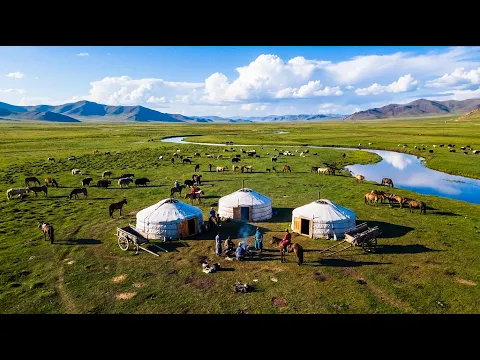

An ancient local proverb says, “A Mongolian without a horse is like a bird without wings.” For centuries, the horse has been the primary means of transportation, sustenance, and a tool of war. Mongolia has two main species. The first is the rare Takhi, the only truly wild horse in the world, which has never been domesticated. It nearly disappeared from the wild in the 60s but was saved by specimens in European zoos and is now in slow recovery, with about 400 individuals in the wild.
The second species is the domestic Mongolian horse. Small, measuring only 1.30 m, but extremely agile and resilient, they were responsible for the rapid expansion of Genghis Khan’s Empire. Today, they are pillars of peaceful survival, raised free and without shoes. It is estimated that there are more than 3 million horses in Mongolia, a number greater than the human population of the country.
Living Traditions: From Festivals To Throat Singing

The nomadic culture is vividly expressed in its festivals. The largest of these is the Naadam, the National Festival held in July. Horse racing is the center of it all, but in a unique way: the jockeys are children aged 5 to 13, and the races can extend up to 30 km across the plains. In the western region, the Eagle Festival celebrates the tradition of the Kazakhs, who hunt using golden eagles, a skill passed down from father to son.
The music is also a reflection of the isolation in the steppes. The sound of the ‘Khuur’, a two-stringed violin, is often accompanied by the ‘Khoomii’, the famous throat singing. It is believed that this unique vocal technique, where the singer produces multiple tones simultaneously, was developed by shepherds who spent long periods alone tending to their herds in the silent vastness.
From Gobi Fossils To Northern Reindeer Herders
The geography of Mongolia is as extreme as its climate. To the south, the vast Gobi Desert is not made only of dunes, but primarily of gravel and stones. It was there that the first dinosaur eggs in history were found, revealing how these animals hatched, and where the famous Velociraptor was discovered in 1924. The desert is also home to the Bactrian camel, with two humps.
In total contrast, the northern part of the country is covered by coniferous forests, lakes, and mountains, forming part of the Siberian boreal forest. It is there that the Dukha live, one of the last reindeer herding peoples in the world, who depend on these animals for absolutely everything: milk, meat, and transport. In the Altai Mountains, to the west, the isolation is such that many villages remain inaccessible for much of the winter.
The Challenge Of The Most Polluted Capital In The World
Although isolated life defines the image of the country, the modern reality is a paradox. Almost half of the entire population of Mongolia lives in the capital, Ulaanbaatar. The city is a center of contrasts, with modern skyscrapers on one side and extensive “Ger neighborhoods” on the other, where families from the countryside try to adapt to urban life without abandoning their traditional homes.
The biggest challenge of the capital is heating. During the harsh winters, the massive burning of coal and wood in the Ger neighborhoods to combat the extreme cold generates catastrophic levels of air pollution. This phenomenon has made Ulaanbaatar the most polluted capital in the world, creating a serious public health problem that clashes directly with the pure image of the steppes.
Mongolia is a symbol of autonomy and adaptation. Even with the advance of Ulaanbaatar, the nomadic culture remains the foundation of national identity. The way Mongolians deal with their environment, respecting the cycles of nature and only utilizing what is necessary, is an example of balance between tradition and survival. In the same territory where once departed the most feared army on Earth, today children ride freely, celebrating the heritage of a people who have learned to live with the wind, rather than against it.
This coexistence between the nomadic past and the urban present is fascinating. Do you believe that this traditional lifestyle will manage to resist globalization and climate challenges? Or is urban life, even polluted, the inevitable future? Leave your opinion in the comments, we want to know your view on this way of life.