






 Portuguese
  Spanish
  5 min of reading
  0 comments


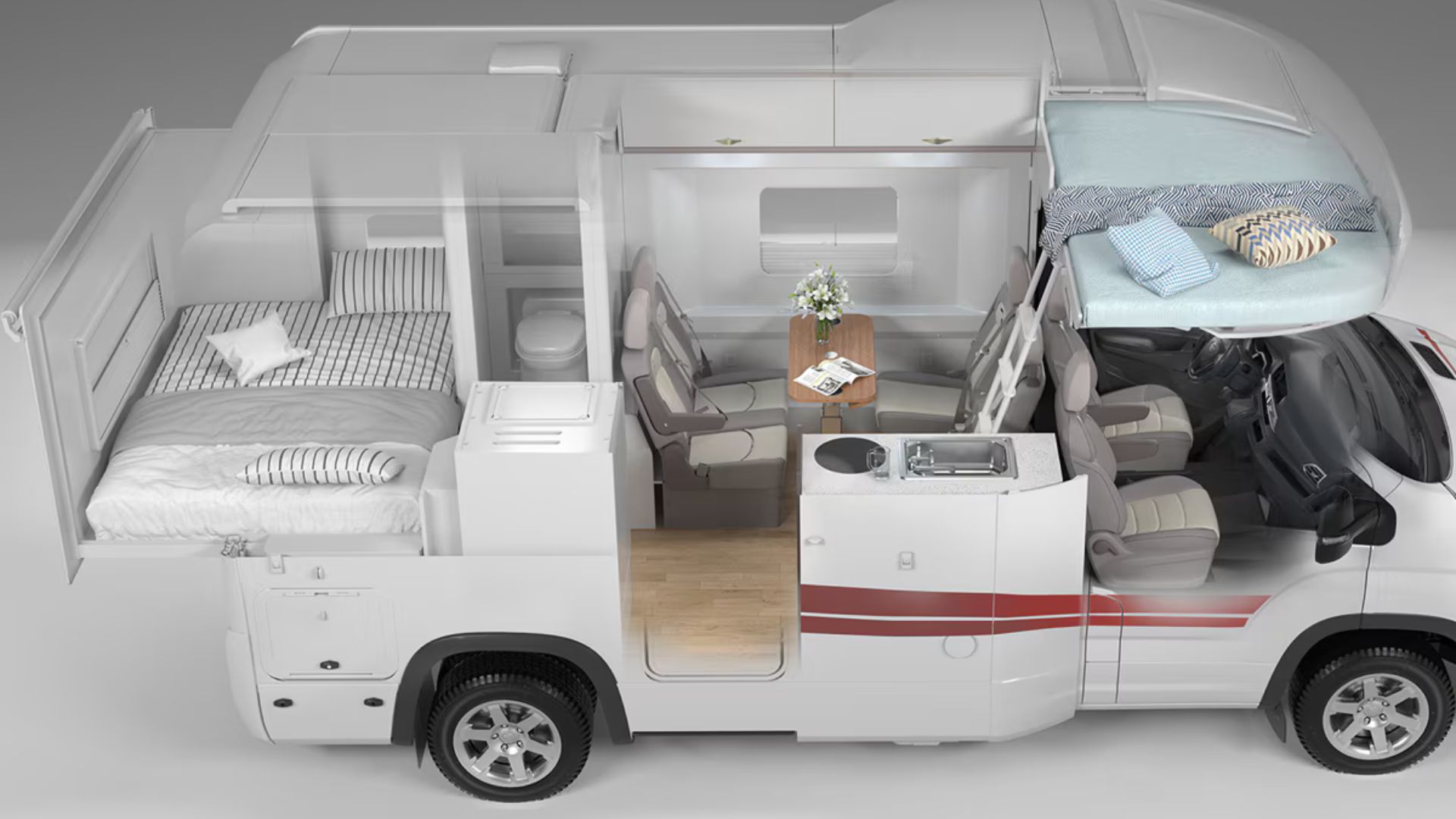
Extreme Engineering Transforms Motorhomes Into Mobile Mansions With Elevator, Retractable Terrace, And Even Integrated Helipad.
The global motorhome industry has entered a new phase of technological audacity, combining mobile architecture solutions, aerospace engineering, and nautical design to transform recreational vehicles into expandable, self-sufficient, and visually striking structures capable of rivaling fixed mansions in comfort and sophistication.
A survey presented by the channel Power of Industry shows how recent projects demonstrate that manufacturers from China, Europe, the United States, and Oceania are vying for attention with concepts that break with the traditional rectangular shape, incorporating retractable mechanisms, automated systems, and even aerial platforms integrated into the roof.
Motorhome That Rotates 90 Degrees And Doubles Internal Space
Among the highlights is the Romotow T8, conceived in New Zealand, which proposes a structural break by allowing the central module of the caravan to rotate 90 degrees when parked, creating an “L” configuration that increases usable space and reveals a protected terrace.
-
British Lawyer Faces Up to Two Years in Prison After Organizing Volunteers to Clean Polluted River in Brazil

-
Unable to Afford a Traditional Home, Brazilian Woman Builds a Compact Mobile House Using Recycled Materials

-
Women in a Brazilian Community Empowered to Renovate Homes Independently Through Design and Planning Skills
-
Man Builds Solar-Powered Tiny Home to Escape Rent, Faces Demolition Order in Expensive Australian Region


During movement, the set maintains a closed aerodynamic profile, but upon reaching the destination, the rotating mechanism repositions the living space outside the main line of the chassis, doubly increasing the internal surface and creating a patio integrated with the main environment.

The movement is executed by hydraulic systems designed to stabilize the structure even on uneven terrain, reducing vibrations and ensuring automatic leveling while the module moves, a solution that reinforces the proposal to unite mechanical precision and residential comfort.
Chinese Model With Retractable Second Floor And Internal Elevator
If the New Zealand innovation bets on lateral expansion, Chinese engineering decided to grow vertically with the Maxus Life Home V90 Villa Edition, presented as a van that transforms into a two-story residence by activating an elevation system in the roof.
When parked, the upper part rises and reveals a second floor surrounded by glass, with an integrated balcony and an area configured as a panoramic living room, enhancing the feeling of space without compromising the height regulations during highway travel.
The most commented element, according to the Power of Industry, is the installation of a cylindrical internal elevator, an uncommon solution in recreational vehicles, which connects the main floor to the upper floor and reinforces the proposal to transport experiences typical of high-standard real estate to the road.
Inside, glazed surfaces with opacity control and minimalist decor highlight the strategy of transforming the motorhome into a showcase of embedded technology, compacting in a few meters solutions normally associated with luxury apartments.
Hidden Garage For Transporting Supercars

Another aspect of this race involves the integration of hidden garages, allowing the owner to transport a sports car inside the motorhome itself, a solution described as a response to the logistical challenge of navigating urban centers after parking a large vehicle.
European manufacturers have developed sliding platforms between the axles that support the weight of supercars, keeping the vehicle protected beneath the living space and freeing the user for shorter moves without the need for external trailers.
Supertrailers of Celebrities With Multiple Axles
On an even larger scale, supertrailers used by celebrities and major film productions have expanded the concept of mobile homes by incorporating multiple axles, hydraulic lifting systems, and internal areas comparable to complete apartments.
The model known as “The Heat,” often associated with Hollywood productions, has become a symbol of this category by combining two expandable floors, a screening room, and high-end finishes, requiring special licenses due to its weight and dimensions.
Total Autonomy For Extreme Expeditions
In the expedition segment, the proposal takes on different contours and prioritizes energy autonomy, structural robustness, and the ability to operate in remote areas where conventional infrastructure is nonexistent and self-sufficiency becomes a basic requirement.
The EarthRoamer LTi represents this line by adopting a 4×4 truck chassis, lightweight composite structure, and high-capacity solar system, combined with lithium batteries and large water and fuel tanks for extended periods off the electrical grid.
Amphibious Motorhome That Enters The Water At 130 Km/H

While some projects focus on durability on solid ground, others advance over water with amphibious solutions, such as the Terra Wind, presented as a motorhome capable of traveling on highways and, upon reaching a lake or river, converting into a motorized boat.
With a reinforced hull and integrated nautical propulsion systems, the vehicle allows navigation without the need for a trailer or additional transport, bringing together a residential cabin, living area, and direct operation from the driving post.
Palace On Wheels With Terrace And Helipad
In the realm of futuristic design, the eleMMent Palazzo Superior has gained notoriety for its circular cabin and an elevating terrace on the roof, creating an open area with a bar and lounge above the body, a proposal that reinforces the idea of itinerant luxury.
Meanwhile, the Furrion Elysium concept exceeds multimodal integration by including a retractable platform on the roof designed to accommodate a light helicopter, such as the Robinson R22, transforming the motorhome into a ground base with aerial support.
According to the Power of Industry, this set of projects reveals how modern engineering has explored every available centimeter to redefine spatial limits, incorporating rotation, elevation, and sliding mechanisms that completely alter the traditional geometry of caravans.

The common strategy is to concentrate innovation in structural systems capable of expanding usable area only when parked, maintaining dimensions compatible with road regulations during displacement and preserving safety and stability in motion.
By combining lightweight materials, hydraulic automation, solar energy, and controlled transparency solutions, these models reposition the motorhome as a mobile laboratory of adaptable architecture, where each function must coexist with weight, height, and mobility restrictions.
The result is a segment that has ceased to compete solely for internal finishing and has begun to contend for prominence based on structural complexity, exploring the intersection between road, water, and even air as natural extensions of the concept of itinerant housing.
In this context, the luxury market on wheels consolidates a global showcase of technological experimentation, displaying solutions that challenge traditional formats and broaden the discussion on the future of mobile housing on an ever more ambitious scale.





-

-

-

-

-

-

50 people reacted to this.