






 Portuguese
  Spanish


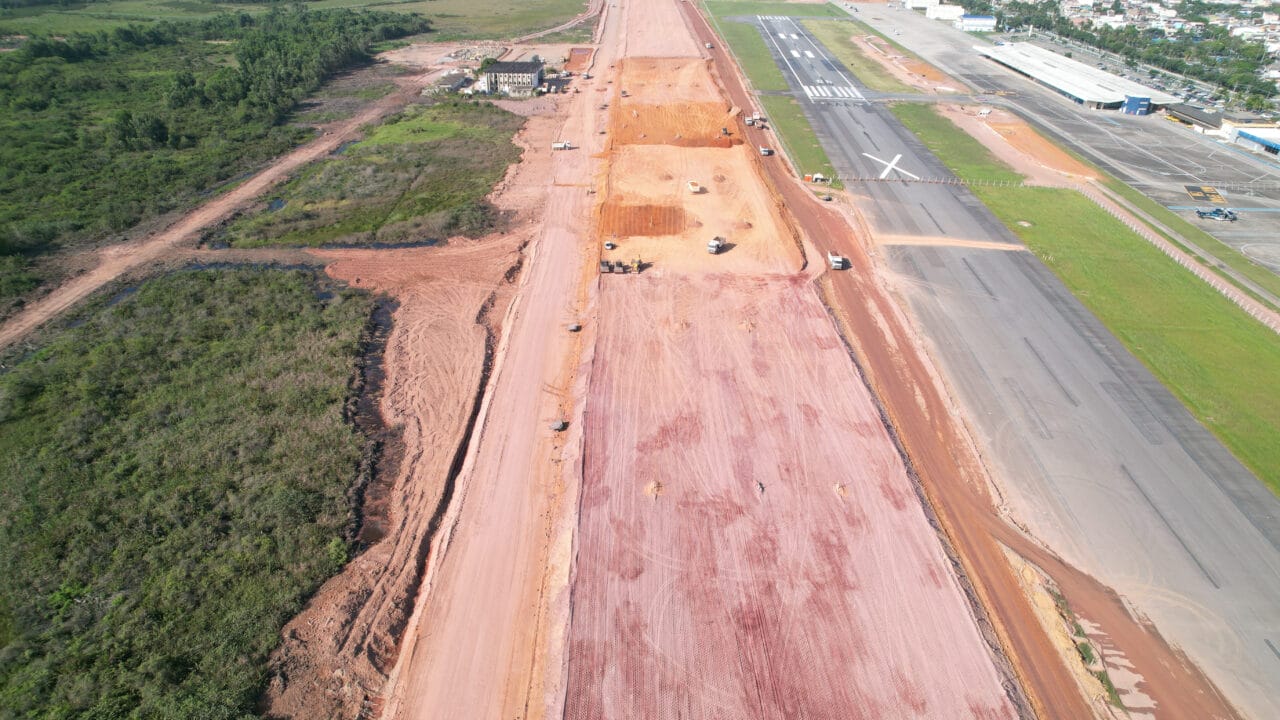

Technology Reduces Construction Time and Anticipates Break Before Rainy Season
The construction of the new runway at Macaé Airport, in Rio de Janeiro, has stood out as an example of innovation and efficiency in Brazilian engineering. Thanks to the application of advanced technologies, the Bem Voar consortium, led by Construtora Barbosa Mello (CBM) and Engeform Engenharia, managed to accelerate the work schedule, completing the first phase of the project ahead of schedule. This achievement not only demonstrates the ability to overcome logistical and operational challenges but also marks a turning point in the construction of airport infrastructures in the country.
Acceleration Thanks to Technology
The project, which started in July of last year, faced the challenge of executing a series of complex stages within a restricted timeframe. The goal was to complete most of the work before the onset of the rainiest season of the year, to avoid delays and potential complications. By utilizing an innovative combination of 3D BIM modeling, machine control platforms, and a fleet management system with cutting-edge features, the consortium not only achieved this goal but also optimized the execution time by 27 days. This technological integration resulted in a 15% increase in construction productivity, a significant milestone given the limited operational conditions imposed by the need to keep the airport operational and comply with strict safety standards.
Impact and Completion Forecast
The construction of the new runway at Macaé Airport is not just a matter of technical advancement; it has critical importance for the region’s logistics. The airport serves as an essential access point for Macaé and the Campos Basin, a key area for Brazil’s oil, gas, and energy industry. With completion expected in March 2025, the new runway, which will be 1,410 meters long, will allow for the operation of turboprop aircraft and jets. This upgrade will transform the airport’s profile, increasing its capacity and reinforcing the infrastructure necessary to support market dynamics.
-
99Food Under Investigation by Brazilian Consumer Protection Agency for Lack of Price Transparency, Faces Potential $2.8 Million Fine

-
U.S. City Builds Tiny Home Village on Water Company Land to House 136 Homeless People: Inside the Social Housing Units

-
Woman Turns Shipping Container into Home, Embraces Rural Life to Cut Monthly Expenses to Just Over $330
-
France Revamps 530 Social Housing Units with Large Balconies and Glass Facades Without Demolishing Existing Buildings




Currently, the works are 50% complete, on a technical pause, awaiting resumption in March. The success achieved so far highlights not only the importance of technological innovation in construction but also Brazil’s capacity to execute complex projects efficiently and accurately. The new runway at Macaé Airport promises to be a vital asset for the region’s infrastructure, significantly contributing to the development of the oil, gas, and energy sector in the country.
Source: Marcelo Quaz – Loures Consultoria.








