






 Portuguese
  Spanish


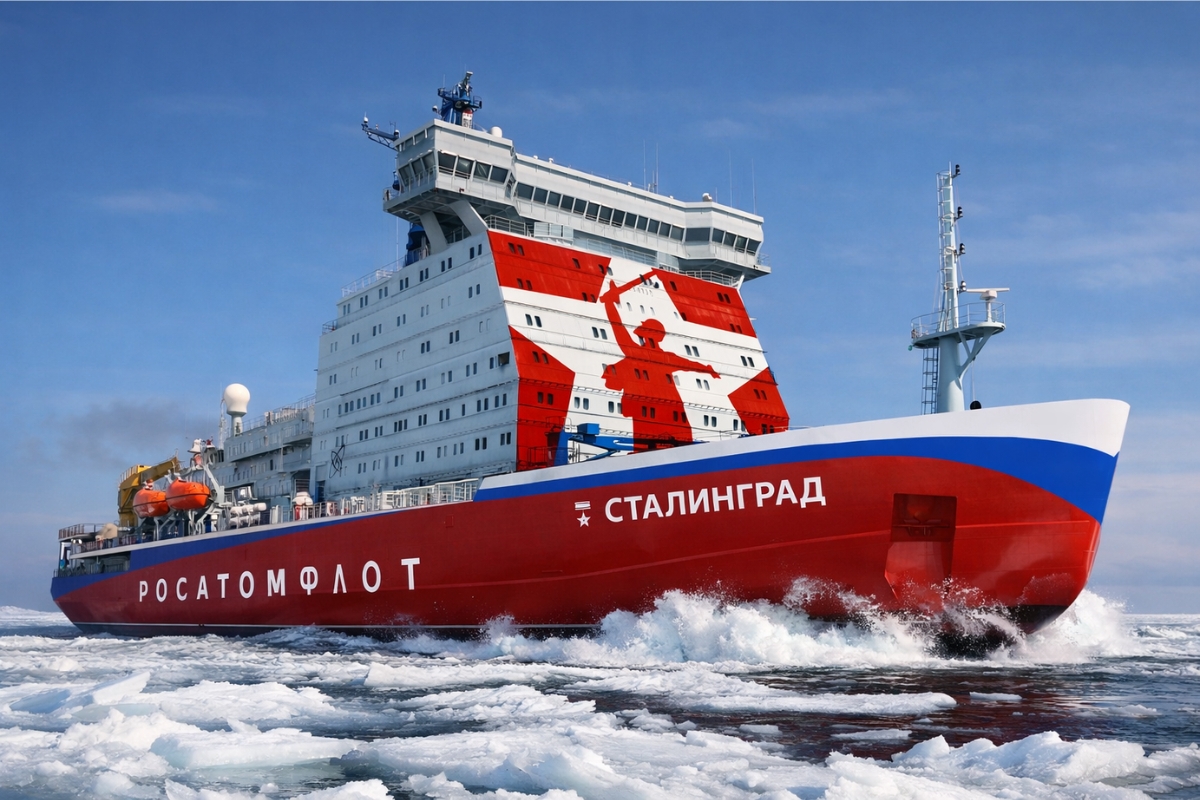


The Construction of the Seventh Nuclear Icebreaker of Project 22220 Advances and the Ship is Set to Strengthen the Fleet with Operations in Thick Ice.
The keel of the Stalingrad was laid at the Baltic Shipyard, marking another milestone in the construction of the seventh nuclear-powered icebreaker of Project 22220. The series is known for operating in extreme conditions and for opening routes in heavy ice areas.
Once in service, the Stalingrad will become part of the Russian nuclear fleet and will be the ninth ship of this group. The highlight of the project is its performance, with the capability to break ice up to 3 meters thick.
What Happened and Why This Caught Attention
The laying of the keel signals the advancement of the nuclear icebreaker program of Project 22220. It is a line of ships that gained prominence by combining power, autonomy, and operation in difficult navigation areas.
-
Scientists Confirm “Greening” of Antarctica: Ice on the World’s Coldest Continent Turns Green as Mosses Multiply Over Tenfold in Four Decades

-
2,000-Year-Old Gold Rings Found with Human Bones in Thailand Reveal Rare Burial and Feature Ancient Indian Inscription

-
Lenovo Unveils Legion Y700 Tablet with RGB Backlighting, 5G, and SIM Card Support

-
World’s First Nuclear Hydrogen Unit Begins Operation: Copper-Chlorine Technology with Initial Capacity of 150 Liters per Hour, Aiming for 3,000 Liters per Hour




The central goal is to ensure continuous operation in Arctic areas, where ice imposes severe restrictions on conventional vessels. The ability to break ice up to 3 meters places the model in a high-performance category.
The name Stalingrad was chosen in reference to the city that is now Volgograd, in tribute to the Battle of Stalingrad. The confrontation took place between July 17, 1942 and February 2, 1943, with a victory for the Red Army.

Why the Ship was Named Stalingrad
The choice of the name refers to a historical landmark of World War II. The tribute cites the Battle of Stalingrad as one of the most decisive of the conflict.
The keel laying ceremony was scheduled to coincide with the start of Operation Uranus in November 1942. This moment marked the Soviet counter-offensive in the Stalingrad region.
During the ceremony via videoconference, Vladimir Putin stated that the new icebreaker should operate in the Arctic, breaking a path through the ice and becoming a symbol of the strength and creativity of the Russian people. The focus of his speech was on working in harsh conditions and the ability to execute ambitious plans.
Trans-Arctic Transport Corridor and the Northern Sea Route
One of the points mentioned at the event was the creation of the Trans-Arctic Transport Corridor, which incorporates the Northern Sea Route. The proposal was discussed as a large-scale task, linked to logistics and presence at high latitudes.
Alexey Likhachev, general director of Rosatom, declared that the completion of this goal should strengthen the country’s role and support national projects in the Arctic. The idea of logistical sovereignty of the Russian Federation was also mentioned.
During the same event, veteran of the Battle of Stalingrad Pavel Vinokurov, who turned 103 years old in November, handed Likhachev a capsule with soil from Volgograd. The material will be kept aboard the icebreaker.
Visual of the Stalingrad and What Changes in Practice
The visual design of the Stalingrad uses red and white colors. The sides of the superstructure are white, while the front displays a mural with a white star of the honored city on a red background, referencing the sculpture The Motherland Calls.
In addition to the symbolic aspect, the scheme has an operational function. The visual identity helps distinguish the Stalingrad from the Leningrad, another icebreaker of the same series under construction, which has a blue and white superstructure.
The project’s author and head of the Art and Design Department of the Rosatom Communications Center, Vladimir Ruzhnikov, stated that defining the visual of a nuclear icebreaker is a significant task. He also cited the context of the 80th anniversary of Victory and the nuclear sector as elements that amplify the symbolic weight of the creation.
What are the Rules, Deadlines, and Conditions of the Project
At the moment the keel was laid, the Stalingrad was 4% completed, with three initial sections already assembled. The progress indicates the beginning of structural assembly of the hull, a critical stage in the shipbuilding schedule.
The ship has specific differences compared to its predecessors, as improvements are incorporated into each vessel based on accumulated experience. Nevertheless, the core characteristics of Project 22220 remain.
Among them are the double-draft design, two RITM 200 reactors, and an alternating current electric propulsion system with asynchronous motors. This set sustains the capacity for operations in ice up to 3 meters.
What Can Happen from Now On
The Project 22220 program continues with other units underway. At the Baltic Shipyard, the nuclear icebreakers Chukotka and Leningrad are also under construction.
With the future entry into service of the Stalingrad, the Russian nuclear fleet is expected to gain another ship aimed at operations in the Arctic. The ability to tackle thick ice reinforces operations on high-latitude routes and supports plans for transport and logistics in the region.
The movement indicates continuity in the expansion of specialized naval means and the consolidation of presence in areas where ice remains the main obstacle to navigation.








Estados Unidos debería ocupar Groenlandia aprovechando que ningun país europeo la defendería, y que tiene solo 50 mil habitantes , como un mini pueblo. Esra vacía.
Se haría de grandes recursos.
Canada ya es más difícil, pero también la puede ocupar tiene un gran potencial.
Entonces sí sería grande america
Ué, mas para que Navio Quebra Gelo, pois todo dia os pessimistas de plantão dizem que o Gelo do planeta está derretendo elevando o nível do mar.
Precisamente, se hace más delgado y ya se puede romper
Os países que usarem a energia nuclear em motores para transportes de carga pesada e contínua como navios e trens e idem para o transportes de massa de populações urbanas como metrôs, avançarão para um alto nível de desenvolvimento ou à fronteira final reduzindo os problemas de superpopulação com economia efetiva e quem sabe a rota final da questão energética…