Portuguese
  Spanish




The New 2025 Hybrid Clio Arrives Larger, More Technological, and with an Advanced Mechanical Set, Featuring a Multimode Gearbox, Enhanced Performance, and Efficiency That Draws Attention in the European Hatch Segment.
The new Renault Clio hybrid debuts its sixth generation larger, more technological, and with a new 160 hp full hybrid set combined with a multimode gearbox capable of operating in about fifteen combinations.
Maintaining its role as the brand’s best-seller, the hatch accelerates from 0 to 100 km/h in 8.3 seconds, reaches 180 km/h, promises an average consumption close to 3.9 l/100 km, and continues to be based on the CMF-B platform, but with an updated mechanical and electronic package.
Design of the 2025 Hybrid Clio
Even in a completely new generation, Renault chose not to break with the formula that made the Clio one of the best-selling cars in Europe, with around 17 million units sold since its launch in 1990.
-
Suzuki Jimny Nomade 5-Door: A Rugged Family SUV with 1.5L Engine and 4WD, Priced Around $18,000 in Brazil

-
Suzuki XL6: Affordable Premium Minivan in India Offers Seating for Six, Hybrid Engine, and Impressive Fuel Efficiency

-
Banco do Brasil and Uber Launch Cashback Program Offering Up to 3.5 Loan Installments Back, Drivers Gain Access to New Cars Worth Up to $30,000 Through Move Brasil Initiative

-
Looking for a Car for Dirt Roads? Fiat Uno, Strada, and Volkswagen Gol Offer Durability and Affordability



The basic proportions of the hatch remain familiar, but the appearance is sharper and more sporty.
At the front, the grille has been redesigned and occupies almost the entire width of the car, framed by a new daytime running light signature in the shape of a “C.”
The headlights, now more horizontal, reinforce the feeling of width and bring the model closer to the brand’s new visual language.
The bumper features more pronounced lines and aerodynamic elements that help support the efficiency narrative.

The side profile retains the typical silhouette of a compact hatch but adopts lines reminiscent of coupes, especially in the design of the rear windows and the integration of the roof with the C-pillar.
The roof remains nearly flat until the rear glass area, ending in a discreet spoiler that also contributes to aerodynamics.
At the back, the standout features are the hexagonal-shaped optical groups, which are notable for choosing not to adopt the light strip that connects the taillights.
In dimensional terms, the new Clio is about 7 cm longer, reaching approximately 4.12 m in length, with 1.77 m in width, 1.45 m in height, and 2.59 m in wheelbase.
Interior of the 2025 Clio
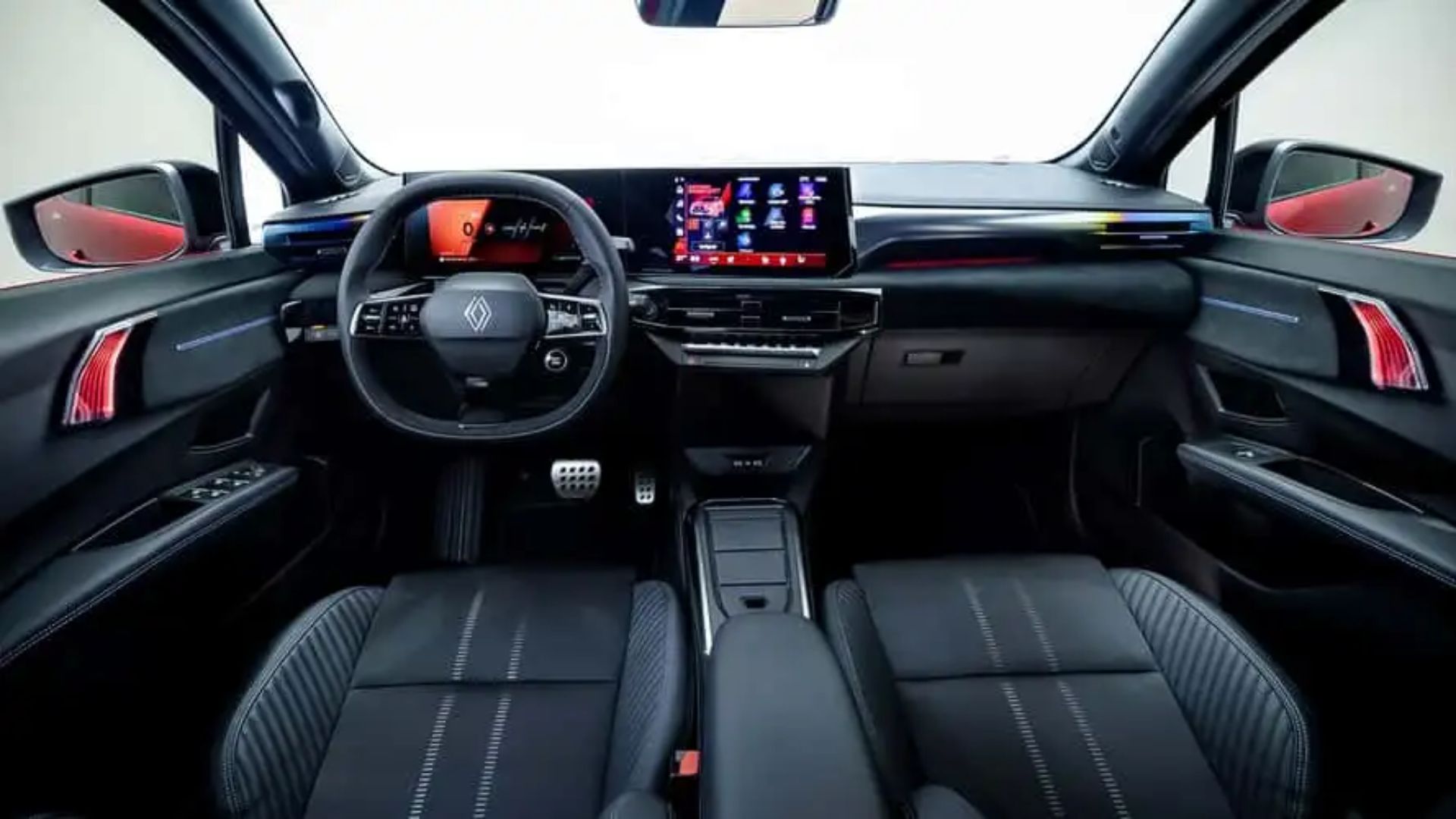
If the evolution is clear on the outside, the leap is even more evident inside.
The cabin has been redesigned with a focus on perceived quality and technology.
Soft-touch surfaces, backlit fabric appliqués, and even Alcantara trims appear in the more expensive versions, especially in the sporty Esprit Alpine.
The dashboard combines a digital display for the instrument cluster, of up to 10.1 inches, with a large central monitor, slightly angled towards the driver.
The multimedia system uses a platform developed in partnership with Google, including integrated navigation, voice commands, Google Maps, Google Assistant, as well as Android Auto and Apple CarPlay.
The center console has been redesigned to free up space.
The automatic transmission control has moved to an area to the right of the steering wheel, also concentrating buttons for driving assistants and other main functions.
This allowed for creating more usable area between the front seats, with better-utilized storage compartments.
The gain in external dimensions translates to good space for four adults, with more room for knees and heads.
The trunk maintains one of the best volumes in the segment, with 391 liters in the hybrid configuration.
Hybrid Mechanics and Technology

Although the structural base remains the CMF-B platform, Renault has deeply revised the powertrain.
The highlighted version is the full hybrid E-Tech with a new 1.8-liter gasoline engine, Atkinson cycle, combined with two electric motors and a 1.4 kWh battery, larger than the one used previously.
The system delivers 160 hp of combined power and operates with a multimode automatic transmission, without a torque converter.
The gearbox offers four gears dedicated to the combustion engine and two specific ratios for the electric part.
The electronics manage these gears in different arrangements, resulting in around fifteen possible combinations.
In practice, the car can start and travel urban sections mostly with the electric motor.
According to the brand, the Clio full hybrid E-Tech can operate up to 80% of urban routes in electric mode, depending on usage.
In combined cycle, the official figures indicate consumption close to 3.9 l/100 km and emissions of 89 g/km of CO₂.
Driving Experience
In real-world use, the combination of the 1.8-liter gasoline engine and the electric motors translates to quick responses at low speeds, thanks to the immediate torque of the electric system.

The acceleration from 0 to 100 km/h in 8.3 s ensures competitive performance, while the top speed reaches 180 km/h.
One point highlighted in the initial tests is the acoustic insulation.
In urban stretches, the hatch spends a good part of the time in absolute silence, running only with the electric motor.
When the combustion engine kicks in, the transition occurs almost imperceptibly.
Even in stronger accelerations, the noise remains distant from the occupants.
The operation of the multimode transmission has also improved.
The shifts are smoother, and the integration between the electric and thermal parts has been refined to avoid torque “gaps.”
In terms of dynamics, the Clio preserves its reputation as a pleasant hatch to drive.
The steering is quick enough to convey agility, with weight adjustable according to the driving modes.
The suspension seeks a balance between firmness and comfort.
It controls body roll well in corners without making the car excessively stiff.
Even in the Esprit Alpine version, with 18-inch wheels and lower profile tires, the calibration avoids harsh impacts.
Versions, Equipment, and Prices

The range of the new Clio in Europe includes the 1.2 TCe with 115 hp with a manual gearbox and the E-Tech 1.8 hybrid with 160 hp.
In some markets, the lineup is organized into the Evolution, Techno, and Esprit Alpine versions.
According to recent data, the Clio with the 1.2 TCe engine with 115 hp starts at €18,900, while the E-Tech 160 hp hybrid, especially in the Esprit Alpine configuration, exceeds the €28,000 range, varying by country and taxation.
Even in the more accessible versions, the hatch comes standard with 16-inch wheels, LED headlights, air conditioning, a digital dashboard, a large multimedia center, two Type-C USB ports, adaptive cruise control, and electric parking brake.
More sophisticated items appear in higher versions, such as sporty-looking seats, soft trims, improved sound, and a complete suite of driving assistants.
Outside of Europe, the model remains distant from the Brazilian market.
The Clio was discontinued in the country in 2016/2017, with the Kwid taking over the entry-level position.
So far, there has been no official announcement of the new generation’s return to Brazil.
Faced with a more powerful, efficient, and well-equipped hybrid compact hatch, the question remains whether the Brazilian public would be willing to pay more for a hybrid compact of this level.