Portuguese
  Spanish


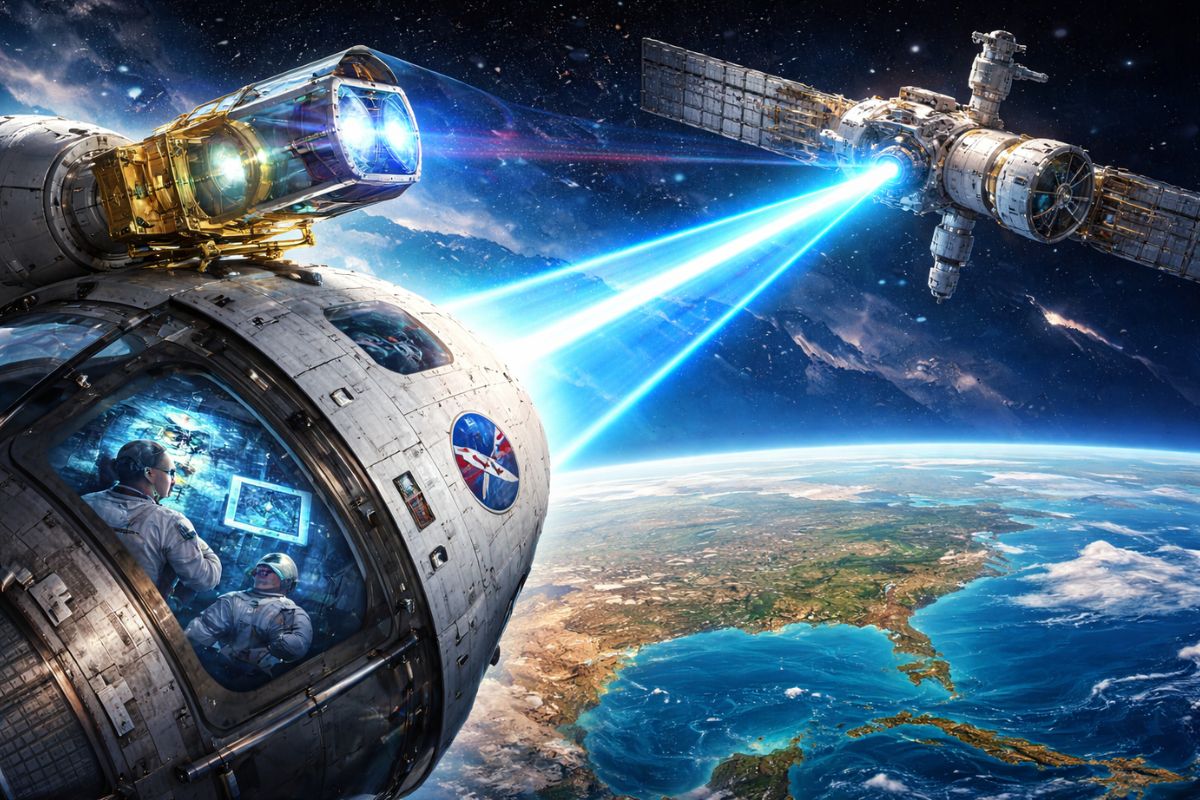


Besides preparing the way for a base on the Moon, Artemis 2 tests a laser communication capable of sending images and videos in 4K and that can inspire advances in streaming, compression, and cryptography
Artemis 2 is the kind of mission that seems distant from our lives, but it often affects it more than we imagine. While astronauts were hundreds of thousands of kilometers from Earth, they captured images of the planet, even with cell phones. But the point is not the photo. What stands out is how this data was sent: not by the “old way” of radio, but with a new laser communication system, described as 100 times more powerful.
This matters because when NASA needs to solve a difficult problem in space, it ends up creating pathways that later reappear down here. Often, the destination is the Moon, but the impact reaches our wallets, the internet, and the technology we use every day.
The laser internet test and why it draws so much attention
The base explains that the mission sent images, 4K videos, and information using a laser communication system that is much more powerful than the radio systems used so far.
-
She spent 73 years breathing inside an iron lung, survived the aftereffects of polio, and became the last woman in the United States dependent on the equipment before dying at 78 years old.

-
Brazilian students created a $1 filter using pine bark, cotton, and 3D-printed parts to clean cassava wastewater, reduce the toxicity of a hazardous waste, and transform contaminated water into biofertilizer.

-
Astronaut from Artemis II steps down after mission to the Moon and decision surprises after a record of 406,771 km, a historic 10-day journey, and an unprecedented achievement for Canada.

-
A fossil kept for years in a small museum in Montreal concealed 450-million-year-old soft tissue, a discovery that has only happened once before in history.


The purpose of this type of technology is to help connect Earth to even more distant places in deep space.
When you increase transmission capacity and improve data efficiency, you open up space for applications that resemble what we experience today with the internet and cell phones, only at a more advanced level.
Where this could hit first: streaming, compression, and security
There is a part of the base that makes this very clear: we already use technology like 5G and rely on data compression, because without it, the volume of information does not circulate.
What the Artemis 2 experience could generate, according to the text, are new technologies for compression and encryption. In other words: faster conversations, more efficient transmission, and more secure communication, even if we can’t pinpoint exactly how this will turn into a product.
It’s as if space is a testing ground where you can fail, measure, adjust, and improve, until the day someone adapts it for civilian use.
It’s not the first time a space mission becomes a shortcut to common technology
The base reminds us that this has happened several times. When humans first set foot on the Moon, no one imagined that it would also help boost the satellite industry that today supports communication, monitoring, and everyday services.
GPS and satellite communication appear as a direct consequence of this wave of development, and today it is hard to even think about daily routines without it.
The cell phone camera, the thermometer, and even pillow foam


Another concrete example mentioned is from NASA’s propulsion laboratory in California, where the sensor that is now in your cell phone camera was created. However, it was not designed for selfies. It was designed to enable photography in space.
The infrared used in thermometers that measure temperature by approaching the ear also appears as a legacy, because the technology was used to measure the temperature of stars. And even pillow foam makes the list, derived from a material made to ensure safety in rocket seats.
The curious detail is always the same: none of this was created with everyday use in mind, but it ended up fitting perfectly into it.
Why Artemis 2 accelerates this type of side effect
The foundation summarizes the logic in a very human way: complex missions involve activities that we have never done before, so it is inevitable to develop new technology. And this technology ends up becoming a secondary benefit.
The central objective of Artemis 2 is to advance the process that could lead to a base on the Moon and then to Mars. However, along the way, it is very likely that some of these solutions will change our daily reality, whether in communication, devices, or new materials.
The mission tries to solve gigantic challenges, but the “extra prize” is that these solutions often spill over into the real world.
What may appear afterward: products, materials, and gains beyond space
The foundation suggests that when technologies begin to mature, products with these innovations and also new materials, such as metal alloys, different plastics, and ceramics may emerge. The idea is that these fruits will appear over time, when what was tested in missions becomes commercially applicable.
In the end, the story is less about “a mission far away” and more about how space continues to be a laboratory that pushes technology forward.
If this laser communication really becomes part of everyday life, when do you think you would notice it first: in a video that stops buffering, in a more secure call, or in some application that doesn’t even exist today?